Place to stay · Erongo
Etusis Lodge
A lodge and riding centre on a 22,000 hectare unfenced reserve south of Karibib, halfway between Windhoek and Swakopmund. Basotho horses, hiking and Hartmann's mountain zebra.
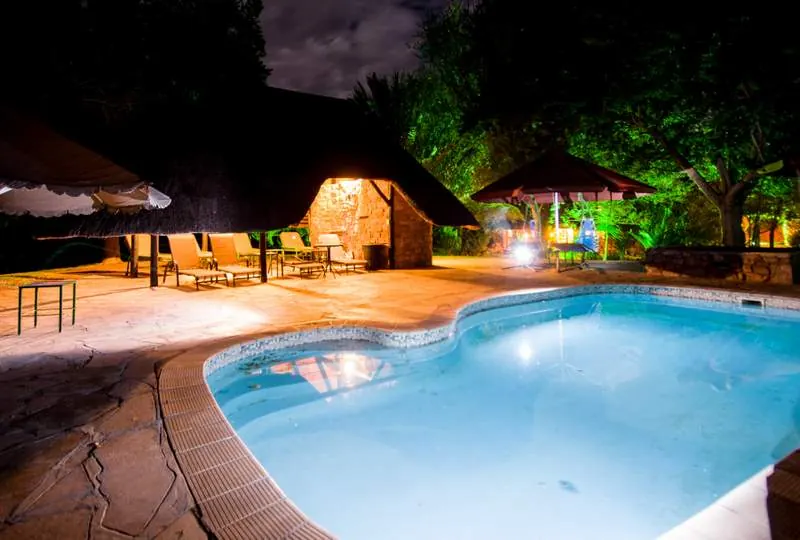
Etusis Lodge sits under the Otjipatera mountains south of Karibib, roughly halfway between Windhoek and Swakopmund (about 220 km and three hours from each). Volker and Susanne Ledermann took over what was still a working farm in 1993 and have grown it into a 22,000 hectare reserve with no game fences. People come for the horses. Rides are matched to your ability, so it works even if you’ve never sat on a horse.
What to expect
There are around 20 Basotho horses, sure-footed on the stony hills. Rides run from an hour to a full day, with sundowner rides and multi-day trips that sleep out in tents or small huts. Non-riders can join family outings where some ride and some walk, often to the Etusis waterfall. Below the falls is a small lake up to 12 m deep that hasn’t dried up in living memory, which gives the farm its name (“the place where you can dive”).
Hartmann’s mountain zebra turn up on almost every drive. The owners set up a foundation with Zürich Zoo to protect them. Kudu, oryx, springbok, klipspringer and baboons are common, and leopard and cheetah live here too, though you’ll rarely see them.
Practical details
- Phone: +264 64 550 826. Reservations desk: +264 61 224 712.
- From the B2 at Karibib, take the C32 south and follow the Etusis signs for 36 km.
- Seven thatched bungalows (renovated in 2017, air-conditioned, step-in showers, step-free access) come with breakfast and dinner. There are also tents, a self-catering farmhouse and a campsite.
- Transfers run from Karibib, where the Intercape bus stops. There’s also a farm airstrip if you arrange it in advance.
Good to know
The website is mostly in German, but the team speaks English and Afrikaans too. The marked hiking trails suit most fitness levels. Carry plenty of water, and the lodge lends out radios.
Last updated 7 October 2026. Sources: Etusis Lodge, Etusis Lodge, wildlife reserve, Etusis Lodge, getting there, Etusis Lodge, riding, Etusis Lodge, bungalows, Etusis Lodge, hiking, Etusis Lodge, contact, Info-Namibia.
Marker pens, an 'extinct' horse and a pool with one way out
The man who started this reserve also started edding, the marker pen firm. In 1960 Volker Ledermann and a school friend, Carl-Wilhelm Edding, set up a business in Hamburg with 500 marks, selling felt-tips imported from Japan before they made their own. The lodge says Ledermann rode eventing for Germany in the 1950s and was one of the first people to bring Icelandic horses to mainland Europe. It was his liking for their smooth extra gait, the tölt, that drew him to the horses of Lesotho.
Horses the FAO lists as extinct
In Lesotho he found officials bringing in stallions from abroad, Ireland among other places, to “improve” the Basotho pony. A scheme to cross in Connemara ponies had begun in the 1970s. He argued for an import ban and lost, so he and Ewald Isenbügel, a professor at the University of Zurich, went to Lesotho to look for horses that had not been crossed. Blood tests in South Africa confirmed which were pure, and it took some years to buy enough. The herd was ridden out to a friend’s farm across the border, rested, then trucked to Etusis.
In 2007 the FAO listed the Basuto pony as extinct. Some of the animals guests ride here tölt. The breeding itself has moved to Dornhügel, the sister farm near Grootfontein, where there is more water.
The pool at the end of a dead end
Before any of this, Hertha and Erhard Krüger lived in the old farmhouse with their three children. They stayed 52 years, until 1993, and ran karakul sheep.
The pool under the waterfall is the only water for many kilometres that nobody remembers drying up. The fall itself runs only every few years. The pool lies at the end of a dead end, so an animal that walks in to drink has to walk back out the same way, and the leopards know it. A single suite stands above the water, 3 km from the main buildings. The lodge offers a leopard by moonlight as a maybe and no more. It says the cats are seldom seen, though their tracks are all over the sand.
When the zebra move
There were 50,000 to 75,000 Hartmann’s mountain zebra in Namibia in the early 1950s. Farmers shot them as competition for grazing and water, and by an air count in 1968 about 7,000 were left. Manni Goldbeck, writing in The Namibian in 2025, put the figure at about 32,000. Around Etusis, the lodge says, they were close to gone in 1993. The Ledermanns banned hunting on their own land, had the herds’ movements studied and talked the neighbouring farmers into shooting fewer.
Field studies of mountain zebra found they are most active in the early morning and from late afternoon until sunset, drink once or twice a day, and on cold mornings stand on east-facing slopes to warm up. So take the first drive or the sundowner one. With no fences the game goes wherever the last rains left grazing. After dark it is springhares, bat-eared foxes and aardwolves, and you can sleep out in a small stone hide beside a waterhole.
Wire snares and foot traps still kill zebra and antelope here every year. The family’s foundation pays for rangers and for people to search out the traps.
Rock named after the farm
Geologists named the Etusis Formation after this farm, because its red rock shows so well here. It began as river sand and gravel dumped in rift valleys from about 900 million years ago and was later cooked into quartzite. The marble is younger, laid down as lime on a sea shelf after the worldwide glaciation of about 635 million years ago. The beds run for some 20 km around Karibib and reach this far south-west.
The state holds the mining rights. Marble is still quarried inside the reserve, the foundation says lithium is being pushed too, and part of its money goes on lawyers. The old diggings in the hills were for gold, tourmaline, copper and mica.