Place to stay · Gobabis
Gobabis Guest House
Owner-run bed and breakfast on Lazarette Street in a quiet part of Gobabis, with six en-suite rooms, a self-catering family unit, a pool and secure parking.
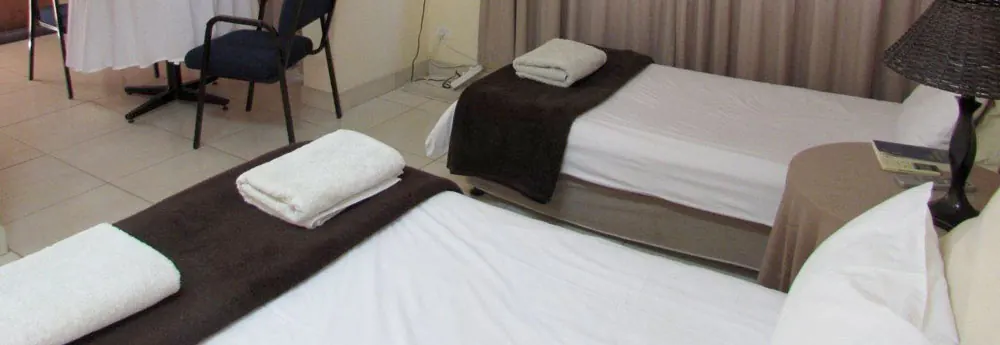
Gobabis Guest House is a small owner-run B&B in a residential street on the edge of Gobabis, close to the shops and restaurants. Gobabis sits on the B6 about 200 km east of Windhoek and roughly 110 km short of the Botswana border at Buitepos, so this is the obvious kind of place for a last night in Namibia before crossing, or a first night after. It works for people on business as well as road trippers.
What to expect
There are six en-suite rooms and a family unit. The double rooms come with twin or double beds, and two of them have room for an extra single bed if you ask. There is one single room. Every room has air-conditioning, a TV, a bar fridge and tea and coffee things. Breakfast is included and dinner can be arranged.
The family unit sleeps six in two bedrooms (four singles and a double), with a sitting room, a bathroom and a kitchenette, and is let on a self-catering basis.
Outside there is a pool and a braai area. Mountain bikes can be hired for the bush tracks near town.
Practical details
- Address: 8 Lazarette Street, Gobabis.
- Phone +264 62 563 189 or +264 81 292 5086.
- Wifi throughout, and secure parking inside the property.
Good to know
The town’s name is tied to elephants. One long-held reading is “elephant fountain”, and the guesthouse points out a life-sized elephant statue at one of the old springs nearby. Wikipedia notes the origin of the name is disputed. One of the few buildings left from the German garrison years is the 1896 military hospital (the Lazarett), declared a national monument in 1974.
Last updated 7 October 2026. Sources: Gobabis Guest House, Gobabis Guest House, Accommodation, Wikipedia, Gobabis, Wikivoyage, Gobabis.
Lazarett Street, the 1896 army hospital and its murdered doctor
The address is the story here. Lazarett is German for a military hospital, and Gobabis still has one, standing about a kilometre to the north-east of the guest house. The guest house spells its street Lazarette, the map says Lazarett. Either way the old hospital is one of the few buildings left in Gobabis from the German garrison, and the plaque on its wall has a line on it that I have not seen explained anywhere.
What the plaque says
The plaque is dated 1976, two years after the hospital was made a national monument (number 067/1974 on the register), and it says the same thing three times, in German, Afrikaans and English. Building began in 1896. The army used it as a hospital until 1908. Then, with no explanation at all: on 24 May 1907 Staff-Surgeon Dr Oskar Wienecke was murdered in the vicinity. Who killed him, and why, the plaque does not say, and I have not found an account that does.
A photograph from July 2019 shows a low house on a stone footing with square verandah pillars and a tin roof. The plaster has come away to the brick in places, and there is a satellite dish bolted to one corner. Washing bowls and a kettle sit on the verandah wall, so somebody appeared to be living in it. Treat it as a look from the road.
Why Gobabis needed a hospital in 1896
Soldiers had only been here since the middle of 1895. The Herero chief Nikodemus Kavikunua had claimed Gobabis. The Germans turned him down and put in a garrison, with the trade to and from Bechuanaland as the stated reason. Within a year it was under attack. On 6 April 1896 the Mbanderu and the Khauas Nama fought the garrison at Gobabis itself. Lieutenant Otto Lampe was killed. So was Eduard Lambert, the last captain of the people who had held this spring since Amraal’s day.
The rising was over in May. Kavikunua and the Mbanderu chief Kahimemua Nguvauva were shot at Okahandja that June, and the surviving Khauas were taken to a camp in Windhoek and put to forced labour. The hospital belongs to that year. So did a fort, built in 1896 and 1897, of which nothing is left. In January 1904, at the start of the Herero war, the town was under siege.
The elephant by the spring
The guest house tells its visitors that Gobabis means the drinking place of elephants, and points them to a life-sized elephant statue at one of the old springs nearby. That is the popular reading, and the missionary Heinrich Vedder made it stick. Linguists are less sure. Goba and bis more likely give “the place where people quarrelled”, which fits the town’s nineteenth century rather well.
The elephants themselves are not in doubt. The older Khoekhoegowab name is said to mean the place where the elephant came to lick, and one explanation offered for it is that tusks were kept down the well to stop them cracking in the dry heat. The English name has an author too. In 1845 the Wesleyan Joseph Tindall wrote that he had reached Gobabis, “which I named Elephant’s fountain”. So the elephant name was his choice, not a translation. The statue has picked its side anyway.