Place to stay · Hardap
Duwisib Guestfarm
Small family guest farm a short walk from Duwisib Castle, with eight rooms in an old sandstone workshop, a self-catering bungalow and five shaded campsites. Hosts run 4x4 farm drives.
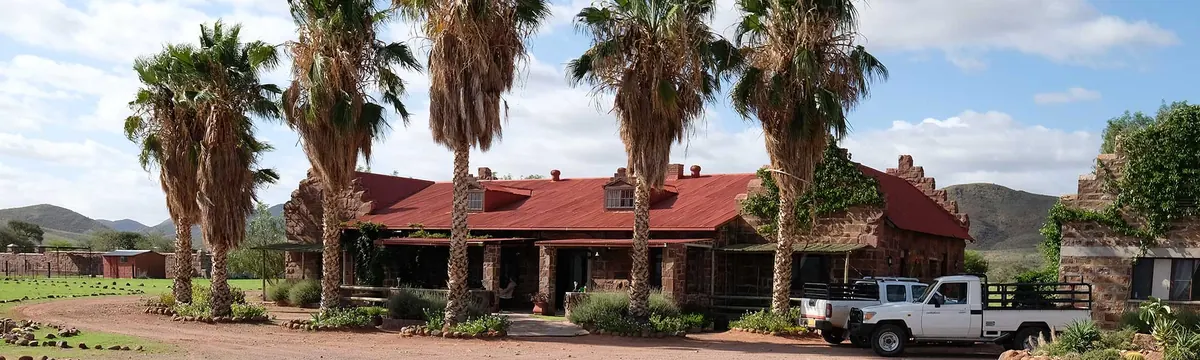
Duwisib Guestfarm is the family farm right next to Duwisib Castle, the sandstone fort Baron Hans Heinrich von Wolf built in the hills southwest of Maltahöhe before the First World War. The castle is a museum run by Namibia Wildlife Resorts, and everything on the farm is within walking distance of it. The farm sells itself as a stopover, and it does fit neatly between Sossusvlei and the south, on the way to Lüderitz or the Fish River Canyon.
What to expect
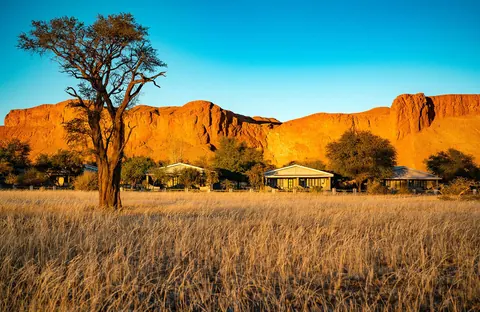
It’s small. There are 8 guest rooms, one self-catering bungalow and 5 campsites. The rooms are inside the farm’s old workshop, built from local sandstone, each with an en-suite shower, ceiling fan and its own veranda. You can book them with dinner and breakfast or as self-catering, where you get a small kitchen, a gas cooker, a bar fridge and an outside braai. The Springbok bungalow sleeps two in twin beds and has its own kitchen.
The campsites sit under camel thorn trees, each with running water and a seating area, sharing an ablution block with solar-heated showers.
Practical details
- Phone: +264 63 293 344. Cell: +264 81 354 3619. Email: duwisib@iway.na.
- Wi-fi and mobile signal only at reception and the pool.
- From Sesriem it’s roughly 170 to 180 km depending on route, and about 191 km from Mariental via Maltahöhe.
Good to know
Christian Frank-Schultz, who owns the farm with Rolene, takes guests on a 4x4 drive around the property to talk about the plants, animals and how they farm in this dry country. There’s also a sundowner spot, Baron’s View, about 10 to 15 minutes’ walk up a hill near the lodge. The castle museum holds 18th and 19th century antiques, armour and paintings.
Last updated 7 October 2026. Sources: Duwisib Guestfarm, Duwisib Guestfarm, accommodation, Duwisib Guestfarm, camping, Duwisib Guestfarm, nature drive and sundowner, Duwisib Guestfarm, contact and directions, Namibia Wildlife Resorts, Duwisib Castle, Wikipedia, Duwisib Castle.
Breakfast in the baron's forge
At the end of 1909, the year the castle was finished, Hansheinrich von Wolf counted his stock at Duwisib: 95 Hereford cattle, 600 merino sheep, 72 horses and 18 mules and donkeys. The horses were the point. Thirty-eight of them were mares and nine were thoroughbreds, and by 1911 the herd had grown to about 350, with karakul sheep and a few camels from Arabia added on the side.
A stud that size needs a blacksmith. The working buildings went up west of the castle in the same red stone: a riding arena almost 300 m away, utility rooms, staff housing and a forge. Part of that cluster is the guest farm. The rooms are in the old workshop, and the forge is where you eat breakfast.
The half of Duwisib the state did not buy
Von Wolf had asked the German government for about 140,000 hectares in the south and was allowed 20,000 to begin with, eight farms in the Maltahöhe district. A second application got him more, though the estate never passed 55,000. Everyone calls him the baron. His family held no such title, which is why the farm’s own website puts the word in quote marks. He was planning a church too. The steamer Muanza reached Lüderitz with the altar, organ and stained glass on 1 August 1914, the day the war began, and sailed for South America without unloading.
Nor did he come back. He was killed by shrapnel in France on 4 September 1916. The estate was declared bankrupt after South African troops took the country and was sold to a Swedish family, the Murrmanns. Their only son was killed in the next war and a company bought it. When the state took the castle in the 1970s it took only the building and 50 hectares around it. The farmland stayed in private hands, and it is that land the Frank-Schultz family farms today, with sheep and cattle where the thoroughbreds were.
Did the wild horses come from here?
It is the story everyone wants to be true: the baron dies, some 300 horses wander off into the Namib and their descendants are the herd at Garub near Aus. It doesn’t hold up well. Garub is about 250 km to the south-west. Ron Swilling, writing about the horses in 2010, found that a manager at Duwisib recorded none missing until around 1940, and the Garub herd had been noticed some twenty years before that. Emil Kreplin, mayor of Lüderitz before the war, bred work and racehorses at Kubub, and in 1915 army horses grazing at Garub were scattered by bombing. Those are the better bets.
What the farm does have is older. Travel News Namibia describes a large stone on the property worn smooth by rhino rubbing their flanks against it, left from when black rhino lived in this country. Ask about it on the farm drive, which Christian Frank-Schultz leads himself.
A castle you may not get into
Namibia Wildlife Resorts has kept the castle closed to visitors since 2022 and in July 2026 still gave no reopening date. One camper at the guest farm, writing that same month, said a man sitting outside with a key let them in anyway. I wouldn’t plan a detour around that.
Two travellers’ reports, from 2019 and 2022, both treat it as a single night on the way somewhere else, which is how the farm sells itself, and both rate the food highly. The 2019 one says the host sat down to meals with the guests and told stories. A couple who came through in August 2015 called the beds hard as rocks. That is one account, and an old one.