Place to stay · Hardap
Namib Desert Lodge
A 66-room Gondwana lodge at the foot of the fossilised dunes on the C19, 60 km north of Sesriem. Two pools, a waterhole, marked trails and drives in the Gondwana Namib Park.
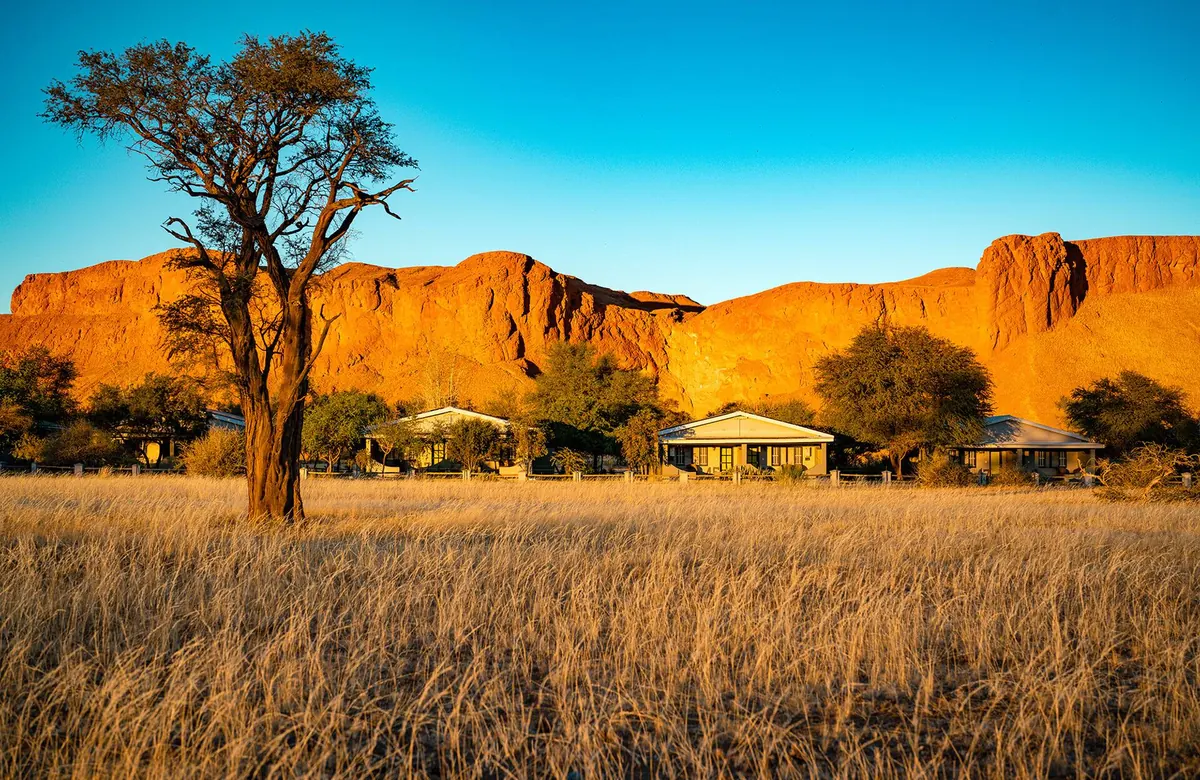
Namib Desert Lodge belongs to the Gondwana Collection and lies on the C19, about 30 km south of Solitaire and 60 km north of Sesriem, the gate for Sossusvlei. Its setting is the reason to pick it: the rooms back onto a ridge of red, fossilised dunes, ancient sand turned to sandstone, inside the private Gondwana Namib Park. It’s a big, practical lodge for a night or two, and a long way from the busy strip at Sesriem.
What to expect
There are 66 rooms, mostly twins, plus five doubles, four triples and four family rooms, with one adapted for guests with limited mobility. Rooms have air conditioning, a safe, a veranda and tea and coffee. The lodge has a restaurant, a bar, a curio shop and two unheated pools. Gemsbok come in to drink at the waterhole.
The fossil dunes are Tsondab sandstone. Gondwana says the dunes formed about 20 million years ago and hardened between 16 and 8 million years ago, and the rock holds fossil ostrich eggshell and insect burrows. Collecting fossils is banned.
Practical details
- Reservations: +264 61 427 200. After hours: +264 81 129 2424.
- Check-in 2pm, check-out 10am.
- Morning and afternoon nature drives run in the Gondwana Namib Park, and a guided half-day Sossusvlei trip can be pre-booked.
- Self-guided trails start at the lodge. Ask for the trail map at reception.
Good to know
The 45-minute night walk after dinner can only be booked at the lodge. If you aren’t driving yourself, the Go2 Tourism Shuttle stops here on daily runs from Windhoek, Swakopmund and Kalahari Anib Lodge.
Last updated 7 October 2026. Sources: Gondwana Collection, Namib Desert Lodge, Gondwana Collection, fossilised dunes.
Fossil dunes, giant eggshell and a waterhole with 500,000 followers
In April 1986 the South West African post office put petrified sand dunes on a 25 cent stamp, one of a set of four rock formations drawn by Johan van Niekerk. The dunes on the stamp are up on the Kuiseb River, but the rock is the same Tsondab sandstone that stands as a red cliff behind the rooms at Namib Desert Lodge. Most guests photograph it at sunset and leave for Sesriem before dawn.
Eggs of two kilograms
The shell fragments in this sandstone are not from ostriches as we know them. The palaeontologists Martin Pickford, Brigitte Senut and Yannicke Dauphin sorted giant eggshell from across the Namib into a run of egg types that follow one another up through the layers: one they named Namornis in 1994, then four called Diamantornis, then two early ostriches before the living bird. The idea was that a chip of shell could date a cliff, though later finds showed some types overlap. Namornis is put at about 17 to 16.5 million years old, and one of its two species takes its name from the Elim gullies north of Sossusvlei. Its shell runs up to 4 mm thick. A modern ostrich egg manages 2.5 to 3 mm, weighs around 1.5 kg and holds a litre. The old ones topped 2 kg and held up to 1.7 litres.
The geologist Gabi Schneider tells the story in Passage Through Time: The Fossils of Namibia (2004), illustrated by Christine Marais. Her reading is that the ostrich line began in Africa and spread to Eurasia later. The same rock keeps the tunnels of termites and beetles and, rarer still, spider webs.
The waterhole with a following
There are two waterholes and people confuse them. One is in view of the dining terrace, under the cliff that is lit up after dark. The other is 8 km off on an open plain, built in 2006, two years after Gondwana bought the guest farm that became the park. A solar pump feeds it from a borehole 100 m deep.
That second one is the famous one. Jens Viëtor, Gondwana’s IT man, began putting weather cameras up at the lodges in 2010, and this lodge’s went to the waterhole. A live screen at reception followed in 2016, then a YouTube channel in 2021, with the picture sent 35 km across the dunes by wireless link. On 7 June 2026 the channel passed half a million subscribers. The round rock in the middle, added in 2021, is a bird perch that also cuts evaporation. Two horses from a neighbouring farm walk in now and then, because the park has no boundary fence.
Three species on the drive, two dozen on the camera
Gemsbok are the animal nearly everybody reports: on the self-guided trail across the dry riverbed in the early morning, on the sundowner drives, at the water. Springbok and ostrich are the other regulars. One early walker adds rosy-faced lovebirds and sociable weavers at their nests.
The camera’s list is far longer and includes giraffe, Hartmann’s mountain zebra, blue wildebeest, brown and spotted hyaena, cheetah and leopard. That is what passes through the park’s 127 square kilometres over years, not what one sundowner drive delivers. Roxanne Reid, who wrote up the sundowner in 2015, heard her guide name porcupine, bat-eared fox, giraffe, mountain zebra and brown hyaena and saw gemsbok, springbok and ostrich. She felt hurried past them, and forgave it once the vehicle climbed the dune. There are no lions, elephants or rhino in this part of Namibia.
Expert Africa, which sends people here, calls the lodge functional and says plainly that it caters mostly for coach tours, so don’t expect a hideaway. It is also further from the famous dunes than the map suggests. The Sesriem gate is 60 km down the C19, and Sossusvlei is about as far again beyond it.