Place to stay · Kamutjonga
Ngepi Camp
Riverside camp on the Okavango south of Divundu, with campsites, tree houses and bush huts, open-air ablutions and boat and mokoro trips on the river.
Ngepi is a camp on the Okavango River a short way south of Divundu, on the road that runs down to the Mohembo border with Botswana. It is known for its river-bank pitches and its sense of humour, which shows up in the signs and the ablutions. This map pin marks one of the campsites, but bookings and check-in go through the camp as a whole.
What to expect
Most pitches sit right on the river bank with grass to camp on and parking alongside for a vehicle, trailer or caravan. A few bush sites further back have more shade and privacy but no water view. Each site has a solar power point, a river water tap and a fireplace. The showers and toilets are shared and open to the sky, and they are odd enough that the camp lists a tour of them among its activities. There are also tree houses and a few family bush huts if you would rather not pitch a tent.
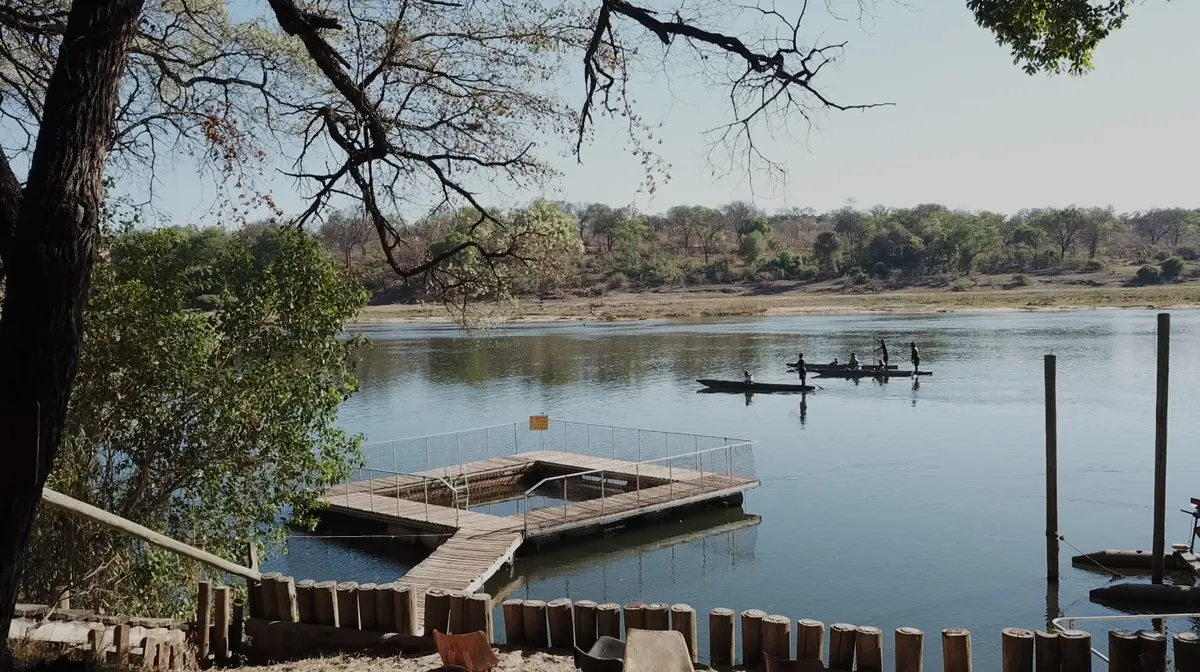
From camp you can book boat cruises, mokoro trips, fishing, birding and village walks, game drives and trips to Popa Falls. There is also a floating pool in the river itself.
Practical details
From the B8 at the Divundu bridge, take the Mohembo road south for 10 km, then follow the Ngepi sign for 4 km. The camp says the track is fine for a 2WD. Check-in is from 2pm. Solar power runs from 10am to 10pm and each socket is limited to 5 amps, so bring an extension cable and leave the kettle at home. Wi-Fi is at the bar and reception area, not at the pitches.
Good to know
Bring your own grid for the fire and a torch for the walk to the ablutions at night. Bwabwata National Park is close by for game drives, and Popa Falls is just up the road near Divundu.
Last updated 7 October 2026. Sources: Ngepi Camp, Ngepi Camp, campsites, Wikipedia, Divundu.
Ngepi's river dragon and the chicken wire cage
In 1977 a man was out on the Kavango with friends when their canoe stuck fast in open water. By his account it was pulled under with him still in it, and he came out on the bank almost six hours later in only his trousers. His is one of 78 Hambukushu accounts gathered in 2013 for the legal scholar Manfred Hinz’s study of customary water law. The thing he blamed has a name, and Ngepi borrowed it for its rafting trip.
Dikongoro, the python with horns
The people interviewed agree on the main points. It looks like a python but carries horns. It keeps to deep, dark, still pools with foam on top. If it holds your canoe you pay in your own blood, or drop something silver or gold over the side. Moronga Caray, a guide at Ngepi, told a visiting writer much the same in 2014 and added a rule: a dead chief is buried along the river, never out in the bush, or Dikongoro comes for the body. Thomas Larson’s book The Hambukushu Rainmakers of the Okavango (2001) has the origin. Dikongoro was once a chief, Sinyungu, whose spirit left his body at the graveside and went into the river.
It is not a subject for small talk. Talking about it is believed to bring death or harm to a relative. So naming a rafting trip the Dikongoro Dragon is a bit cheeky, though the owner, Mark Adcock, wrote in 2019 that he meant it as respect and that many of his staff say they have seen the creature.
Four homesteads, then fifty
The environmental plan drawn up for the camp in February 2025 says the lodge was built in 1987, on 28.7 hectares held under a permit to occupy. There were four homesteads nearby when it opened and there are more than fifty now, because people who would once have moved on stayed for the work and built in concrete and iron. Trees were cut well beyond the homesteads, so the camp now pays 23 neighbours a monthly sum for each tree they keep alive at home, about 2,300 trees in all.
There is no staff village. Everyone walks in from home, and the washing is still done by hand in four galvanised baths that drain into the vegetable garden.
What “floating pool” means
A visitor who photographed it in July 2005 put it more plainly than any brochure, captioning his picture a “chicken wire cage” against hippos and crocs. A Windhoek newspaper said much the same in October 2006, reporting that Getaway magazine had named Ngepi its Africa’s Camp of the Year in a top ten that included Sun City and Mala Mala.
Hippos all night, and a track that floods
Hippos are the sound of a night here. A couple who had a tree house in March 2011 wrote that they grunted all night, and a woman staying with her family in February 2012 woke to the same noise from the river below. For buffalo, wild dog and kudu you drive into Bwabwata, as one forum writer did over Christmas 2013.
The four kilometres of track in are easy when dry and get resurfaced after every rainy season. Floods are another matter. The March 2011 couple arrived over a dry causeway, watched the water creep up for days, then drove out and left the car across the river. When the camp boat took them over next morning a buffalo was standing at the landing place. A French driver described the same track in February 2013 as a lake, with water up to the windscreen of his 4x4. The other complaint, from several members of one 4x4 forum, is noise.