Place to stay · Karas
Kanaan Desert Retreat
A N/a'an ku sê desert reserve of 35,000 ha below the Tiras Mountains on the D707, with eight tents on dinner and breakfast, eight campsites and guided dune drives.
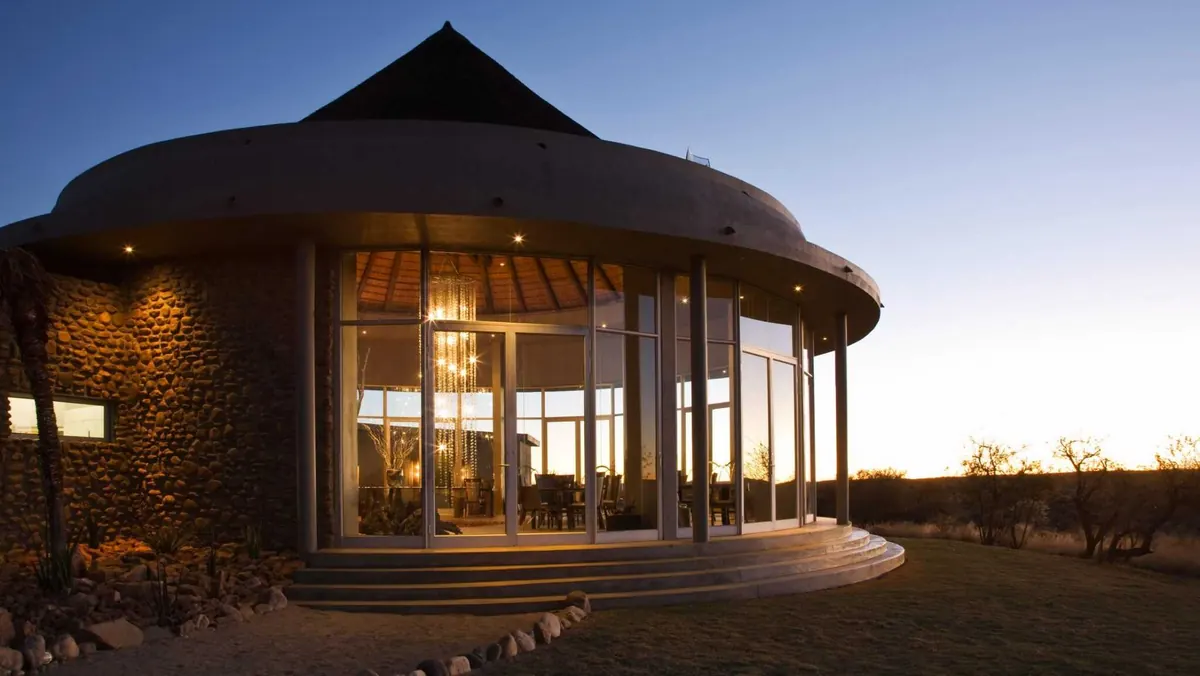
Kanaan Desert Retreat is a reserve of about 35,000 ha on the edge of the Namib, below the Tiras Mountains in southern Namibia. It is run by the N/a’an ku sê Collection, the group behind the N/a’an ku sê Lodge and Wildlife Sanctuary, and the land has been under rehabilitation since 2014. The retreat is on the D707 gravel road, with Helmeringhausen as its nearest settlement and the Namib-Naukluft Park as its nearest big park.
What to expect
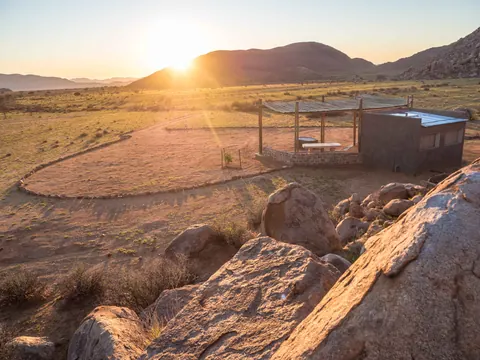
There are eight canvas tents, each with its own bathroom and a view over a waterhole. Tent rates include dinner and breakfast. Campers get eight self-catering sites, each with shade netting, its own ablution and a braai area. The main area has a restaurant, a bar and a swimming pool.
The activity list is long for a place this size. There are scenic dune drives mid-morning or mid-afternoon, a sunrise drive, a sunset drive into the Tiras Mountains, a photographic safari, blo-karting when the wind allows, a summer night drive, a winter nature walk and horse riding at dawn or dusk. The retreat’s wildlife checklist names springbok, gemsbok and kudu, along with hyena, caracal, cheetah and leopard. They say plainly that no sighting is guaranteed.
Practical details
- Direct line +264 81 681 7422, central reservations +264 61 228 869, kanaan@naankuse.com.
- The nearest settlement is Helmeringhausen, which is a private farm with a country hotel and an airstrip rather than a town.
- Some activities have age or height limits for children.
Good to know
Every activity depends on availability and the weather, so ask about the ones you want when you book. Private guided tours are on request only.
Last updated 7 October 2026. Sources: N/a'an ku sê Collection, Kanaan Desert Retreat, Wikipedia, Helmeringhausen.
Oil lamps, a donkey cart and hyenas that eat the plumbing
In 2004 the farm Kanaän had a website and big plans. The home page asked for investors and floated a filling station and a roadhouse on the D707. By 2006 the site showed something smaller. Hermi and Marlene Strauss had five double rooms in the renovated farmhouse and no electricity, on purpose, because oil lamps kept the feel of an old farm. Photography was the main thing on offer, with Land Rover drives into the dunes. There was also a donkey cart ride, sold on the promise that it would make you grateful for modern travel.
It worked on the people who found it. Among the letters the Strausses posted on their site, several were from Germans, and two couples said they had written to the Iwanowski guidebook to tell it to send more people. As late as April 2014 a visiting photographer, Anne Berger, was in the vehicle while Hermi rounded up his oryx. They were doing 80 km/h, she wrote, and the oryx alongside were not far short of 70.
Sixty-eight kilometres of wire
N/a’an ku sê took the farm over that year and started pulling fences. The foundation puts the total removed at 68 km, and volunteers were still rolling up wire in the winter of 2024. Along the road the stock fence is being swapped for braided wire, there to stop cars turning off into the veld without snaring an oryx or a springbok. The western side borders the Namib-Naukluft, and the point is that what walks out of the park can keep walking.
What the four dams see after dark
The research team keeps camera traps at four waterholes: Sleepout Dam, Ostrich Dam, Hyena Dam and Puffadder Dam. A fifth watches the rubbish dump. They run on a timer from dusk until just after dawn, because by day the cards filled up with oryx and ostrich standing at the water for hours. In July 2024 the night cameras had leopard and spotted hyena. August added cheetah and kudu.
The hyenas are the surprise. Ingrid Wiesel’s Brown Hyena Research Project in Lüderitz says spotted hyenas were first reported in the southern Namib only in the early 1990s, probably following game down from the north in a drought, and that the biggest group known there is three animals. At Kanaan the foundation says the clans make regular use of natural caves. They also dig up the water pipes and bite them, and the 2024 research report grumbles about the cost of new pipe.
Guests see almost none of this. Expert Africa has had ten of its travellers log sightings here since 2019. Four in five saw oryx, only the odd one a brown hyena or a zebra, and nobody a leopard, a spotted hyena or a wild cheetah. The two rescued cheetahs that lived in the enclosure had both died, according to one guest who stayed in August 2022, so ask what is there now before you promise the children a feeding.
A model, a cheetah and the complaints that repeat
In September 2024 David Yarrow, who says he has been going back to Namibia’s deserts for about 20 years, photographed the model Shanina Shaik beside a cheetah in the dunes here at sunrise. That print is Dune. Another, Enjoy the Silence, has a cheetah under a huge dead tree. No wild cat: Yarrow calls it the biggest male in the van Vuurens’ care.
Ordinary guests are less posed. Two who stayed in winter, one in July and one in August, say the tents are very cold at night and have no heating. Several mention the paths between car park, tents and dining room: steep, rough and hard on anyone unsteady. One camper on the 4x4 Community forum sounded happier. He called Kanaan not to be missed and rated the D707 bad in sections but good on average.