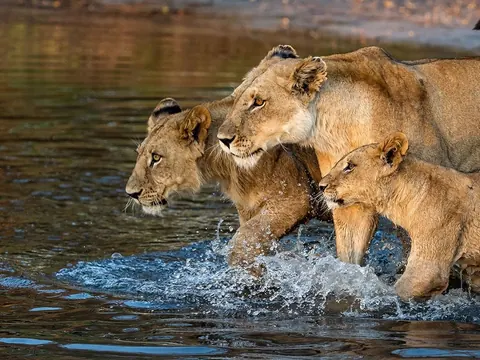
Place to stay · Palmwag Tourism Concession
Wilderness Desert Rhino Camp
Wilderness camp in a wide valley of the Palmwag Concession in Damaraland, built around tracking desert-adapted black rhino on foot with Save the Rhino Trust monitors.
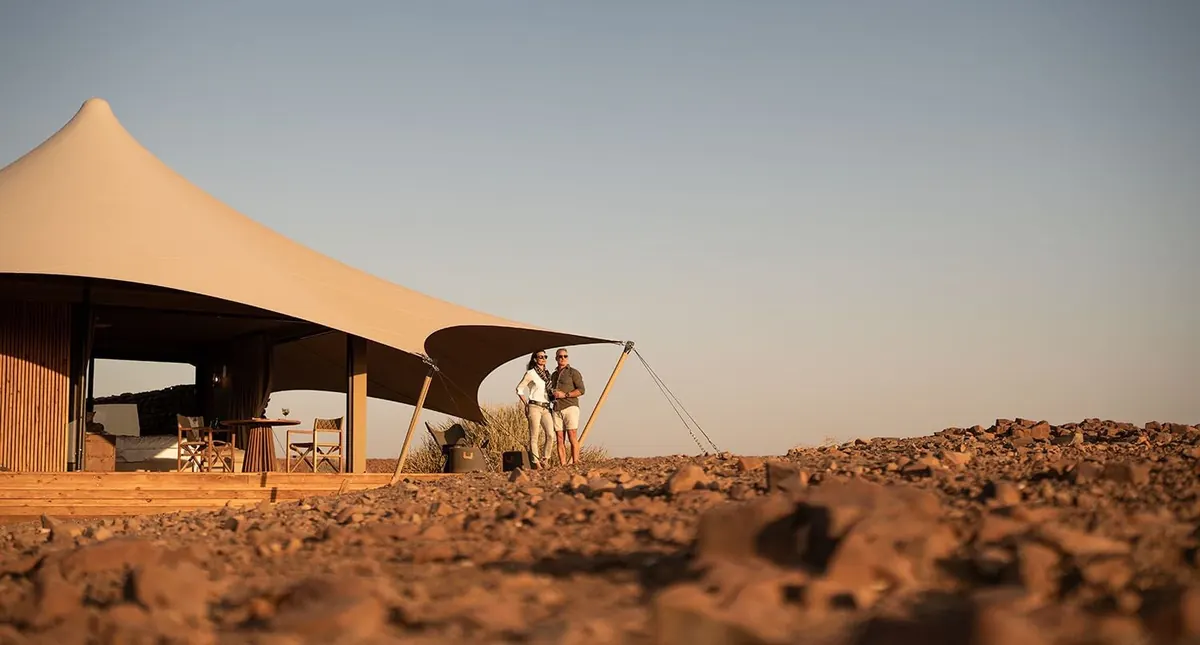
Desert Rhino Camp is a small Wilderness camp in a wide valley inside the Palmwag Concession, the huge stretch of basalt hills and dry rivers in north-western Damaraland. It started out as a field station for protecting black rhino, and tracking them is still the reason to book. The camp is a partnership between Wilderness, three community conservancies and Save the Rhino Trust, whose trackers come from local communities and follow the rhino on foot across unfenced country.
What to expect
The camp was rebuilt recently and now has six canvas and stone suites, one of them a family unit, for up to 14 guests. Its camp fact sheet also lists an eight-tent layout for 16 guests, so the set-up depends on when you go. Each suite has its own stargazing deck. There is a pool and wifi, and power comes from solar panels.
The main outing is rhino tracking with the monitors. Beyond that there are nature drives, guided walks for the smaller plants and animals, and stargazing. Wilderness names Hartmann’s mountain zebra, giraffe and springbok among the animals here, and welwitschia grows on the plains around camp.
Practical details
- Stays are fully inclusive: meals, two activities a day, park fees, laundry and local drinks.
- Bookings go through a Wilderness travel designer. The camp page gives no driving directions, so ask about transfers when you book.
- Wilderness lists a private vehicle as an option.
Good to know
Palmwag sits on the Red Line, the veterinary fence that splits northern Namibia from the rest of the country, and Wikipedia says it holds the largest population of south-western black rhino in Africa. Wilderness credits the partnership with an 80% drop in poaching and a growing rhino population over its 21 years. Wilderness also has Damaraland Camp and Doro Nawas in the region if you want to combine camps.
Last updated 7 October 2026. Sources: Wilderness, Desert Rhino Camp, Wilderness, camp fact sheet, Save the Rhino Trust Namibia, Wikipedia, Palmwag.
Getaway, Don't Worry and the rhinos that avoid the airstrip
In 2015 the writer Roxanne Reid climbed a stony rise near this camp to watch a bull called Getaway. He was 40 that year, born in 1975, which makes him older than Save the Rhino Trust itself. By her account he held about 409 square kilometres and had been dehorned the year before. Five years later a Wilderness writer, Anton Kruger, described another bull whose range is close to camp: Don’t Worry, 30 years old, browsing euphorbia and even a welwitschia.
Rhinos here have names and histories because the trust’s trackers know each one, as the Palmwag page says. What gets less attention is that this camp has been a research site since it opened in 2003 as Palmwag Rhino Camp.
The rhinos keep six kilometres from the runway
From early on the trackers recorded how tourism affected the animals’ behaviour. Research between 2003 and 2008 turned those records into two rules: a set way of approaching a rhino, and a rotation so no area is used every day. Then, from June 2009 to May 2010, Jeff Muntifering (now the trust’s science adviser) and his co-authors mapped where rhinos went, and published the result in the journal Oryx. Rhinos stayed away from ground within six kilometres of an airstrip and within a kilometre of any track driven daily. A natural water source that had vehicles at it more than 16 times a month was far less likely to be used.
That is why the camp’s 1,265 or so square kilometres are cut into sectors (Reid counted four) that are used in turn, and why Wilderness says any one rhino meets guests only about three times a month. It also explains the driving.
Poaching across the north-west peaked at 18 rhinos in 2014. A 2023 paper by Muntifering and colleagues recorded four in 2017 and none in 2018.
Half an hour, or thirteen
The trackers find the rhino and radio the camp guide. When Reid went, nothing wore a collar: they read spoor, then checked ear notches and horn shape. Guests walk the last stretch in single file, downwind, on hand signals, over rocky ground. Nobody carries a rifle.
How long it takes is luck. Reid was woken at five, drove half an hour and watched Getaway for 45 minutes. Travellers writing to Expert Africa tell it differently: a rhino found at 14:30 after eight hours in September 2019, nearly ten hours and 140 km in October 2022, a 13-hour day in February 2025. One couple in August 2022 had a ten-hour first day and only a distant look before the rhinos smelt the vehicle, and they skipped the second day. Two nights is a gamble, three is better.
The early starts are cold. Guests in September 2023 and June 2026 both wrote about the thick ponchos and hot water bottles handed out on the vehicle.
Squirrels, hyena cubs and not much else
A guest in 2019 complained there was “little else” to see. That is harsh but not far off. Expert Africa’s tallies put giraffe and oryx at nearly every stay, spotted hyena at about a third, lion and brown hyena at about one in five. On a drive in 2024 Reid found a spotted hyena clan with six youngsters that came up to sniff the vehicle and chew at its tyres.
Her guide, Bons Roman, whose name turns up in the traveller reports year after year, stopped for a ground squirrel eating the yellow fruit of a Damara milk-bush. He had read that they do it in winter and had never seen it. One traveller in July 2022 wrote that the springs near camp had dried up and the drives ran longer.
Park fees
Wilderness Desert Rhino Camp is inside Palmwag Tourism Concession. International visitors pay from US$6 €5 · N$100 a day. See all Palmwag Tourism Concession fees