Park · Kunene, Namibia
Palmwag Tourism Concession
A huge, unfenced block of basalt hills and dry rivers in northern Damaraland, home to desert-adapted black rhino and elephant. You need a permit and a 4x4 to drive it, or you join a guided trip from Palmwag Lodge.
Short answer
At Palmwag Tourism Concession, international visitors pay from N$100 (about US$6, €5.50 or £4.50) per adult per day, depending on which section you visit. The rates apply from 1 November 2025 to 31 March 2027.
- Daily fee, international adult
- US$6 €5 · N$100from, by section
- Malaria
- Kunene is one of the regions where the CDC says malaria is transmitted and recommends preventive tablets.
- Places to stay
- 15
- Park fee nearby: Skeleton Coast Park
- US$17 €15 · N$280about 109 km away
Palmwag Tourism Concession fees 2026
Checked Palmwag Lodge & Camp tariffValid 1 November 2025 to 31 March 2027, per person per day, in Namibian dollars.
| Pay point | International visitors | SADC nationals |
|---|---|---|
| Day entry fee | US$6 €5 · N$100 | N$50 |
| Overnight and camping fee | US$9 €8 · N$150 | N$100 |
- The sheet also lists a vehicle fee of N$150 per vehicle per day.
- You need a permit to enter the concession. It is sold at the control gates (Twee Palms, Aub, Elephant Song and Hoanib at Amspoort) and at Palmwag Lodge reception. Pay cash at the gates, or cash or card at the lodge.
- The concession is open to 4x4 vehicles only. Its six marked wild campsites have no facilities. Camping cannot be booked or paid for in advance, although the sheet says entry and camping fees can be paid upfront by EFT by special arrangement.
- The sheet gives one SADC rate and one foreign rate and no separate rate for Namibians, who are SADC nationals. It gives no child rate.
- Local guides enter free.
- The operator says the fees are set by the Ministry of Environment, Forestry and Tourism and can change at any time.
- The sheet gives no end date. The end date shown here is our own placeholder, the end of Namibia's financial year on 31 March 2027, not a date the operator published.
- Fees are set by Palmwag Lodge & Camp. Official tariff · Seen a new rate? Tell us
US$1 = N$16.64 · €1 = N$18.60 · £1 = N$22.31 (ECB rate, 3 Nov 2026, N$1 = R1). Converted amounts are approximate; you pay in Namibian dollars.
How we got these figures
- Figures from the Palmwag Concession info sheet that Gondwana Collection links from its Palmwag Lodge page; the file name dates it November 2025 (the PDF itself was saved on 15 January 2026). It states no start or end date, so the start recorded here is the date in the file name.
- Gondwana's Palmwag Lodge and Palmwag Campsite pages list guided activities inside the concession but do not print the entry fee.
- Gondwana's Palmwag Lodge page already shows activity prices for 1 November 2026 to 31 October 2027, but the concession info sheet it links is still the November 2025 one, so these entry fees may change when a new sheet is issued.
- Gondwana Collection Namibia, Palmwag Concession info (November 2025) · official · checked 12 Oct 2026
- Gondwana Collection Namibia, Palmwag Lodge · official · checked 12 Oct 2026
Palmwag is a tourism concession on communal land in the far north of Damaraland, in Kunene, where red basalt hills, flat-topped Etendeka mountains and dry riverbeds run west towards the Skeleton Coast Park. Gondwana, which runs the lodge, puts it at about 5,800 square kilometres. There are no fences and it is not a national park. People come for the desert-adapted black rhino, protected here by Save the Rhino Trust, and for elephant, mountain zebra and a few lions.
Getting there
Everything starts at Palmwag Lodge, in an oasis of makalani palms on the Uniab River, a few kilometres north of the junction where the C40 from Kamanjab over Grootberg Pass meets the C43. Khorixas is about 160 km to the south-east and Terrace Bay on the coast about 200 km west. The roads are gravel, and the C43 breaks up in the rainy season. The Red Line veterinary fence crosses the main road at Palmwag, and the lodge also has a 1,300 m airstrip.
When to go
The dry months are the easy choice. Winter mornings are cold in an open vehicle, so bring a warm layer. Rain comes between December and March, and not much of it: one wet season that left the grass long brought about 50 mm. After rain the elephants drift away from the lodge’s spring to water out in the veld, and the Uniab, dry for most of the year, can come down in flood across the tracks.
What to do
You can drive yourself, but only in a 4x4 and with a permit from the control gates or lodge reception, which also hands out a map and the rules. The nearest gate is 17 km from the lodge. There are six marked wild campsites with nothing at them, and camping cannot be booked ahead. If you have no 4x4, or no rough-road experience, take a guided outing from the lodge instead: a half or full day nature drive, a guided walk of 2 km or 5 km, a night under canvas, or rhino tracking on foot with trackers who know each animal. Rhino tracking and the sleep-out are not for children under 12. On a half day the lions are often too far away to reach, so the full day gives you a better chance. The concession fees are set by MEFT and shown in the table on this page.
Good to know
Palmwag Lodge sells diesel and unleaded from 07:00 to 19:00 (cash, Visa or Mastercard). Fill up here, because in Kaokoland to the north only Opuwo has a filling station. The gravel road south towards Twyfelfontein is known for sharp stones and punctures, so check your spare before you set off. Elephants sometimes walk through the campsite at night: keep food in the car and use a torch. Kunene is a malaria region according to both the CDC and Namibia’s health ministry, so see a travel clinic before you go. Any red meat in the car is taken off you at the Red Line when you cross it heading south.
Wildlife you might see
15- likelyBlack rhino (desert-adapted)Found by Save the Rhino Trust trackers on the guided rhino tracking outing, then approached on foot. All yearsource
- likelyHartmann's mountain zebraOpen plains and rocky slopes, often with foals. All yearsource
- likelySpringbokGrassy plains between the gate and the Aub Canyon, sometimes in herds of over a hundred. All yearsource
- likelyOryx (gemsbok)Across the plains. All yearsource
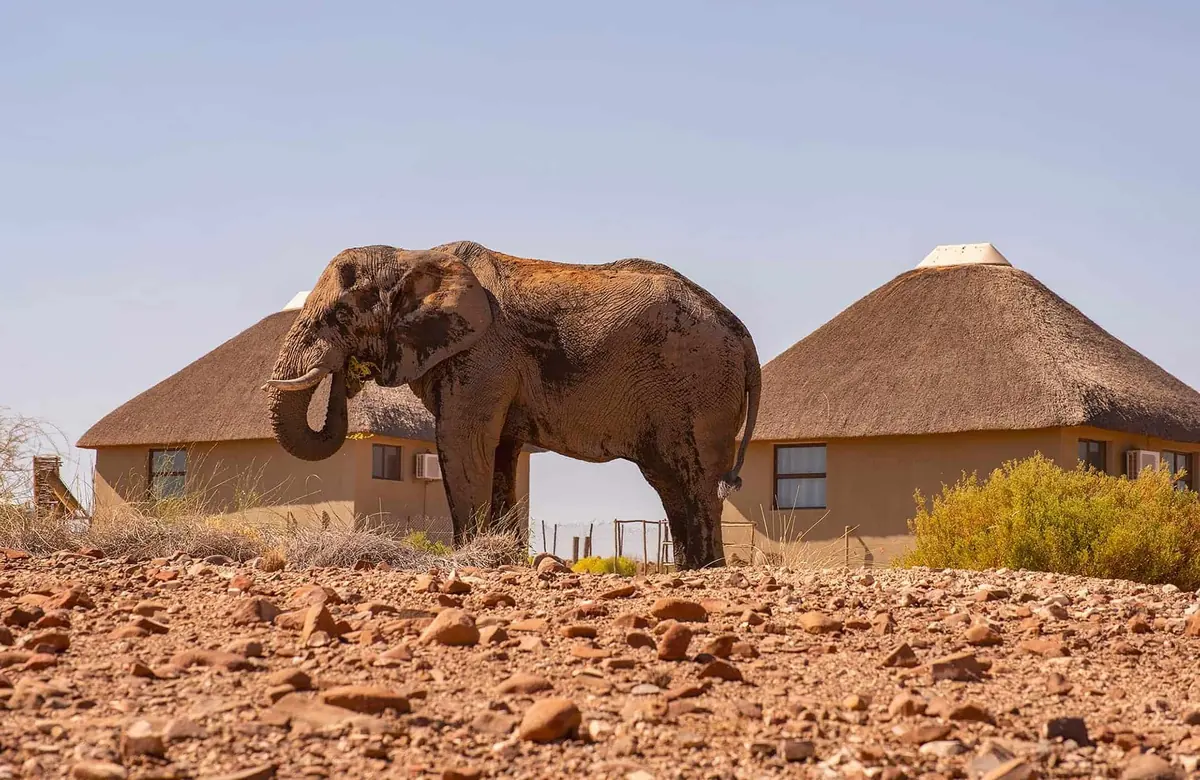
- possibleDesert-adapted elephantAlong the Uniab River. In dry spells the spring at the lodge can draw them into the lodge grounds and campsite; after good rains they stay out in the veld. Most often near the lodge in the dry seasonsource
- possibleGiraffeLook for ringwood trees browsed into flat umbrella shapes. All yearsource
- possibleKuduAll yearsource
- possibleKlipspringerAll yearsource
- possibleRüppell's korhaanPlains on the way from the gate to the Aub Canyon. All yearsource
- possibleHerero chatPossible on full-day drives in the concession. All yearsource
- possibleRüppell's parrotPossible on full-day drives in the concession. All yearsource
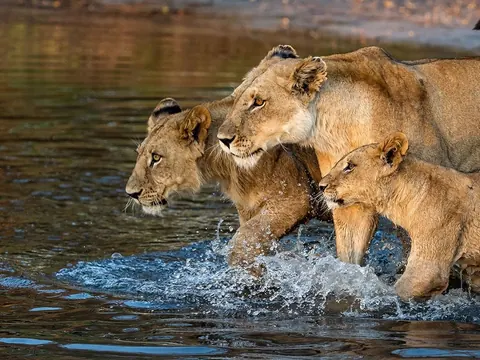
- rareLion (desert-adapted)Wide-ranging. Rangers track where they are, but they are often too far for a half-day drive. All yearsource
- rareLeopardAll yearsource
- rareCheetahAll yearsource
- rareSpotted hyenaAll yearsource
Likelihood is for a normal visit of two or three days, from the sources linked. Nothing is guaranteed in the wild.
Hikes and walks
3- Guided morning hike (5 km)
An early morning walk that climbs a koppie near the lodge and loops back. The guide covers tracks, small animals, plants and geology.
Permit: Guided only, booked through Palmwag Lodge
Roxanne Reid, Africa Addict (Palmwag Lodge) - Guided morning hike (2 km)
Leaves at about 07:00. The shorter walk, focused on animal tracks and the animals that live in the concession.
Permit: Guided only, booked through Palmwag Lodge
Gondwana Collection Namibia, Palmwag Lodge - Rhino tracking on foot
An open vehicle takes you to where trackers have found a rhino, then you walk in. It leaves between 06:00 and 06:30 depending on the season and is not open to children under 12.
Permit: Guided only, booked through Palmwag Lodge
Gondwana Collection Namibia, Palmwag Lodge
Staying safe in Palmwag Tourism Concession
- Malaria
- Kunene is one of the regions where the CDC says malaria is transmitted and recommends preventive tablets. See a travel clinic before you go and cover up at dusk. source
- Wildlife on foot and in camp
- There are no fences. Elephants come through Palmwag Campsite at night, drawn by the water in the Uniab, so keep food locked in the car, keep your distance and carry a torch after dark. source
- Concession rules
- The concession is open to 4x4 vehicles only. Motorbikes, quad bikes, drones and trucks over 4 tons are banned, you must stay on the marked tracks, the speed limit is 30 km/h and there is no driving after sunset. You may not approach animals on foot, and should keep well back from black rhino, elephant and lion. source
- Sharp stones and punctures
- The gravel road from Palmwag towards Twyfelfontein can be covered in very sharp stones. Travellers on a South African 4x4 forum reported several punctures on it and a queue at Palmwag to get them fixed. Check your spare and tyre kit before heading out. source
- Rain and floods
- The Uniab is dry for most of the year but can come down in full flood after a storm and cut the tracks. Ask at the lodge or gate about conditions before setting off after rain. source
- Euphorbia damarana
- This grey-green bush grows all over the area and is Namibia's most toxic plant. Broken branches leak a poisonous milky sap, so leave it alone. Rhino and kudu eat it without harm; people cannot. source
Tips from travellers
- Fill up at Palmwag Lodge, which sells diesel and unleaded from 07:00 to 19:00 and takes Visa and Mastercard. official
- Buy the permit at a control gate or at lodge reception and pick up the map and rules sheet there. Gates take cash only; the lodge takes cash or card. official
- The six marked campsites have nothing at them. Camp only on those, never close to a waterhole or in the main bed of the Hoanib River, and take all your rubbish out with you. official
- If you want lions, book the full-day drive. Rangers know where they were last seen, but they are often too far away to reach in half a day. one source
- Regulars on French travel forums say the concession is not worth trying without a 4x4. If you have an ordinary car, book a guided drive from the lodge instead. several sources
- Heading south out of Kaokoland you pass the Red Line veterinary control, and any red meat you carry is taken off you, so plan your cool box around it. several sources
Checked 7 October 2026. Conditions change, so confirm with the park or venue before you go.
The lioness from Aub Canyon and a rhino called Teabag
In 1982 a botanical artist called Blythe Loutit went looking at plants on the inland edge of the Skeleton Coast in Monty, her old short-wheelbase Land Rover, with an Irish terrier called Eccles for company. She got a puncture and her jack was broken. The woman who got her going again was Ina Britz, a farm girl from Kamanjab, who showed her how to work a high-lift jack and had bad news. At a spring she had just come from lay three dead rhinos, shot up with an automatic weapon, the horns gone.
Damaraland was a restricted area then, which suited the people emptying it. The tribute the rhino journal Pachyderm printed when Loutit died names them: the South African army and government officials, shooting from the air and from trucks wherever there was water. Loutit and Britz roped in their husbands, a few businessmen in Windhoek and community leaders in Damaraland and set up the Namibia Wildlife Trust, which turned into Save the Rhino Trust. Britz died in August 1985, the year the first census found 56 rhinos.
A child’s letter and a rhino called Teabag
A lot of the early money came from schoolchildren selling rhino friendship patches. In the late 1980s one child wrote in to ask why, if horn is only fingernail, nobody just cut it off. The Department of Nature Conservation did exactly that, twice, in Damaraland.
By 1986 the trust had three tracking teams and ten game guards drawn from the communities. What they have built since is a file on every animal, with photographs, covering seven rhino generations by the time Loutit died in June 2005. Her British research director, Mike Hearn, had drowned surfing that January.
The file is why the rhinos here have names. In 2011 the trackers told a reporter from The Namibian that they knew 17 in the concession by name. Verity was 39 and pregnant, had a piece missing from one ear and used about 450 square kilometres. Diana calved at 40, lost the calf to a lion and died soon after. Another is Teabag, because the scout who first saw the animal had no paper and wrote his notes on the last teabag in his pack. That comes from Conrad Brain, who wrote in 2012 about rhinos caught around Palmwag being lifted out by Huey helicopter to restock old rhino country elsewhere in the north-west.
On Christmas Day 2012 a herdsman, Shaka Karutjaiva, found a cow near Mbakondja killed by a single bullet through the heart and lungs, her calf still alive beside the carcass. A man confessed within an hour of being confronted that day and showed the police where he had hidden the horns. The calf died on the way out.
The Queen was born here
By the end of 1990 every known lion on the Skeleton Coast, radio collars and all, had been shot or poisoned over livestock. In 1997 word got round that a few were hanging on in the hills around Palmwag. Philip Stander, known as Flip, went looking, and a year into his Kunene Lion Project 20 lions wore collars.
One was a cub born in the Aub Canyon in September 1998 and logged as Xpl-10. At 20 months she walked north with three young males, first to the Hoanib and then to the Hoarusib, more than 130 km away, and in August 2002 her cubs were found on the beach. Stander counted them the first lions on that coast in 12 or 13 years. She had 13 cubs in five litters and died in May 2014, aged 15. They called her the Queen.
Stander’s records show the Obab lionesses going down to the Uniab Delta in the Skeleton Coast Park and sometimes eating seals there. Animals that can cover 70 km in a day are not waiting at a waterhole for you.
On the night of 30 May 2025 a lioness called Charly, Xpl-114, killed a visitor, Bernd Kebbel, on the Hoanib at the top end of the concession. Stander’s report blamed years of crowding. Up to twelve vehicles at a time had sat far inside the 50 metre limit, and all 24 hunts she tried with more than four of them around were spoiled. She was lean, hungry and no longer wary of people.
Rhino from the camp, elephant from the lodge
Expert Africa publishes what its travellers have reported seeing since mid-2018, and when I checked in October 2026 the split was telling. From Desert Rhino Camp, deep inside, every one of them had seen black rhino and about four in ten had seen elephant. From Palmwag Lodge it was the other way round: roughly four in ten saw rhino and eight in ten saw elephant. The elephants follow the Uniab to the spring beside the lodge, most of all when the veld is dry. The lodge figure counts every guest, including those who never booked the tracking. Choose your base by the animal you want.
Tracking means an early start. The Namibian’s reporter left before dawn, drove for over an hour, picked up Verity at 100 metres and watched from about 50. The writer Roxanne Reid got to around 150 metres from a rhino feeding on a euphorbia among welwitschias. Expect long, dusty hours in an open vehicle either side of that.
Six hours for ninety kilometres
Sandra Windisch, who wrote in 2021 about driving in through the northernmost gate with her husband and two daughters of six and seven, called it the longest day of their trip: 90 km in six hours, the girls counting zebra and giraffe. They carried a satellite phone and knew that help, once called, could still be days off. That is one family’s account.
The rock under the wheels is lava that poured out between 136 and 132 million years ago, as Africa and South America came apart. Most of that lava field is now in South America.
The warden out here in 2014 was Chris Bakkes, a novelist who lost his left arm to two crocodiles in the Kruger and went about with a one-eyed Jack Russell called Tier. At the lodge bar, the tree alongside is full of noisy rosy-faced lovebirds, says a Tracks4Africa writer who stopped for lunch.
In and around Palmwag Tourism Concession
23 places listedWhere to stay in Palmwag Tourism Concession 15
 CampsiteCamping Palmwag Lodge+264 61 427 200gondwana-collection.com
- HotelPalmwag Lodge+264 61 427 200gondwana-collection.com
- 20.31°S 13.65°ECampsiteSpringbokwasser Gate Campsite
- 19.83°S 13.79°ECampsiteAub Combretum Camp
- 19.56°S 13.35°ECampsiteBlackridge camp sites
- 19.81°S 13.47°ECampsiteC-4 Crowthers Campsite
- 19.22°S 13.45°ECampsiteElephant Song Campsite (Hoanib River)
Show all 15 places to stay
- Hein’s Campsite · Campsite
- Kai-Ais Campsite · Campsite
- Mudorib Bottom Junction Campsite · Campsite
- Mudorib Mouth Campsite · Campsite
- Mudorib Top Junction Campsite · Campsite
- Theun’s Campsite · Campsite
Sights 8
- Aub CanyonViewpoint
- AwaxasViewpoint
- Barab-Aub confluenceViewpoint
- KawaxabAttraction
- The PoortAttraction
- Tweepalm ViewpointViewpoint
- Van Zyl´s GatViewpoint
- Viewpoint PalmwagAttraction
Quick answers
How much is the entry fee for Palmwag Tourism Concession?
International visitors pay N$100 (about US$6, €5.50 or £4.50) per adult per day. These rates apply from 1 November 2025 to 31 March 2027 and are set by Palmwag Lodge & Camp (Gondwana Collection Namibia).
Do Namibians and SADC citizens pay less at Palmwag Tourism Concession?
SADC nationals pay N$50 per adult per day. You need ID or a passport to get the lower rate.
When were these Palmwag Tourism Concession fees last checked?
We last checked them on 12 October 2026 against 2 published sources. We re-check every two weeks, but always confirm with Palmwag Lodge & Camp (Gondwana Collection Namibia) before you travel.
What animals can you see in Palmwag Tourism Concession?
You have a good chance of seeing black rhino (desert-adapted), hartmann's mountain zebra, springbok and oryx (gemsbok). Lion (desert-adapted), leopard, cheetah and spotted hyena are there but rarely seen.
What are the best hikes in Palmwag Tourism Concession?
Guided morning hike (5 km) (5 km), Guided morning hike (2 km) (2 km) and Rhino tracking on foot. See the hikes section for times, difficulty and permits.
Palmwag Tourism Concession and the parks nearest it
| Park | International adult | Distance | Where |
|---|---|---|---|
| Palmwag Tourism Concession | US$6 €5 · N$100 | · | Kunene |
| Skeleton Coast Park | US$17 €15 · N$280 | 109 km | Kunene |
| Cape Cross Seal Reserve | US$17 €15 · N$280 | 226 km | Erongo |
| Etosha National Park | US$17 €15 · N$280 | 241 km | Oshana |
Where the Palmwag Tourism Concession fees come from
- Gondwana Collection Namibia, Palmwag Concession info (November 2025)
- Gondwana Collection Namibia, Palmwag Lodge
Open data: all park fees (CSV) · JSON (CC BY 4.0)
Cite as: Travel Africa Guide, "Palmwag Tourism Concession fees 2026", checked 12 October 2026, https://travelafrica.guide/namibia/palmwag-tourism-concession/
Map of Palmwag Tourism Concession
See every place on this map as a list