Park · Kunene, Namibia
Skeleton Coast Park
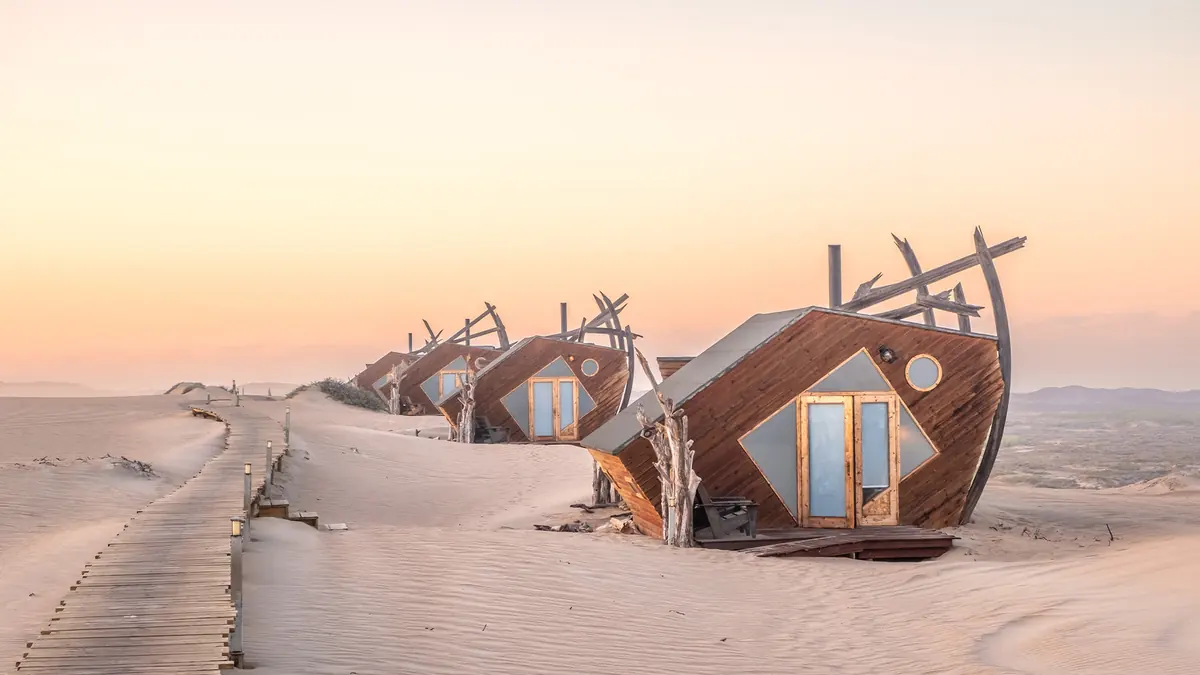
A long strip of fog, gravel plains and dunes from the Ugab River to the Kunene on the Angolan border. You can drive the south on a salt road; the north takes a fly-in or guided trip.
Short answer
At Skeleton Coast Park, international visitors pay N$280 (about US$17, €15 or £12.50) per adult and N$180 per child per day. The rates apply from 1 April 2026 to 31 March 2027.
- Daily fee, international adult
- US$17 €15 · N$280
- Malaria
- The CDC lists the Kunene Region, which includes this park, among Namibia's malaria areas and recommends preventive tablets there.
- Places to stay
- 1
- Park fee nearby: Palmwag Tourism Concession
- US$6 €5 · N$100about 109 km away
Skeleton Coast Park fees 2026/27
Checked Ministry of Environment, Forestry and Tourism tariffValid 1 April 2026 to 31 March 2027, per person per day, in Namibian dollars.
| Who | Adult | Child |
|---|---|---|
| International visitorsUS, Europe and everyone else | US$17 €15 · N$280 | US$11 €10 · N$180 |
| SADC nationals | N$180 | N$100 |
| Namibian citizens | N$60 | Free |
- Children aged 8 and under enter free. The child rate is for ages 9 to 15; Namibian children in that age group pay nothing. From 16 the adult rate applies.
- Vehicle fee per day, on top of the per person fee: N$60 for 10 seats or less, N$150 for 11 to 25 seats, N$600 for 26 to 50 seats and N$1,000 for 51 seats or more.
- The Namibian rate is for Namibian citizens. The gazette sets fees by nationality, so a foreigner living in Namibia pays the rate for their nationality.
- Each fee is half park entrance fee and half conservation fee; the figures shown are the two added together.
- These fees were gazetted with effect from 1 April 2026 and have no end date. I show them as valid to 31 March 2027, the end of Namibia’s financial year, and will re-check then.
- Fees are set by Ministry of Environment, Forestry and Tourism. Official tariff · Seen a new rate? Tell us
US$1 = N$16.64 · €1 = N$18.60 · £1 = N$22.31 (ECB rate, 3 Nov 2026, N$1 = R1). Converted amounts are approximate; you pay in Namibian dollars.
How we got these figures
- SafariFind gives the same adult figures but lower child rates (N$140 foreign, N$90 SADC) than the gazette; I used the gazette child rates.
- Government Gazette No. 8877 of 1 April 2026, Government Notice No. 115 (MEFT fee schedule), copy hosted by the Legal Assistance Centre · official · checked 7 Oct 2026
- Tourism Update (27 January 2026) · one source · checked 7 Oct 2026
- Namibian.org (19 January 2026) · one source · checked 7 Oct 2026
- Africa Beat (6 February 2026) · one source · checked 7 Oct 2026
- TravelComments.com (29 January 2026) · one source · checked 7 Oct 2026
- SafariFind · one source · checked 7 Oct 2026
The Skeleton Coast Park covers 16,845 km² of desert shore in Kunene, from the Ugab River north to the Kunene River on the Angolan border, roughly a third of Namibia’s coastline. Proclaimed in 1971, it has no fences and no artificial waterholes, and most of it is closed to cars. People come for the emptiness: fog over gravel plains, dunes running into heavy surf, a few wrecks and serious surf angling at Terrace Bay and Torra Bay.
Getting there
From Swakopmund the C34 runs north past Henties Bay and Cape Cross to Ugabmund Gate, about 110 km beyond Cape Cross. The road is salt and gravel, fine when dry and slick when fog wets it, so keep under 80 km/h. It runs about 140 km to Springbokwasser Gate, where you can turn inland up the Huab valley into Damaraland. Torra Bay lies about 10 km and Terrace Bay about 50 km further north, and you need a booking to drive to either. North of Terrace Bay the coast is reached only on a fly-in safari or with a concession operator.
When to go
It is dry all year, and what little rain there is falls mostly from January to March. The cold Benguela Current keeps the coast foggy and windy, and temperatures run from about 7°C to 32°C. Torra Bay campsite opens only in December and January, the summer fishing season. The rest of the year Terrace Bay, with rooms, chalets, a restaurant and a bar, is the main place to stay.
What to do
Just inside Ugabmund are the ribs of the South West Seal, a fishing boat that caught fire and was beached here. Near the Huab mouth an oil rig abandoned in the early 1970s lies collapsed on the sand, and the lagoon beside it draws cormorants and gulls. Anglers go after galjoen and kob off the beaches at Torra Bay and Terrace Bay. From Terrace Bay you can walk in the Uniab delta, where springs draw springbok and oryx and the river spills over a small waterfall into a sandstone gorge.
Do not expect a beach lined with old hulls. The sea and the sand dispose of wrecks fast, so only a handful of recent ones are left to see.
Good to know
- If you are only driving through, the ministry’s (older) leaflet says you buy an entry permit at either the Ugab or Springbokwasser gate. Lonely Planet says the transit permit is free, so check at the gate what you will pay. There is a cut-off. Lonely Planet gives 13:00 to enter and 15:00 to leave; a reader comment on Tracks4Africa gives 15:00 for entry.
- Driving off the tracks is banned. Tyre marks last for decades on the gravel plains.
- Fuel inside is sold only at Terrace Bay and, in season, Torra Bay. Fill up in Swakopmund, Henties Bay or Khorixas and carry water.
- After rain the Ugab can flow at the southern gate, so ask before you cross.
- The CDC lists the Kunene Region, which includes the park, as a malaria area. Ask a travel clinic.
- The park fee is in the table on this page.
Wildlife you might see
14- likelyGaljoen, kob and bronze whaler sharkSurf angling off the beaches at Torra Bay and Terrace Baysource
- possibleBlack-backed jackalAlong the shore and the coast road. All yearsource
- possibleGemsbok (oryx)Along the coast road. All yearsource
- possibleSpringbokUniab River delta, where springs surface in the old river channelssource
- possibleHartmann's mountain zebraTowards the north-eastern exit at Springbokwasser, where game becomes more commonsource
- possibleOstrichTowards the north-eastern exit at Springbokwassersource
- possibleCape fur sealAlong the coast; the large colonies at Cape Fria are in the closed northern sectionsource
- possibleWhite-breasted cormorantHuab lagoon by the collapsed oil rig, with gullssource
- possibleGreater and lesser flamingoRiver mouths and coastal wetlandssource
- rareBrown hyenaAround the Uniab delta; sightings are unpredictablesource
- rareDesert-adapted elephantDry river valleys such as the Uniab, Hoanib and Hoarusib; the northern ones only on guided tripssource
- rareLionTowards the north-eastern exit and, very occasionally, on the beach; sightings are exceptionalsource
- rareHeaviside's dolphinOffshoresource
- rareLappet-faced vultureDesert plains inland of the coast roadsource
Likelihood is for a normal visit of two or three days, from the sources linked. Nothing is guaranteed in the wild.
Hikes and walks
1- Uniab River delta walk
NWR suggests walking from Terrace Bay into the nearby Uniab River delta for birds, game and the dunes. It publishes no set route or distance, so keep to short walks close to the road.
Permit: Booked stay at Terrace Bay
Namibia Wildlife Resorts (Terrace Bay Resort)
Staying safe in Skeleton Coast Park
- Malaria
- The CDC lists the Kunene Region, which includes this park, among Namibia's malaria areas and recommends preventive tablets there. The coast is dry, foggy desert, but most routes out of the park head inland through Kunene, so ask a travel clinic which advice fits your route and pack insect repellent. source
- Remoteness and the road
- There are almost no facilities. The official advice is to enter with enough fuel, water and supplies and not to wander far from your car. The road is mostly gravel and fog makes it slick, so keep below 80 km/h. source
- Gravel road accidents
- Accidents are common on Namibian gravel roads. Check what your hire car insurance covers, as many policies exclude accidents that involve no other vehicle or animal, and avoid driving at night outside towns. source
- Off-road driving
- Driving off the road is strictly banned; it leaves scars in the desert that can last for centuries. There are a few short detours to points of interest, so use those. source
- The sea
- Heavy surf, rocks just offshore and fog put many ships on this shore. The surf pounds the beaches all year and the Benguela upwelling keeps the water cold, so treat it as a coast for fishing and looking rather than swimming. source
- Ugab River crossing
- The Ugab, at the southern gate, is usually dry but can flow after rain. The gate staff know the state of the crossing, so ask before you drive in, especially without four-wheel drive. source
Tips from travellers
- Plan your day around the gate cut-off. Lonely Planet says transit drivers must pass the entry gate by 13:00 and leave through the other gate by 15:00 the same day; a reader comment on Tracks4Africa gives 15:00 for entry, so check with MEFT and do not arrive in the late afternoon. one source
- The transit permit only covers the road between Ugabmund and Springbokwasser. It was free in the ministry's 2015 leaflet, but a new park fee schedule took effect on 1 April 2026, so ask at the gate whether transit is still free. To drive on to Torra Bay or Terrace Bay you need an NWR booking made in advance, and the gate asks to see the confirmation. official
- Fuel is scarce. The park leaflet lists petrol and water at Terrace Bay, which you can only reach with a booking, so fill up before you enter. official
- Do not come expecting a beach of old shipwrecks. Wrecks here do not last long; the South West Seal just inside Ugabmund is one of the few still easy to see from the road. one source
- After driving the salt road, wash the underside of the car. Salt from the road surface sticks to the chassis. one source
- Pack a warm, windproof layer. Fog and wind off the cold sea can make the beach chilly at either end of the day, while the gravel plains inland heat up. several sources
Checked 7 October 2026. Conditions change, so confirm with the park or venue before you go.
Lions on the beach and the tug lost saving a liner
On 17 December 2024 a collared lioness known to researchers as Xpl-108 walked out of the desert at the Uniab delta, up the coast from the Torra Bay campsite in the middle of its two-month season. In the early hours of the 19th she killed a large Cape fur seal on the beach. She then worked the shore and the reed beds at the river mouth, and spent Christmas Eve resting in reeds just east of the main road.
Three orphans on an island in a spring
Lions hunted this shore until conflict with people inland wiped them out in the 1980s. The last ones in the park were dead by 1990. They came back from about 2002, but it took another fifteen years before any of them worked out that the sea was edible.
The ones who did were three sisters. Their mother, Xpl-55 of the Hoanib Floodplain pride, died when they were eleven months old. They crossed the dunes to a spring at the Hoanib mouth, holed up on an island in it and lived on cormorants, red-billed teal and the odd flamingo, stalked half under water in the reeds. In August 2017 they found the seal colony at Möwe Bay and fed on carcasses. By 2018 two of them were killing seals at the river mouth. Flip Stander of Desert Lion Conservation kept a tally for eighteen months: 60 cormorants, 18 seals and 2 flamingos, 86 per cent of what they ate by weight. Magazine writers call the three Alpha, Bravo and Charlie.
The third sister went inland, joined an older lioness up the Hoanib and learnt to hunt giraffe. Stander’s project lists her as Xpl-114, spells the name Charly, and calls her arguably the most photographed lioness in Namibia. On the night of 30 May 2025 she killed Bernd Kebbel, a 59 year old businessman, after he left his tent at a camp on the Hoanib. Kebbel had been giving the lion project money for collars and repairs since before 2010, at first anonymously. Charly was put down on 1 June. The project’s report blamed habituation. Safari vehicles had been sitting an average of 10.6 m from her, where the agreed distance is 50 m.
What a self-driver can expect at the Uniab
All of that happens in the closed north or inland around the Palmwag concession, on guided trips. The public road reaches one place where beach lions turn up, the Uniab delta between Torra Bay and Terrace Bay. Xpl-108 belongs to the Obab group inland and comes down for oryx at the springs and seals on the beach. One summer she spent more than thirty days inside the 40 km of beach around Torra Bay that the lion project has ringed with a virtual fence. A collar crossing it alerts the lion rangers and the camp managers. A party of anglers who got too close to a lioness there had their vehicle charged.
So the chance is real and small. It is best from late November to January, when she has been recorded there, and the seal kills on record happened at night or before sunrise. At Terrace Bay the place to look at dusk is the generator building. Expert Africa says cormorants roost on it for the warmth, and that jackals and sometimes a brown hyena hang about underneath.
Eleven police trucks and a bomber in a salt pan
The wreck that made the coast famous lies in the closed section, about 50 miles south of the Kunene. The Blue Star liner Dunedin Star, carrying munitions for the Eighth Army, hit something on the night of 29 November 1942 and was run aground. A motorboat put 63 people on the beach, eight women and three babies among them, before the surf put it out of action.
Then the rescuers started needing rescue. The Walvis Bay tug Sir Charles Elliot helped get the last of the crew off the liner, turned for home and ran aground north of Rocky Point on 4 December. Her first officer Angus McIntyre and deckhand Mathias Korabseb did not survive the swim to the beach. Captain Immins Naudé landed an air force Ventura near the castaways and it sank through the crust of a salt pan. A police convoy under Captain J.W.B. Smith drove up from Windhoek, fetched the last people off the beach and had its eleven trucks home on 23 December. Naudé went back in January, dug his bomber out in four days, took off on the 29th and was in the sea 43 minutes later. He and his two crew swam ashore. Nobody from the liner died.
John Marsh wrote it all up in 1944 under the title Skeleton Coast, and the book is where the name took hold.
The lawyer whose clients wanted a harbour
Louw Schoeman was an attorney whose clients were prospecting up here and looking into a harbour. He got hooked, pushed for the park that was proclaimed in 1971, and from 1977 took paying guests into the far north. He died in 1993 and his sons Bertus, André, Leon and Henk carried on. The firm flies its guests in by Cessna 210 these days. A deep-water port at Cape Fria has been proposed on and off since the 1980s all the same.
Not every scheme stayed on paper. The fallen oil rig near the Huab mouth was put up by Ben du Preez, who was after oil and diamonds in the late 1960s and early 1970s and found neither.
Six hours of gravel for one night
Expert Africa puts Terrace Bay at about six hours from Swakopmund, and says most people sleep once and leave. It calls the rooms functional, one of its guests called them very dated, and another wrote of having reached the end of the world. A 4x4 forum writer called the coast forlorn and massive in the same breath, and said it was the seals at Cape Cross that lived up to the hopes. This park suits people who like emptiness for its own sake. It will bore anyone waiting for something to happpen.
In and around Skeleton Coast Park
12 places listedWhere to stay in Skeleton Coast Park 1
 CampsiteTorra Bay
Sights 8
- Angra FriaBeach
- Collapsed Oil RigViewpoint
- DekkabaaiViewpoint
- Huab RiverViewpoint
- South West SealViewpoint
- Steenbras RifViewpoint
- Terrace Bay Angling BorderViewpoint
- ToscaniniViewpoint
Fishing spots 2
- Fish Cleaning FacilityFishing spot
- StudentebaaiFishing spot
Restaurants and cafes 1
- Terrace Bay RestaurantRestaurant
Quick answers
How much is the entry fee for Skeleton Coast Park?
International visitors pay N$280 (about US$17, €15 or £12.50) per adult and N$180 per child per day. These rates apply from 1 April 2026 to 31 March 2027 and are set by Ministry of Environment, Forestry and Tourism (MEFT).
Do Namibians and SADC citizens pay less at Skeleton Coast Park?
Namibian citizens pay N$60 per adult and SADC nationals pay N$180 per adult per day. You need ID or a passport to get the lower rate.
When were these Skeleton Coast Park fees last checked?
We last checked them on 7 October 2026 against 6 published sources. We re-check every two weeks, but always confirm with Ministry of Environment, Forestry and Tourism (MEFT) before you travel.
What animals can you see in Skeleton Coast Park?
You have a good chance of seeing galjoen, kob and bronze whaler shark. Brown hyena, desert-adapted elephant, lion and heaviside's dolphin are there but rarely seen.
Skeleton Coast Park and the parks nearest it
| Park | International adult | Distance | Where |
|---|---|---|---|
| Skeleton Coast Park | US$17 €15 · N$280 | · | Kunene |
| Palmwag Tourism Concession | US$6 €5 · N$100 | 109 km | Kunene |
| Etosha National Park | US$17 €15 · N$280 | 314 km | Oshana |
| Cape Cross Seal Reserve | US$17 €15 · N$280 | 314 km | Erongo |
Where the Skeleton Coast Park fees come from
- Government Gazette No. 8877 of 1 April 2026, Government Notice No. 115 (MEFT fee schedule), copy hosted by the Legal Assistance Centre
- Tourism Update (27 January 2026)
- Namibian.org (19 January 2026)
- Africa Beat (6 February 2026)
- TravelComments.com (29 January 2026)
- SafariFind
Open data: all park fees (CSV) · JSON (CC BY 4.0)
Cite as: Travel Africa Guide, "Skeleton Coast Park fees 2026/27", checked 7 October 2026, https://travelafrica.guide/namibia/skeleton-coast-park/
Map of Skeleton Coast Park
See every place on this map as a list