Park · Erongo, Namibia
Cape Cross Seal Reserve
The world's largest breeding colony of Cape fur seals, two replicas of the cross Diogo Cão planted in 1486, and a short boardwalk on the coast north of Henties Bay.
Short answer
At Cape Cross Seal Reserve, international visitors pay N$280 (about US$17, €15 or £12.50) per adult and N$180 per child per day. The rates apply from 1 April 2026 to 31 March 2027.
- Daily fee, international adult
- US$17 €15 · N$280
- Malaria
- The CDC does not list Erongo among the Namibian regions where malaria is spread, and says it is rare elsewhere in the country.
- Places to stay
- 2
- Park fee nearby: Dorob National Park
- US$17 €15 · N$280about 33 km away
Cape Cross Seal Reserve fees 2026/27
Checked Ministry of Environment, Forestry and Tourism tariffValid 1 April 2026 to 31 March 2027, per person per day, in Namibian dollars.
| Who | Adult | Child |
|---|---|---|
| International visitorsUS, Europe and everyone else | US$17 €15 · N$280 | US$11 €10 · N$180 |
| SADC nationals | N$180 | N$100 |
| Namibian citizens | N$60 | Free |
- Children aged 8 and under enter free. The child rate is for ages 9 to 15; Namibian children in that age group pay nothing. From 16 the adult rate applies.
- Vehicle fee per day, on top of the per person fee: N$60 for 10 seats or less, N$150 for 11 to 25 seats, N$600 for 26 to 50 seats and N$1,000 for 51 seats or more.
- The Namibian rate is for Namibian citizens. The gazette sets fees by nationality, so a foreigner living in Namibia pays the rate for their nationality.
- Each fee is half park entrance fee and half conservation fee; the figures shown are the two added together.
- These fees were gazetted with effect from 1 April 2026 and have no end date. I show them as valid to 31 March 2027, the end of Namibia’s financial year, and will re-check then.
- Fees are set by Ministry of Environment, Forestry and Tourism. Official tariff · Seen a new rate? Tell us
US$1 = N$16.64 · €1 = N$18.60 · £1 = N$22.31 (ECB rate, 3 Nov 2026, N$1 = R1). Converted amounts are approximate; you pay in Namibian dollars.
How we got these figures
- SafariFind gives the same adult figures but lower child rates (N$140 foreign, N$90 SADC) than the gazette; I used the gazette child rates.
- New Era reported in 2025 that the draft schedule kept this park free for Namibians. The gazetted schedule charges Namibian adults N$60, so the draft was changed.
- Government Gazette No. 8877 of 1 April 2026, Government Notice No. 115 (MEFT fee schedule), copy hosted by the Legal Assistance Centre · official · checked 7 Oct 2026
- Tourism Update (27 January 2026) · one source · checked 7 Oct 2026
- Namibian.org (19 January 2026) · one source · checked 7 Oct 2026
- Africa Beat (6 February 2026) · one source · checked 7 Oct 2026
- TravelComments.com (29 January 2026) · one source · checked 7 Oct 2026
- SafariFind · one source · checked 7 Oct 2026
- New Era (report on the 2025 draft fee schedule) · one source · checked 7 Oct 2026
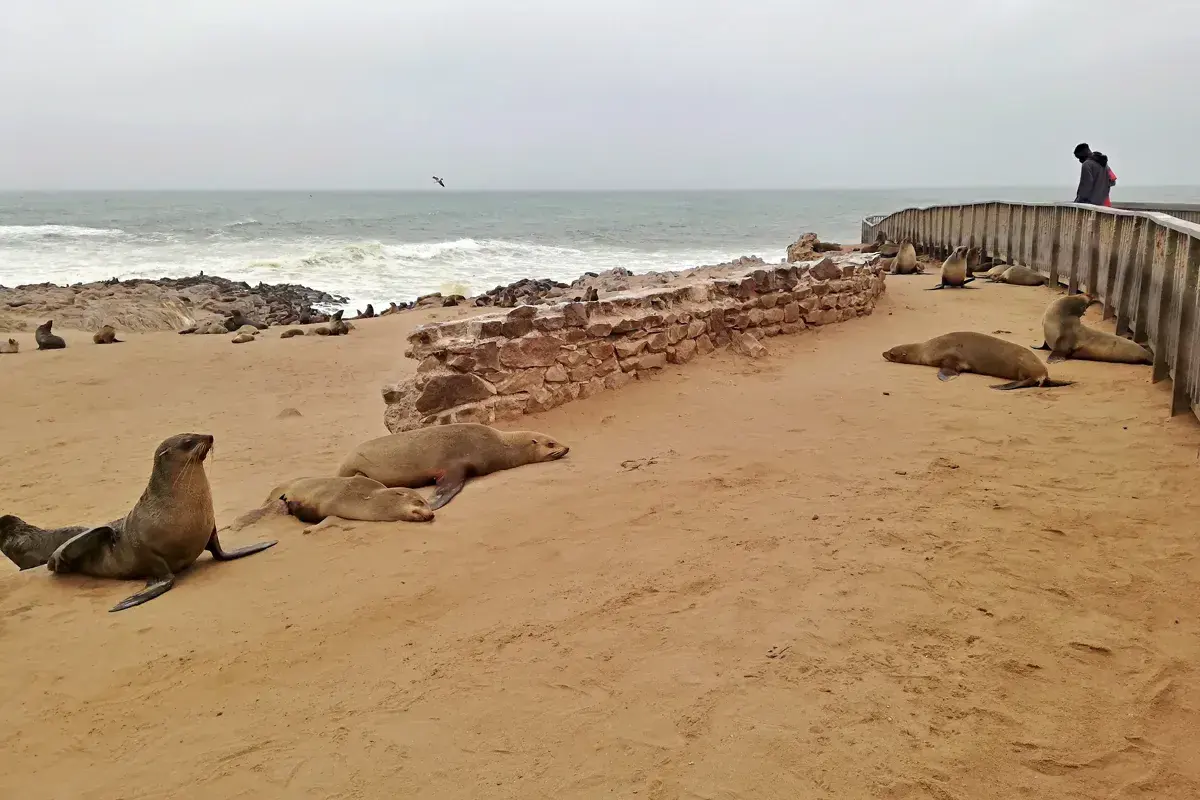
Cape Cross is a low rocky headland on the Erongo coast where more Cape fur seals breed than anywhere else on earth. In the November and December breeding season MEFT puts the number at up to 210,000. The reserve is small, about 60 square kilometres, proclaimed in 1968 and run by the Ministry of Environment, Forestry and Tourism. Most people make it a short stop on the drive up the coast, and the smell is reason enough not to linger.
Getting there
The reserve is off the C34 coast road, about 120 km north of Swakopmund and 60 km past Henties Bay. It has been tarred as far as Henties Bay since 2019. North of town it is a salt road of packed salt and sand, fine for an ordinary car but slippery when wet. Allow about an hour and a half from Swakopmund. There is no public transport.
There is no petrol at Cape Cross and very little water. Fill up in Swakopmund or Henties Bay, and stock up there too if you are going on into the Skeleton Coast Park.
When to go
The colony is there all year. Pups are born in late November and December, and in October the big bulls come ashore to fight for territory. The reception has two sets of hours: 08:00 to 17:00 from 16 November to 30 June, and 10:00 to 17:00 from 1 July to 15 November. Expect cool air, wind and fog off the Benguela Current in any month.
What to do
Get your permit at reception, then drive to the car park at the end of the road. A 200 metre walkway of recycled plastic, with information boards and fine for wheelchairs, runs along the edge of the seals, and some lie right under it. Black-backed jackals hang about the colony for scraps, and after dark the odd brown hyaena comes down to the beach.
Near the colony stand two replicas of the padrão, the stone cross Diogo Cão planted in 1486 to claim this coast for Portugal. A German naval officer took the original to Berlin in 1893, where the Deutsches Historisches Museum holds it. Both are part of a National Heritage Site. The rusty bits in the sand are left from a guano boom that started in 1895 and was over nine years later. Namibia’s first railway was built here in those years, across what is now the salt pan.
Good to know
- No angling is allowed in the reserve, and the bird platforms in the south are closed to the public.
- The reserve has a few basic campsites by the sea, with long drop toilets and no running water or electricity. Cape Cross Lodge, just outside the boundary, has rooms, a restaurant and its own campsite.
- Seals are harvested in the reserve each year under quotas set by the Ministry of Fisheries and Marine Resources (in 2023 the harvest began on 1 July).
- The CDC reports a rabies outbreak in Cape fur seals in Namibia. Do not touch or go close to any seal, and get medical help straight away if one bites you.
Wildlife you might see
10- very likelyCape fur sealOn the rocks and beach right beside the walkway. All year, with up to 210,000 in the November and December breeding seasonsource
- likelyBlack-backed jackalProwling the edges of the colony looking for something to scavengesource
- likelyKelp gullSkimming the sea for foodsource
- likelyCormorantsOver the sea in flocks, often flying in single filesource
- possibleDamara ternGravel plains near the coast, where it nests in scrapes on the groundsource
- possibleGreater and lesser flamingosource
- possibleAfrican black oystercatchersource
- rareBrown hyaenaBeaches around the colony. At nightsource
- rareKiller whaleIn the sea offshoresource
- rareCopper shark (bronze whaler)In the water off the colonysource
Likelihood is for a normal visit of two or three days, from the sources linked. Nothing is guaranteed in the wild.
Hikes and walks
1- Seal colony walkway
A 200 metre walkway of recycled plastic along the edge of the colony, with information points. It is suitable for wheelchairs. This is a place to watch, not to hike.
Permit: Reserve permit from the reception
Ministry of Environment and Tourism, Cape Cross Seal Reserve brochure
Staying safe in Cape Cross Seal Reserve
- Malaria
- The CDC does not list Erongo among the Namibian regions where malaria is spread, and says it is rare elsewhere in the country. It advises tablets only for the regions it names. Use the usual care against mosquitoes, and check the advice again if you go on north into Kunene. source
- Salt road
- The C34 is tar to Henties Bay, then a salt road all the way north to the Ugab Gate. Keep to 80 km/h on gravel, slow right down when the surface is wet because it turns slippery, and wash the underside of the car afterwards. source
- Seals and off-road driving
- Stay on the walkway, keep to existing roads and tracks, and never feed or throw anything at the seals. Driving off the road destroys lichen fields and the nests of Damara terns. source
- Rabies in seals
- The CDC reports a rabies outbreak in Cape fur seals in South Africa and Namibia. Do not touch or go close to any seal, whatever anyone tells you, and get medical help straight away if a seal bites you. source
- Wind and cold
- The shore here is often foggy and windy, and it can feel cold. Pack a windproof jacket and a warm layer, and wear closed shoes. source
- Swimming
- The sea at Cape Cross is rough and cold. Enjoy the beach, but this is not a place for a swim. source
Tips from travellers
- The smell of the colony is overpowering. A bandana or scarf over your nose and mouth helps. one source
- For pups go in late November or early December. For bulls fighting over territory go in October. one source
- Check the reception hours before you plan your day. From 1 July to 15 November it opens at 10:00, not 08:00, and closes at 17:00 all year. official
- If you camp in the reserve you can see the seals early, before day visitors arrive. Bring your own toilet paper, water and food, as there is no running water or electricity and the nearest shop is in Henties Bay. one source
- Do not leave food out at the campsite overnight. Jackals visit, and you will find their tracks on the beach in the morning. one source
- Buy food, water and other supplies in Swakopmund or Henties Bay before heading up the Skeleton Coast, as shopping further north is very limited. several sources
Checked 7 October 2026. Conditions change, so confirm with the park or venue before you go.
The cross that left for Berlin, and the men the guano killed
The cross Diogo Cão left on this headland carries two dates, and neither matches the year he is thought to have landed. Its inscription, cut in Latin and Portuguese under the royal arms, counts 6,685 years from the creation of the world and 1,485 from the birth of Christ. Historians put the landing in January 1486. The pillar was limestone, three and a half metres tall and a little over a tonne, and it stood here for four centuries. Cão himself is a loose end. The ministry’s history sheet has his crew sailing home without him, an old Portuguese chronicle has him back in Portugal, and nobody has settled it.
Two crosses at the cape, and neither is the real one
When Captain Gottlieb Becker of the German cruiser Falke came ashore in January 1893 the pillar was still standing but leaning badly. He took it down, left a wooden cross in its place and shipped the original to Germany. The Kaiser ordered a copy in granite, with a German inscription and the imperial eagle added, and that copy went up at the cape in 1895. So the older of the two crosses you see today is itself a colonial object.
The second came in the 1980s, when the National Monuments Council put up a dolerite replica, closer to the original and paid for by private donations. The ministry says this is the one on the exact spot where Cão’s stood. The council chose to keep the Kaiser’s version too. Near them are stones most people walk past, among them a ‘seal stone’ with an English summary of the old inscription and an oval one engraved with Cão’s coat of arms.
The original had a longer trip. It spent more than a century in Germany and passed to the Deutsches Historisches Museum in Berlin in 1990. In June 2017 Namibia asked for it back. Two years on it was still the only colonial-era object for which the German government had received an official request of that kind. The museum’s trustees agreed on 16 May 2019 and the pillar was shipped that August. In June 2021 the German government told its parliament that the cross was sitting in a warehouse in Walvis Bay with the handover papers unfinished, held up by the pandemic. I have not found a record of it going on public show since.
What the guano cost: 92 men in three years
In 1895 Walter Matthews travelled north from Swakopmund looking for seals and found the rocks caked in guano as well. With a wealthy uncle’s help he set up the Damaraland Guano Company. For nine years a camp of about a hundred men worked the cape, with a police station, a customs office, a post office (robbed, in what the ministry calls the country’s first postal robbery) and a plant to distil water. Drinking water also came by ship from England, in torpedo bottles. The small museum at Cape Cross Lodge, which Nadine Downing and her mother Conni opened in 2013, holds workmen’s tools, crockery, bits of the railway and photographs from the early 1900s.
The ministry’s own history sheet gives the cost. Between 1899 and 1901, 92 men died here, which it says was half the workforce. Their graveyard is near the reception office and gets far less attention than the two crosses. By 1903 the rocks had been stripped bare.
On the drive in, look left. A faint curved line runs between a granite outcrop and the edge of the salt pan. That is the bed of the 21 kilometres of track that carried guano and seal skins down to the ships. The salt pan is the bay they anchored in.
What the seals are doing, month by month
The colony never empties, but it changes. From the middle of October the bulls come ashore, 200 to 300 kilograms each, and stop eating. They hold a patch of rock and fight for it until mating is over. Pups arrive in a rush from mid November into December, born black. After that the cows come and go: roughly four days at sea in summer, nearer a week in winter, then back to pick one pup out of thousands by its call and its smell.
Some years go badly wrong. In 1994 about 10,000 seals died at Cape Cross and some 15,000 cows aborted, which was put down to starvation with a bacterial infection on top.
Jackals by day, hyaenas hardly ever
Black-backed jackals are the animal you will see besides seals, in daylight, working the edges of the colony. Researchers who studied them on the Namib coast found that jackals on empty beaches live in small groups and defend long thin territories, while at a seal rookery with more food than they can eat they live in large groups and do not bother with territories at all. They also found the jackals walking a long way inland on set paths, probably to get away from the cold coast and warm up.
Brown hyaenas do come to the beach, but under cover of darkness, when the day visitors have gone. For brown hyaenas at a seal colony in daylight the place is Baker’s Bay, far to the south in the Tsau //Khaeb (Sperrgebiet) National Park, where the Brown Hyena Research Project works.
The smell follows you out
Every account agrees on the smell, and the ministry’s leaflet is honest about the rest: heat as you get out of the car, then a cold wind as you near the seals. On the 4x4 Community forum one overlander, thinking back to a visit thirty years earlier, put it among the ten smelliest places on earth, and another said the reserve campsite smelled of dead seals when they passed around Christmas 2025. Travel writers mention the noise as much as the smell, a steady racket of bleats and barks.
One family who camped here wrote of how little the seals seemed to care, lying inches from the walkway and flopping over each other. The ministry says the Brandberg can be seen from the cape, so look inland too.
In and around Cape Cross Seal Reserve
6 places listedWhere to stay in Cape Cross Seal Reserve 2
 CampsiteCape Cross Lodge Campsitecapecross.org
- HotelCape Cross Lodge+264 64 694 012capecross.org
Sights 3
- Cape CrossViewpoint
- Cape Cross PadrãoMemorial
- Cape Cross Seal ReserveAttraction
Restaurants and cafes 1
 Cape Cross RestaurantRestaurantcapecross.org
Quick answers
How much is the entry fee for Cape Cross Seal Reserve?
International visitors pay N$280 (about US$17, €15 or £12.50) per adult and N$180 per child per day. These rates apply from 1 April 2026 to 31 March 2027 and are set by Ministry of Environment, Forestry and Tourism (MEFT).
Do Namibians and SADC citizens pay less at Cape Cross Seal Reserve?
Namibian citizens pay N$60 per adult and SADC nationals pay N$180 per adult per day. You need ID or a passport to get the lower rate.
When were these Cape Cross Seal Reserve fees last checked?
We last checked them on 7 October 2026 against 7 published sources. We re-check every two weeks, but always confirm with Ministry of Environment, Forestry and Tourism (MEFT) before you travel.
What animals can you see in Cape Cross Seal Reserve?
Most visitors see cape fur seal. You have a good chance of seeing black-backed jackal, kelp gull and cormorants. Brown hyaena, killer whale and copper shark (bronze whaler) are there but rarely seen.
Cape Cross Seal Reserve and the parks nearest it
| Park | International adult | Distance | Where |
|---|---|---|---|
| Cape Cross Seal Reserve | US$17 €15 · N$280 | · | Erongo |
| Dorob National Park | US$17 €15 · N$280 | 33 km | Erongo |
| Palmwag Tourism Concession | US$6 €5 · N$100 | 226 km | Kunene |
| Okonjima Nature Reserve | US$15 €13 · N$250 | 294 km | Otjozondjupa |
Where the Cape Cross Seal Reserve fees come from
- Government Gazette No. 8877 of 1 April 2026, Government Notice No. 115 (MEFT fee schedule), copy hosted by the Legal Assistance Centre
- Tourism Update (27 January 2026)
- Namibian.org (19 January 2026)
- Africa Beat (6 February 2026)
- TravelComments.com (29 January 2026)
- SafariFind
- New Era (report on the 2025 draft fee schedule)
Open data: all park fees (CSV) · JSON (CC BY 4.0)
Cite as: Travel Africa Guide, "Cape Cross Seal Reserve fees 2026/27", checked 7 October 2026, https://travelafrica.guide/namibia/cape-cross-seal-reserve/
Map of Cape Cross Seal Reserve
See every place on this map as a list