Town · Kunene, Namibia
Sesfontein
A small Kunene village on the C43 between Palmwag and Opuwo, built round six springs and a rebuilt German fort, and the base for guided drives into the Hoanib in search of desert elephants.
Short answer
Sesfontein is in Kunene, Namibia. This page lists 5 places to stay, 1 places to eat and drink and 1 sight. The nearest park with an entry fee on this site is Palmwag Tourism Concession, about 71 km away, where international adults pay from N$100.
- Malaria
- Kunene is one of the Namibian regions where the CDC recommends preventive malaria tablets for travellers.
- Places to stay
- 5
- Eat and drink
- 1
- Sights
- 1
In and around Sesfontein
7 places listedWhere to stay in Sesfontein 5
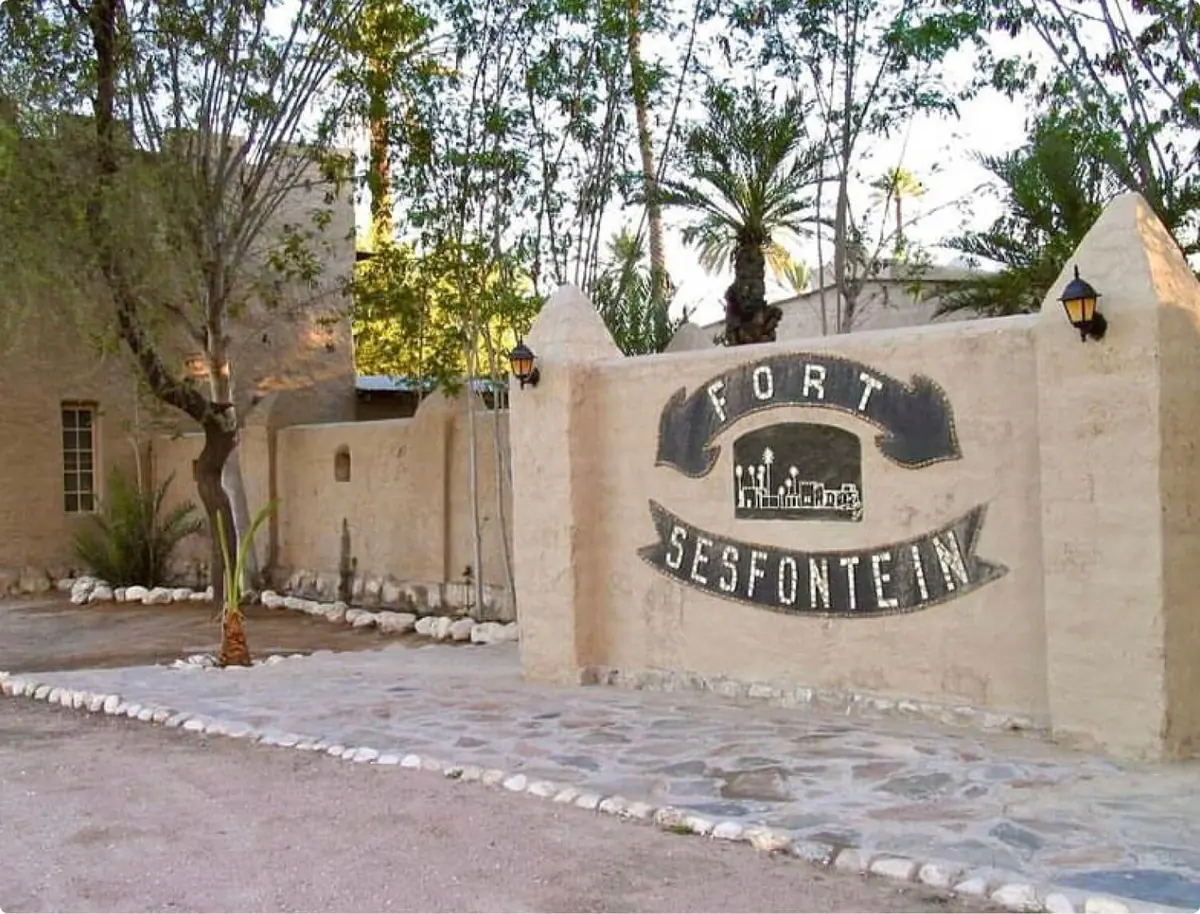
 HotelFort Sesfontein LodgeP.O. Box 1, SESFONTEIN+264 65 275 520fortsesfontein.com
- 19.12°S 13.62°ECampsiteFigtree Community Camp
- 19.12°S 13.62°ECampsiteFort Sesfontein Campsite
Sights 1
- Fort SesfonteinCastle
Bars and pubs 1
- Okiti BarBar
Sesfontein is a village of mud houses, donkey carts and gardens in Namibia’s far north-west, where the old Damaraland meets Kaokoland. The name means six fountains, after the springs that rise here, close to the Hoanib River. In 1896 German soldiers built a fort beside them. It fell to ruin after 1914 and was rebuilt in the 1990s as a lodge, which is now the main reason most travellers stop. The other reason is fuel.
Getting there
Sesfontein sits on the C43, the gravel road that leaves the C39 at Bergsig and runs north past the veterinary fence at Palmwag, through Sesfontein and on over Joubert Pass to Opuwo. Palmwag is about 120 km to the south and Opuwo roughly 130 to 150 km to the north. The C43 is gravel almost all the way (there are a few paved bits on the pass) and breaks up in the rainy season. Plans to tar it have been around since 2016. There is an airstrip for fly-in guests but no public transport. The tracks out of here, to Purros, through the Khowarib Gorge or over Robbie’s Pass, are serious 4x4 country, and only a few car hire firms allow their cars on them, so check your contract.
When to go
This is hot desert, and the dry months are the easy ones. In the rains, rivers across Kaokoland can come down in flood and the gravel turns to mud, so leave a spare day in any plan that relies on the C43. Winter nights can get chilly. The spring that feeds the pools at Ongongo is warm enough to swim in all year.
What to do
The draw is the Hoanib. Both the fort and the guesthouse run full-day drives down the dry riverbed looking for desert elephants, with giraffe, oryx and springbok along the way, and lions and black rhino roaming the same country. Nobody promises a sighting. Rhino tracking with the Sesfontein Conservancy’s rangers is offered too, in small groups. In the village itself you can look round the fort and its small cemetery, or take a donkey cart tour of the gardens and homesteads. About 25 km south, near Warmquelle, the Ongongo Waterfall drops into a clear pool fed by a warm spring. The last stretch is rocky, sedans cannot get there, and the gorge itself is 4x4 only.
Good to know
Fill up here. Sesfontein has a filling station with petrol and diesel next to the fort, and it is the last pump before the Hartmann Valley, so anyone heading for Purros and beyond should carry extra fuel as well. The village shops sell only basics, so bring most of your food from Opuwo or further south. Kunene is one of the Namibian regions where the CDC recommends malaria tablets, so see a travel clinic before you go and use a net. The constituency around Sesfontein is the emptiest in Kunene, with fewer than one person per square kilometre, so leave your route with your lodge before driving into the backcountry.
History and culture
Sesfontein grew up around six springs in dry country between Damaraland and Kaokoland. Nama groups raided Kaokoland from here in the 1800s, the Germans put a fort by the water in 1896, and South Africa later zoned the area as a Nama reserve. Today Otjiherero and Khoekhoegowab are the main home languages, and the rebuilt fort is a lodge.
- 1860s
Swartbooi and Topnaar Nama groups raided Kaokoland, first from Fransfontein and later from Sesfontein, and many Ovahimba and Ovatjimba fled north across the Kunene into Angola. source
- 1879
Boer families of the Dorsland (Thirstland) Trek settled for a while in the Kaokoveld, at Sesfontein (then written Zesfontein) among other places, before most moved on into Angola, the first arriving there in January 1881. In the decades that followed, trekker hunters shot most of the Kaokoveld's elephants. source
- 1885
Jan Uixamab of the Sesfontein Topnaar (ǃGomen) signed a private treaty with Adolf Lüderitz selling communal land. Cornelius Swartbooi had signed a similar deal over parts of the Kaokoveld, mining rights included, about two weeks earlier. source
- 1896
Schutztruppe soldiers (the German colonial army) built Fort Sesfontein as a police post by the springs after a rinderpest (cattle plague) epidemic, to control cattle movement, arms smuggling and the poaching of elephant and rhino. source
- 1914
The Germans abandoned the remote fort when the First World War began, and it soon fell into ruin. When South Africa took over the territory, it built on German laws to zone Sesfontein as a reserve for the Nama. source
- 1984 to 1989
The fort and its cemetery were given provisional national monument status in November 1984. It was never made permanent and lapsed on 31 October 1989. source
- Mid 1990s
Private investors rebuilt the fort from historical photographs and opened it as Fort Sesfontein Lodge, a small hotel with a restaurant and camping. source
- 2005
Sesfontein was proclaimed a settlement, run by the Kunene Regional Council. It is the seat of the Sesfontein Constituency office and has a clinic and a school. source
- Languages
- In the 2023 census, 1,207 of the 2,465 households in Sesfontein Constituency mainly spoke Otjiherero at home and 968 spoke Khoekhoegowab, the click language of the Nama and Damara. Together that is close to nine households in ten. source
- Village life
- Several hundred people live in the village itself, mostly from small herds of livestock and their gardens. The fort runs village tours on a donkey cart, the way locals have long got about. source
- Politics
- Sesfontein has long been a stronghold of the opposition United Democratic Front. In 2004 the constituency was one of the few in Namibia where the UDF's Justus ǁGaroëb beat SWAPO in the presidential vote, and the UDF's Hendrik Gaobaeb won the regional council seat in 2004, 2010 and 2020. source
For German visitors: Fort Sesfontein was built in 1896 by the Schutztruppe of German South West Africa, and the settlement appears as Zessfontein in the Deutsches Kolonial-Lexikon of 1920. source
For German visitors: In July 1885 Adolf Lüderitz signed a private land treaty with Jan Uixamab, leader of the Sesfontein Topnaar, one of several land deals he struck with local leaders that year. source
Main sights in Sesfontein
4- Fort Sesfontein
The fort the Schutztruppe built in 1896, rebuilt in the 1990s and now a lodge. Its small cemetery holds three graves: a soldier who died while it was being built, one who died of illness, and a trader.
Wikipedia: Sesfontein - Hoanib River valley
One of the twelve dry rivers of western Namibia, it flows only every few years after heavy rain. The ana and camel thorn trees along its bed give food and shade to wildlife in otherwise bare country, and it is one of the last places desert elephants live.
Wikipedia: Hoanib - Ongongo Waterfall and Warmquelle
Near the settlement of Warmquelle (German for warm spring) rises a spring also known as Ongongo. Its water was once led to the fields by an aqueduct, and a government irrigation scheme started using it again in 2019.
Wikipedia (German): Warmquelle - Rock engravings near Sesfontein
The fort runs full-day tours to a canyon spring where sandstone slabs are covered in Stone Age engravings of animals, thought to be more than 2,000 years old and still little studied by archaeologists. The fort's guided tour is the way to see them.
Fort Sesfontein Lodge (rock engravings tour)
Did you know?
- Sesfontein means six fountains, after the springs that rise near the village. Older German sources, among them the Deutsches Kolonial-Lexikon of 1920, spell it Zessfontein. source
- Sesfontein Constituency had 8,845 people on about 22,800 km² in the 2023 census, 0.4 people per square kilometre, the lowest density of any constituency in Kunene. source
- The constituency stretches far beyond the village, taking in Warmquelle, Palmwag and Purros and reaching the Atlantic at Möwe Bay and Terrace Bay. source
- The palm trees at the fort were planted by the German police officers who served there. source
- About a third of the female desert elephants in the Hoanib area have no tusks, while the bulls there do. source
Checked 7 October 2026.
Wildlife you might see
9- likelyGiraffeAna and acacia trees along the Hoanibsource
- likelyOryx (gemsbok)Open plains and the Hoanib valleysource
- likelySpringbokOpen plains around the Hoanibsource
- likelyOstrichPlains along the Hoanibsource
- possibleDesert elephantHoanib riverbed, on a guided drive. All year; in dry spells they dig for water in the riverbedsource
- possibleZebraHoanib valleysource
- rareBlack rhinoConservancy land, only with the Sesfontein Conservancy's rhino rangerssource
- rareLionHoanib valleysource
- rareLeopardHoanib valleysource
Likelihood is for a normal visit of two or three days, from the sources linked. Nothing is guaranteed in the wild.
Hikes and walks
1- Ongongo creek walk
A walk up the canyon above Ongongo Waterfall, keeping to the stream until you reach the warm spring it rises from, shaded by a large tree. You can do it on your own or with one of the camp's guides; bring your own water and snacks. The road in is rocky and the gorge is 4x4 only.
Permit: Day visitors pay an entry charge at the campsite
Ongongo Waterfall Campsite
Staying safe in Sesfontein
- Malaria
- Kunene is one of the Namibian regions where the CDC recommends preventive malaria tablets for travellers. See a travel clinic before you leave home, sleep under a net and cover up from dusk. source
- Cholera and drinking water
- The CDC lists Kunene as one of two Namibian regions with active cholera transmission. It is rare in travellers, but drink bottled or treated water and wash your hands before eating. source
- The C43 in the rains
- The C43 through Sesfontein is gravel and breaks up in the rainy season. Rivers across Kaokoland can flood; if one is running, wait for it to drop rather than drive in, and carry a tow rope, a shovel, water and food. source
- Khowarib Gorge and Robbie's Pass
- Both tracks out of Sesfontein look like shortcuts on the map and are not. The Khowarib Gorge track needs a 4x4 with about 35 cm of ground clearance and diff locks, and anything taller than an ordinary SUV will not fit under the trees. Robbie's Pass to Kaoko Otavi takes about seven hours for 110 km, and a week can go by without another car. Take the main road unless you are equipped and experienced. source
- Wild animals in the Hoanib
- Desert elephants, lions and black rhino live in the Hoanib and the country around it. Explore it with a local guide and keep well back from elephants. source
Tips from travellers
- Fill up in Sesfontein. It is the last pump before Purros and the Hartmann Valley, where deep sand can double your fuel use, so carry plenty of extra too. several sources
- Stock up in Opuwo or further south. Village shops in Sesfontein, Warmquelle and Purros sell only basics like rice, pasta and tinned food, and nothing that needs a fridge. several sources
- Check your car hire contract before leaving the C43. Only a few firms allow their cars on Kaokoland's untarred tracks, and you may lose your insurance cover if you break the terms. several sources
- Do not take a sedan to Ongongo Waterfall. The road in is rocky and slow, a bakkie or SUV can manage with care, and the gorge itself is 4x4 only, so leave the car at the top if in doubt. one source
- Rhino tracking is run with the Sesfontein Conservancy's rangers for groups of up to six, aged 14 and over, and comes as a three-night stay at the fort, because the rangers spend a day choosing the area before the tracking day. Book ahead. one source
Checked 7 October 2026. Conditions change, so confirm with the park or venue before you go.
Quick answers
What animals can you see in Sesfontein?
You have a good chance of seeing giraffe, oryx (gemsbok), springbok and ostrich. Black rhino, lion and leopard are there but rarely seen.
Map of Sesfontein
See every place on this map as a list