Park · KwaZulu-Natal, South Africa
Ithala Game Reserve
A mountainous Ezemvelo reserve in northern KwaZulu-Natal with four of the Big Five, no lions, very old rocks and a hillside rest camp that is easy to self-drive.
Short answer
At Ithala Game Reserve, international visitors pay R180 (about US$10.50, €9.50 or £8) per adult and R90 per child per entry. The rates apply from 1 November 2026 to 31 October 2027.
- Entry fee, international adult
- US$10 €9 · R180
- Malaria
- Ithala is outside the malaria area on the Department of Health's national risk map, so no antimalarials are needed for a visit here.
- Places to stay
- 4
- Park fee nearby: Hluhluwe-iMfolozi Park
- US$21 €19 · R360about 101 km away
Ithala Game Reserve fees 2026/27
Checked Ezemvelo KZN Wildlife tariffValid 1 November 2026 to 31 October 2027, per person per entry, in rand.
| Who | Adult | Child |
|---|---|---|
| International visitorsUS, Europe and everyone else | US$10 €9 · R180 | US$5 €5 · R90 |
| SADC nationals | R90 | R45 |
| South African residents | R90 | R45 |
- Day visitors pay this fee once per entry. Overnight guests are not required to pay it.
- South African citizens/residents and SADC nationals must show a valid ID or passport at the gate, otherwise the standard (international) fee applies.
- Ezemvelo states its rates include the Community Levy.
- Whether the SANParks Wild Card covers Ezemvelo parks is not clear from the current official cluster sheet. Budget for the gate fee and ask Ezemvelo before you go.
- Fees are set by Ezemvelo KZN Wildlife. Seen a new rate? Tell us
US$1 = R17.47 · €1 = R19.20 · £1 = R22.93 (ECB rate, 20 Nov 2026). Converted amounts are approximate; you pay in rand.
How we got these figures
- Taken from Ezemvelo's 2026/27 Fees & Charges booklet as hosted by drakensberghikes.com on 20 November 2026. Ezemvelo's own rebuilt website had not posted a 2026/27 tariff on that date, so the booklet is our only source for these figures.
- Ezemvelo KZN Wildlife Fees & Charges 1 Nov 2026 - 31 Oct 2027 (copy hosted by drakensberghikes.com) · one source · checked 20 Nov 2026
- Ezemvelo KZN Wildlife (the rebuilt site lists tariffs only up to 2025/26) · official · checked 20 Nov 2026
Ithala is the reserve KwaZulu-Natal regulars mention when they want to be left alone with the scenery. It covers about 296 square kilometres of broken, cliffy country on the south bank of the Pongola River, 400 km north of Durban and 70 km east of Vryheid. It was proclaimed in 1973 and is run by Ezemvelo KZN Wildlife. The ground drops from 1,450 m on the Ngotshe escarpment to 400 m at the river, over rock about three billion years old. Rhino, elephant, buffalo and leopard are here. Lions are not.
Getting there
From Johannesburg, drive to Vryheid and take the R69 towards Louwsburg; the reserve lies a few kilometres beyond the village. From Durban, follow the N2 north, turn onto the R66 at Pongola, then take the R69 towards Louwsburg. The road from the Mvunyane entrance gate to Ntshondwe Camp is the only tarred road in the reserve. The gravel roads are reasonably well kept and an ordinary car manages them when they are dry, though some close in the rainy season. Ezemvelo’s tariff gives gate times of 05:00 to 19:00 from November to February and 06:00 to 18:00 from March to October. They are strictly enforced.
When to go
Game viewing holds up all year, but May to September is the easy season: thin grass, animals near water, clear afternoons. Temperatures drop sharply from May to August, so bring warm clothes for early mornings and evenings. Summer, October to April, is green and humid with short, violent thunderstorms late in the day. One welcome oddity for a Zululand reserve: the Health Department’s current malaria risk map puts Ithala outside every risk zone, so you do not need tablets for Ithala itself. If you are carrying on to the lower parks further east, ask a travel clinic about those.
What to do
Self-drive is the point. The Ngubhu Loop is a 30 km circuit with about 20 marked points of interest and a picnic site with braais and toilets; the shop at Ntshondwe sells a route map. Both rhino species were brought back and giraffe are everywhere. Look for tsessebe, as Ithala is the only place in KwaZulu-Natal with herds of them, plus red hartebeest, eland, kudu and zebra. Elephant and leopard are present but rarely seen. Over 300 bird species are recorded, with blue korhaan and secretarybird in the upland grasslands and fish eagles and kingfishers along the Pongola. Ezemvelo runs guided drives and walks, and there are four short self-guided nature trails from camp. There is San rock art in the east and old iron workings for anyone with a historical bent.
Good to know
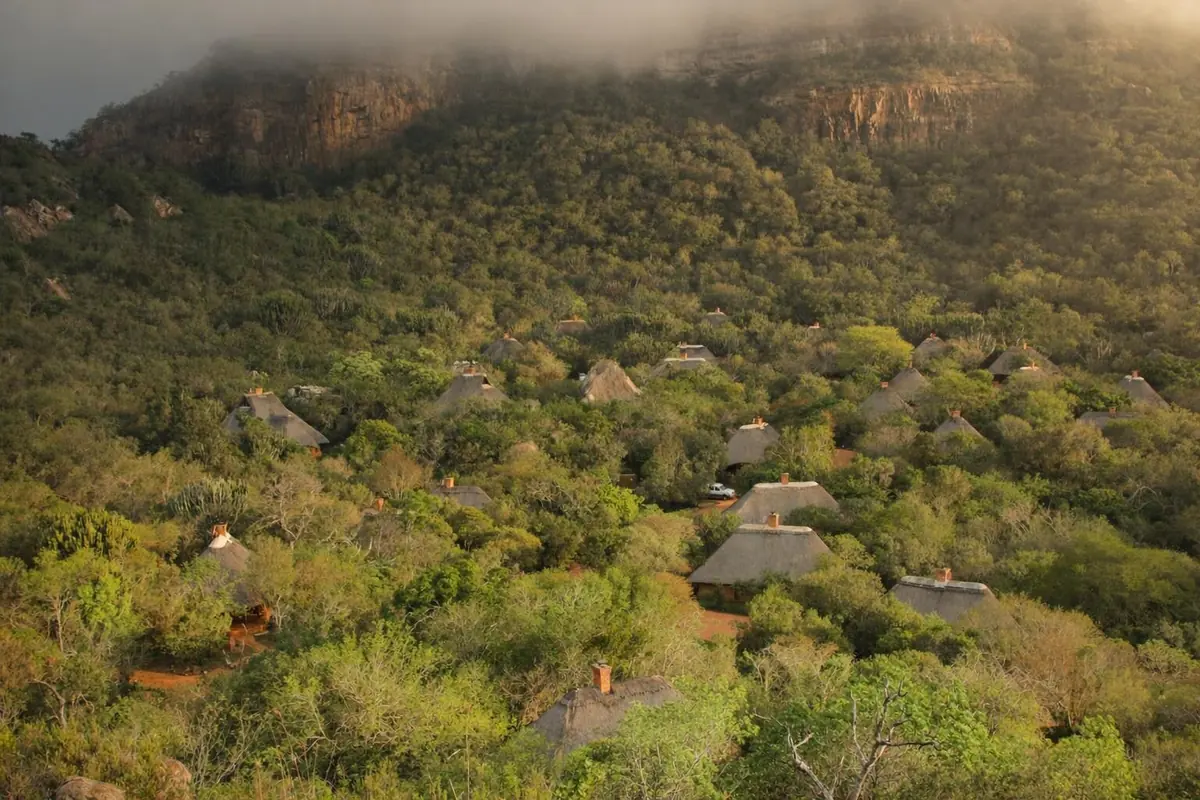
Ntshondwe Camp sits on a steep hillside of aloes and rock stacks below the cliffs, with thatched chalets, a pool, a restaurant and coffee shop with a viewing deck, and an information centre. Three small bush camps (Mhlangeni, Mbizo and Thalu) and the unfenced Doornkraal riverside campsite offer more solitude; book these well ahead and allow daylight to reach them. Elephant bulls sometimes wander near camp, so keep a good distance and never approach one on foot.
Wildlife you might see
13- very likelyGiraffeThroughout the reserve. It is Ithala's emblem and the most obvious big animal on a drive. All yearsource
- likelyZebra, kudu, impala, blue wildebeest and warthogAll yearsource
- likelyTsessebe and red hartebeestTsessebe are the reserve's speciality. Ithala is the only place in KwaZulu-Natal with herds of themsource
- possibleWhite rhinosource
- possibleElandsource
- possibleElephantAnywhere, and bulls sometimes hang around Ntshondwe Camp. Ithala's elephants have a name for being short-tempered, so give them roomsource
- possibleBuffalosource
- possibleVerreaux's eagleA resident pair lives around Ntshondwe Camp, so watch overhead on the camp walkssource
- possibleGrassland birds (blue korhaan, secretarybird, southern bald ibis)Upland grassland on the Onverwagt Loop near the main gate. Blue korhaan call most in the early morningsource
- possibleRiver birds (African fish eagle, Goliath heron, giant and pied kingfishers, African finfoot)Along the Phongola River, around the Phongola picnic site loop. The finfoot keeps to dense overhanging growth and is much harder to findsource
- rareBlack rhinoThick forest along the Dakaneni Loop, where visibility is poorsource
- rareLeopardPresent, but seldom seen. There are no lions in the reservesource
- rareBlue craneUp to three pairs breed in the reserve each yearsource
Likelihood is for a normal visit of two or three days, from the sources linked. Nothing is guaranteed in the wild.
Hikes and walks
5- Plum-coloured Starling Trail
Winds among the big boulders between the camp pool and the cliffs above Ntshondwe.
Permit: Self-guided from Ntshondwe Camp
Roxanne Reid, Africa Addict - Porcupine Trail
Another short self-guided walk from camp, good for dassies and small birds.
Permit: Self-guided from Ntshondwe Camp
Roxanne Reid, Africa Addict - Klipspringer Trail
Goes up onto the mountain behind camp, with wide views over the reserve.
Permit: Self-guided from Ntshondwe Camp
Roxanne Reid, Africa Addict (views noted by Wikipedia) - Bushpig Trail
The longest of the camp walks, up onto the mountain behind Ntshondwe. Elephants do get up onto the mountain, so stay alert.
Permit: Self-guided from Ntshondwe Camp
Roxanne Reid, Africa Addict (elephant warning from Tracks4Africa blog) - Guided bush walk
You can run into elephant, rhino or buffalo on foot, so keep quiet and do what the ranger tells you.
Permit: Guided only, with an armed field ranger from Ntshondwe
Wikipedia (agrees with Roxanne Reid, Africa Addict)
Staying safe in Ithala Game Reserve
- Malaria
- Ithala is outside the malaria area on the Department of Health's national risk map, so no antimalarials are needed for a visit here. Ndumo and Tembe, further east, sit in the low-risk zone, where the advice is to avoid mosquito bites. source
- Elephants
- Stay in the car on drives and keep at least 30 m from elephants. Never block an elephant's way out, and read the elephant notes you are given at the gate, which explain the signs of a stressed animal. Bulls sometimes wander near the restaurant at Ntshondwe. source
- Walking in camp
- Wild animals do come into the camps, so do not walk the trails at night and stay alert in camp at any hour. source
- Vervet monkeys
- Ithala has a lot of vervet monkeys. Close chalet windows and doors when you go out, and do not leave food lying around or feed them. Clear all food away at picnic sites too, where baboons are also about. source
- Roads
- Only the road from the gate to Ntshondwe is tar. The gravel loops are reasonably well kept and most are fine in a sedan when dry, but some sections get bumpy and muddy and some roads close in the rainy season, so ask about conditions first. A high-clearance car makes life easier, and the 4x4 tracks can need low range. source
Tips from travellers
- Do the Ngubhu Loop. It takes two to three hours and has about 20 stops marked with letters of the alphabet, plus a picnic site. one source
- Two days of morning and afternoon drives is enough to cover every road in the reserve. one source
- Pack warm clothes from May to August. Temperatures drop sharply at night, though frost only comes on a few days a year. one source
- Birders should split their time between three areas: the Onverwagt Loop grassland near the gate at first light, the Bergvliet Loop on the ridge, and the Phongola picnic site loop in the riverine bush, which is usually the most productive. one source
- The Bivane 4x4 trail has to be booked at the main camp before you go. It has river crossings, rock sections and hairpins, so it is not one for a soft-roader. one source
Checked 7 October 2026. Conditions change, so confirm with the park or venue before you go.
In and around Ithala Game Reserve
9 places listedWhere to stay in Ithala Game Reserve 4
- 27.51°S 31.20°ECampsiteDoornkraal Campsite
- 27.52°S 31.20°EHotelMbizo Bush Camp
- 27.52°S 31.37°EChaletMhlangeni Bush Lodge Chalets
- 27.50°S 31.21°EHotelThalu Bush Camp
Sights 4
- Horace Rall LookoutViewpoint
- Ngulumbeni Loop ViewpointViewpoint
- Plum-Coloured Starling TrailViewpoint
- Vamela ViewpointViewpoint
Restaurants and cafes 1
- The KraalRestaurant
Quick answers
How much is the entry fee for Ithala Game Reserve?
International visitors pay R180 (about US$10.50, €9.50 or £8) per adult and R90 per child per entry. These rates apply from 1 November 2026 to 31 October 2027 and are set by Ezemvelo KZN Wildlife.
Do South Africans and SADC citizens pay less at Ithala Game Reserve?
South African residents pay R90 per adult and SADC nationals pay R90 per adult per entry. You need ID or a passport to get the lower rate.
When were these Ithala Game Reserve fees last checked?
We last checked them on 20 November 2026 against 2 published sources. We re-check every two weeks, but always confirm with Ezemvelo KZN Wildlife before you travel.
What animals can you see in Ithala Game Reserve?
Most visitors see giraffe. You have a good chance of seeing zebra, kudu, impala, blue wildebeest, warthog and tsessebe. Black rhino, leopard and blue crane are there but rarely seen.
What are the best hikes in Ithala Game Reserve?
Plum-coloured Starling Trail, Porcupine Trail, Klipspringer Trail and Bushpig Trail. See the hikes section for times, difficulty and permits.
Ithala and the parks nearest it
| Park | International adult | Distance | Where |
|---|---|---|---|
| Ithala Game Reserve | US$10 €9 · R180 | · | KwaZulu-Natal |
| Hluhluwe-iMfolozi Park | US$21 €19 · R360 | 101 km | KwaZulu-Natal |
| Ndumu Game Reserve | US$9 €8 · R160 | 119 km | KwaZulu-Natal |
| Tembe Elephant Park | US$9 €8 · R160 | 132 km | KwaZulu-Natal |
Where the Ithala fees come from
- Ezemvelo KZN Wildlife Fees & Charges 1 Nov 2026 - 31 Oct 2027 (copy hosted by drakensberghikes.com)
- Ezemvelo KZN Wildlife (the rebuilt site lists tariffs only up to 2025/26)
Open data: all park fees (CSV) · JSON (CC BY 4.0)
Cite as: Travel Africa Guide, "Ithala Game Reserve fees 2026/27", checked 20 November 2026, https://travelafrica.guide/south-africa/ithala-game-reserve/
Map of Ithala Game Reserve
See every place on this map as a list