Tembe Elephant Park
A community-owned Big Five park of sand forest on the Mozambique border, famous for huge-tusked elephant bulls. Strictly 4x4 only, and a malaria area.

What you'll pay to enter Tembe Elephant Park
VALID 01 NOV 2025 TO 31 OCT 2026 · ZAR PER PERSON PER ENTRY
| Fee | International | SADC nationals | SA residents |
|---|---|---|---|
| Daily conservation fee | R160child R80one source | R80child R40one source | R80child R40one source |
- A vehicle entry fee of R120 is charged on top of the per-person fee (vehicles with 1 to 10 passengers). The lodge lists R230 for 11 to 20 passengers and R340 for more than 20.
- The lodge inside the park (tembe.co.za) gives R80 per person for SA residents and R150 for international visitors, with no date. Its R150 matches neither Ezemvelo's 2023/24 (R140) nor 2025/26 (R160) figure, so it is not counted as confirming this period. It says children aged 3 to 11 pay half the adult rate and those 12 and over pay the adult rate.
- Ezemvelo charges day visitors once per entry and does not require overnight guests to pay it.
- South African citizens/residents and SADC nationals must show a valid ID or passport at the gate, otherwise the standard (international) fee applies.
- Ezemvelo states its rates include the Community Levy.
- Ezemvelo accepts the Wild Card in most of its parks; bring the receipt or authorisation letter.
- Figures marked "one source" were found in a single published source only.
- Set by Ezemvelo KZN Wildlife. Adult rate shown first, child rate below.
CHECKED 06 OCT 2026 · 2 SOURCES
See every place on this map as a list
Tembe protects about 300 square kilometres of Maputaland sand forest, palm veld and the Muzi swamp, hard against the Mozambique border in the far north of KwaZulu-Natal. Chief Mzimba Tembe set the land aside in 1983 to keep the elephants that moved between here and southern Mozambique, and the park opened to the public in 1991 once the Mozambican war ended. Ezemvelo KZN Wildlife runs it with the Tembe community, which owns the lodge. People come for one thing: elephant bulls with ivory you do not see elsewhere.
Getting there
Tembe is just under 400 km from Durban, around five hours of driving, and 240 km from Richards Bay. Take the N2 north, turn onto the R22 at Hluhluwe and follow it to the district road for the gate near KwaNgwanase; Jozini is 72 km away. The roads outside the park are unfenced and full of cattle and goats, so slow down. Inside, there is no tar at all, only deep sand tracks, and only proper 4x4 vehicles with low range are let in. No sedans, no soft-roaders. Lodge guests without a 4x4 leave their cars in secure parking at the gate and get collected. Day visitors are capped at a small number of vehicles, so arrive early. Gates run about 05:00 to 18:00 in summer and 06:00 to 17:00 in winter.
When to go
May to September is best for elephants and general game: the sand forest thins out and the animals gather at the pans. It is still hot by day but the nights are comfortable and the humidity drops. October to April is sticky, with afternoon storms, but that is when the 340-plus bird list fills with migrants and the sand forest specials (Rudd’s apalis, Woodward’s batis, African broadbill) are easier. Tembe is a medium to high risk malaria area all year, worst November to April. Take prophylaxis and cover up at dusk.
What to do
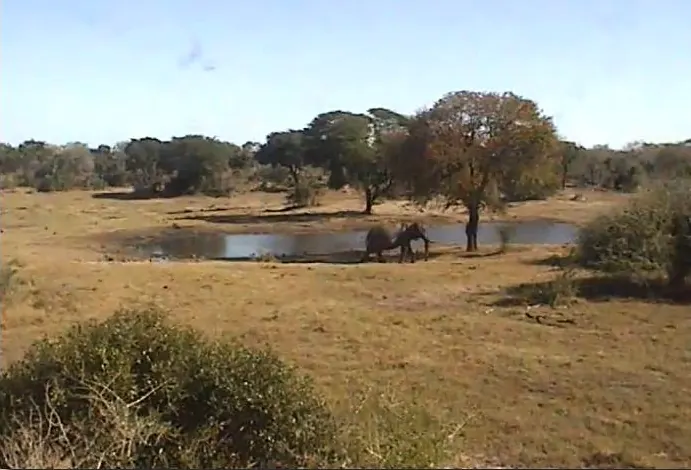
Mahlasela hide in the south-east overlooks a busy waterhole and is where the big bulls drink in the heat of the day; it is also where the park’s webcam points. Give it two or three hours. Ponweni hide sits further north-east on the edge of the Muzi swamp. Self-drivers get a map at the gate and can roam the whole network, but the sand is soft and the tracks are narrow, so passing oncoming vehicles takes patience. Lion, buffalo, leopard and both rhino species are present, as are wild dog, giraffe, nyala and the tiny suni. The lodge offers guided drives, walking trails and a night in a hide.
Good to know
The park holds more than 200 elephants from one of only three naturally occurring populations left in South Africa. Isilo, the giant bull who put Tembe on the map, died in 2014, but others carry heavy ivory. It is very hot in summer: carry water in the vehicle. Accommodation is limited to the community lodge inside (safari tents, pool, spa, restaurant) and Royal Thonga on the boundary, so book ahead, and arrive with a full tank.
In and around Tembe Elephant Park
5 PLACESPlaces to stay 1
- 27.04°S 32.43°E
Sights 4
- Ezinaleni PansViewpoint
- Mfungeni PanViewpoint
- Vukazin PanViewpoint
- Zimambeni PanViewpoint