Park · KwaZulu-Natal, South Africa
Ndumu Game Reserve
A small Ramsar wetland reserve where the Pongola meets the Usutu on the Mozambique border, with the longest bird list of any protected area in South Africa.
Short answer
At Ndumu Game Reserve, international visitors pay R160 (about US$9, €8.50 or £7) per adult and R80 per child per entry. The rates apply from 1 November 2026 to 31 October 2027.
- Entry fee, international adult
- US$9 €8 · R160
- Malaria
- The national malaria risk map (Department of Health, 2024 edition, posted by the NICD in December 2025) puts Ndumo in the low risk zone, where tablets are not advised and the advice is to avoid bites.
- Places to stay
- 1
- Park fee nearby: Tembe Elephant Park
- US$9 €8 · R160about 23 km away
Ndumu Game Reserve fees 2026/27
Checked Ezemvelo KZN Wildlife tariffValid 1 November 2026 to 31 October 2027, per person per entry, in rand.
| Who | Adult | Child |
|---|---|---|
| International visitorsUS, Europe and everyone else | US$9 €8 · R160 | US$5 €4 · R80 |
| SADC nationals | R80 | R40 |
| South African residents | R80 | R40 |
- Day visitors pay this fee once per entry. Overnight guests are not required to pay it.
- South African citizens/residents and SADC nationals must show a valid ID or passport at the gate, otherwise the standard (international) fee applies.
- Ezemvelo states its rates include the Community Levy.
- Whether the SANParks Wild Card covers Ezemvelo parks is not clear from the current official cluster sheet. Budget for the gate fee and ask Ezemvelo before you go.
- Fees are set by Ezemvelo KZN Wildlife. Seen a new rate? Tell us
US$1 = R17.47 · €1 = R19.20 · £1 = R22.93 (ECB rate, 20 Nov 2026). Converted amounts are approximate; you pay in rand.
How we got these figures
- Taken from Ezemvelo's 2026/27 Fees & Charges booklet as hosted by drakensberghikes.com on 20 November 2026. Ezemvelo's own rebuilt website had not posted a 2026/27 tariff on that date, so the booklet is our only source for these figures.
- Ezemvelo KZN Wildlife Fees & Charges 1 Nov 2026 - 31 Oct 2027 (copy hosted by drakensberghikes.com) · one source · checked 20 Nov 2026
- Ezemvelo KZN Wildlife (the rebuilt site lists tariffs only up to 2025/26) · official · checked 20 Nov 2026
Ndumo (often spelt Ndumu) is a birders’ reserve first and a game reserve second. It covers about 10,000 hectares (sources range from 9,000 to 11,000) of floodplain, fig forest and sand forest where the Pongola River joins the Usutu, right on the Mozambique line in the Maputaland corner of KwaZulu-Natal. Proclaimed in 1924, it is one of the country’s oldest reserves and a Ramsar wetland since 1997. More than 430 bird species are recorded, the most for any protected area in South Africa. There are no lions or elephants, but buffalo and hippo are here, so walking is only with an Ezemvelo guide.
Getting there
Ndumo is a long way from anywhere: over 400 km from Durban and just over 100 km from Mkuze. From the N2 north of Mkuze, turn towards Jozini after about 10 km, drive through Jozini and follow the signs to Ndumo. Sources put the Jozini to camp distance at 70 to 80 km, and everyone agrees the last 14 km are rough. Reception keeps office hours of 08:00 to 12:00 and 13:00 to 16:00, and overnight guests are asked to check in by 15:30. Fill up before you come. Some guides mention a store with fuel about 2 km from the entrance, but a 2022 visitor’s guide says there is no fuel stop for guests and points to Ndumu town, about 15 km from the camp, which has a Spar and a fuel station.
When to go
Come in the hot months, October to March, if birds are the reason. That is when the pans are full and the summer migrants, crakes, pygmy geese and painted-snipe are in. One birder who arrived in early April found most of the summer migrants had already gone. The dry winter months, May to September, are more comfortable and better for seeing nyala, giraffe and the general game around what water is left. The Department of Health’s malaria risk map puts Ndumo in its low risk zone, where it advises bite prevention (repellent, long sleeves and trousers at dusk) rather than tablets. Mozambique over the border carries more risk, and summer rain raises it here too, so ask a travel clinic if you are travelling on. Bilharzia is present in the water, so do not swim.
What to do
Nyamithi Pan is the centrepiece, a wide pan with two hides where you may see pelicans, both flamingos, saddle-billed and yellow-billed storks, open-bills and herons, with crocodiles and hippo in attendance. Shokwe Pan and the fig forests along the Pongola are where guides find Pel’s fishing owl, Narina trogon and African broadbill, and the way to see them is on an Ezemvelo guided walk along the river banks, booked at reception. Self-drive is allowed on the designated roads at 40 km/h; the Red Cliffs viewpoint looks over the Usutu into Mozambique. Mammals include nyala, hippo, giraffe, buffalo, red duiker, impala and suni. The rhinos are gone: poaching cut them to six animals, which were moved out in 2017.
Good to know
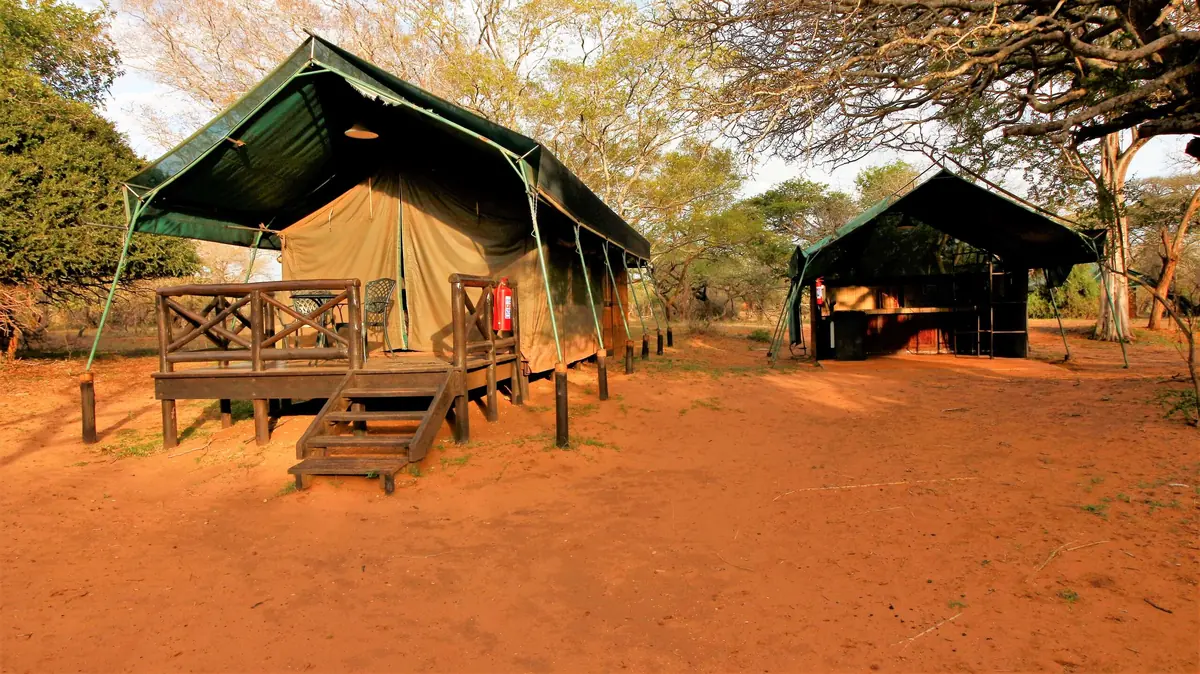
Accommodation is modest: a hutted camp of two-bed and four-bed units and a shaded 14-stand campsite with power points and braai stands. The curio shop sells cold drinks and beer. No pets, and firearms must be declared at the gate. Do not rely on finding fuel near the gate. Arrive with a full tank.
The reserve is under real pressure. Farming and grazing have spread over more than 600 hectares in the east since about 2010, and a 2025 Daily Maverick report put hippo numbers at around 80 (from about 300 in the 1990s) and crocodiles at about 300 (from roughly 1,000). Expect fewer hippos and crocs on Nyamithi Pan than older trip reports describe. Tembe Elephant Park is about 40 km away and the two pair well. You need a proper 4x4 to drive yourself at Tembe, but without one you can book its guided drive in an open vehicle.
Wildlife you might see
11- very likelyWaterbirds on Nyamithi Pan (pelicans, saddle-billed and yellow-billed storks, flamingos, spoonbills, herons)Nyamithi Pan, from the hides on the south side or on a guided drive along the north shore (that road is closed to private cars). Yellow-billed storks, pink-backed pelicans, herons and egrets nest in the fever trees. All year, but the water drops in the dry winter monthssource
- very likelyAfrican fish eagleAround the pans and rivers, and you will hear them calling on most drivessource
- very likelyNyalaThroughout, including around the rest campsource
- likelyHippo and Nile crocodileNyamithi Pan and the rivers. All year. Numbers have dropped sharply: about 80 hippos (from around 300 in the 1990s) and about 300 crocodiles (from roughly 1,000)source
- likelyGiraffe, impala and bushbucksource
- possibleBuffaloThe bush is thick over most of the reserve, which hides the bigger animalssource
- possibleRed duiker and suniSand forest and thickets. Suni is a tiny, shy antelope and easy to misssource
- possibleSand forest birds (pink-throated twinspot, gorgeous bush-shrike, African broadbill, Rudd's apalis, Neergaard's sunbird)Sand forest. They are hard to see in the thick growth, so knowing the calls or going with a guide makes a big differencesource
- possibleAfrican pygmy goose and crakesNyamithi Pan and the other pans. Summersource
- possibleRaptors (bateleur, martial eagle, southern banded snake-eagle, palm-nut vulture)At least 40 raptor species are recorded. Palm-nut vultures are seen at the vulture restaurantsource
- rarePel's fishing owl and Narina trogonRiverine forest along the Pongola River banks and at Shokwe Pan, found on a guided walk. Ask at reception whether the guides know where a Pel's is roostingsource
Likelihood is for a normal visit of two or three days, from the sources linked. Nothing is guaranteed in the wild.
Hikes and walks
2- Guided walks (Sand Forest, Pongola River and Shokwe Pan)
There are buffalo and hippo here, so you may not walk the reserve on your own. Ezemvelo's guides lead morning and afternoon walks into the sand forest and along the river, and they know their birds and trees very well. No distances are published.
Permit: Guided only, book at reception the day before
Roxanne Reid, Africa Addict (agrees with Christian Sperka, sperka.info) - Pongola River and Shokwe Pan forest walk
The walk to take if you want Pel's fishing owl, Narina trogon or African broadbill. It goes through the riverine forest along the Pongola banks and to Shokwe Pan, and it is best done in the morning.
Permit: Guided only, arrange at reception
BirdLife South Africa, Go Birding (morning timing: Christian Sperka, sperka.info)
Staying safe in Ndumu Game Reserve
- Malaria
- The national malaria risk map (Department of Health, 2024 edition, posted by the NICD in December 2025) puts Ndumo in the low risk zone, where tablets are not advised and the advice is to avoid bites. Use repellent all year and cover ankles and arms at dawn and dusk. Mozambique, across the river, is also a malaria country, so speak to a travel clinic if you are going on over the border. source
- Bilharzia and crocodiles
- Bilharzia is present in the reserve's water, and the pans and rivers hold crocodiles and hippos. Do not swim or wade in the pans or rivers. Use the camp pool instead. source
- Walking
- Buffalo and hippo roam freely, so you may only leave your car in the camp, at the hides and picnic sites, or if you break down. Do any proper walking with a guide. source
- Roads
- The last 14 km to the gate are rough. Inside, the gravel roads suit an ordinary car at the 40 km/h limit, but some close when wet and the Red Cliffs 4x4 track is not for a sedan. A high-clearance car is more comfortable. source
Tips from travellers
- Gates open 05:00 to 19:00 from October to March and 06:00 to 18:00 from April to September. Reception keeps office hours (08:00 to 12:00 and 13:00 to 16:00), so book walks and drives inside those times. several sources
- Book the guided drive along the north shore of Nyamithi Pan for an early morning, since that road is closed to private cars. The Ezulweni hide on the south side is a 450 m walk from its car park, but in a normal winter the water in front of it dries up and the birds are too far off for photos. several sources
- Take breakfast or lunch to the Red Cliffs picnic site. It has tables, braai places and toilets, and looks over the Usutu River into Mozambique. several sources
- For birds, come between September and March. By mid April most of the summer migrants have left. several sources
- Come for the birds, not for big game. The bush is very thick, mammal sightings tend to be brief, and there are no lions or elephants. If you want the Big Five, add Tembe Elephant Park, about 40 km away. several sources
- Stock up before you arrive. The shop in the reserve sells little more than cold drinks, and there is no fuel for guests. Ndumu town, about 9 km from the gate, has a Spar and a fuel station, and a trading store about 2 km from the entrance sells basic food. several sources
Checked 7 October 2026. Conditions change, so confirm with the park or venue before you go.
In and around Ndumu Game Reserve
4 places listedWhere to stay in Ndumu Game Reserve 1
- 26.91°S 32.31°ECampsiteNdumo Rest Camp campsite
Sights 3
- Mapondo ViewpointViewpoint
- Ndumo Viewing TowerViewpoint
- Ndumo Vulture RestaurantAttraction
Quick answers
How much is the entry fee for Ndumu Game Reserve?
International visitors pay R160 (about US$9, €8.50 or £7) per adult and R80 per child per entry. These rates apply from 1 November 2026 to 31 October 2027 and are set by Ezemvelo KZN Wildlife.
Do South Africans and SADC citizens pay less at Ndumu Game Reserve?
South African residents pay R80 per adult and SADC nationals pay R80 per adult per entry. You need ID or a passport to get the lower rate.
When were these Ndumu Game Reserve fees last checked?
We last checked them on 20 November 2026 against 2 published sources. We re-check every two weeks, but always confirm with Ezemvelo KZN Wildlife before you travel.
What animals can you see in Ndumu Game Reserve?
Most visitors see waterbirds on nyamithi pan (pelicans, saddle-billed and yellow-billed storks, flamingos, spoonbills, herons), african fish eagle and nyala. You have a good chance of seeing hippo, nile crocodile, giraffe, impala and bushbuck. Pel's fishing owl and narina trogon are there but rarely seen.
What are the best hikes in Ndumu Game Reserve?
Guided walks (Sand Forest, Pongola River and Shokwe Pan) and Pongola River and Shokwe Pan forest walk. See the hikes section for times, difficulty and permits.
Ndumu and the parks nearest it
| Park | International adult | Distance | Where |
|---|---|---|---|
| Ndumu Game Reserve | US$9 €8 · R160 | · | KwaZulu-Natal |
| Tembe Elephant Park | US$9 €8 · R160 | 23 km | KwaZulu-Natal |
| Ithala Game Reserve | US$10 €9 · R180 | 119 km | KwaZulu-Natal |
| Hluhluwe-iMfolozi Park | US$21 €19 · R360 | 152 km | KwaZulu-Natal |
Guides for Ndumu Game Reserve
Where the Ndumu fees come from
- Ezemvelo KZN Wildlife Fees & Charges 1 Nov 2026 - 31 Oct 2027 (copy hosted by drakensberghikes.com)
- Ezemvelo KZN Wildlife (the rebuilt site lists tariffs only up to 2025/26)
Open data: all park fees (CSV) · JSON (CC BY 4.0)
Cite as: Travel Africa Guide, "Ndumu Game Reserve fees 2026/27", checked 20 November 2026, https://travelafrica.guide/south-africa/ndumu-game-reserve/
Map of Ndumu Game Reserve
See every place on this map as a list