Mapungubwe National Park
World Heritage site where the Limpopo meets the Shashe and three countries touch: a lost gold-trading kingdom on a sandstone hill, baobabs, elephants and a malaria warning.

What you'll pay to enter Mapungubwe National Park
VALID 01 NOV 2025 TO 31 OCT 2026 · ZAR PER PERSON PER DAY
| Fee | International | SADC nationals | SA residents |
|---|---|---|---|
| Daily conservation fee | R325child R163 | R149child R74 | R73child R37 |
- Child rate applies to ages 2 to 11; children under 2 enter free.
- Places.co.za labels R76 (resident), R158 (SADC) and R358 (international) adult rates as 2025/26, but these match the SANParks 2026/27 tariff that starts on 1 November 2026.
- Set by South African National Parks (SANParks). Adult rate shown first, child rate below. Official tariff
CHECKED 06 OCT 2026 · 6 SOURCES
See every place on this map as a list
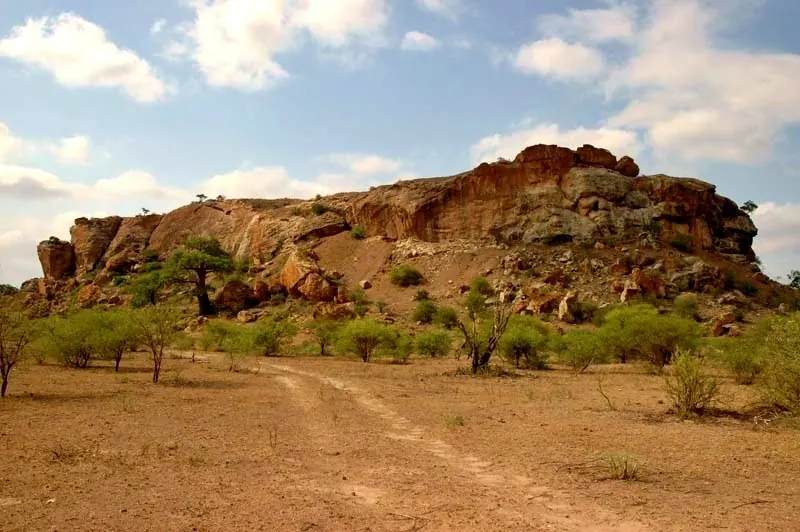
Mapungubwe sits in the far north of Limpopo where the Shashe river joins the Limpopo and South Africa, Botswana and Zimbabwe meet. Around 800 years ago a sandstone hill here was the capital of southern Africa’s first kingdom, trading gold and ivory with the Indian Ocean coast long before Great Zimbabwe. The hilltop graves produced the famous golden rhinoceros. UNESCO listed the cultural landscape in 2003 and the park opened under its current name in 2004. It is about 280 square kilometres of baobabs, red sandstone and mopane, with elephant, lion, leopard and rhino, and it is in a malaria area.
Getting there
From Johannesburg it is around 540 km, roughly six hours. From Polokwane take the R521 north through Alldays, about 200 to 250 km; from Musina the R572 runs about 70 to 80 km west to the gate. Fill up at Alldays or Musina. There is no fuel in the park. The park is split into an eastern section (main gate, Interpretation Centre, Leokwe and Vhembe camps) and a western section (Limpopo Forest Tented Camp, Mazhou campsite, Tshugulu Lodge), separated by private farms. You exit one and drive about 30 minutes on tar to reach the other. Gates open 06:00 to 18:30 from September to March and 06:30 to 18:00 from April to August.
When to go
May to September is dry, with clear warm days and cold nights, and animals concentrate on the river. From October to March daytime temperatures of 38 to 40 degrees are normal and 45 has been recorded, with most rain from November to February. Malaria risk is highest in these wet months. Speak to a travel clinic before you go, whatever the season.
What to do
Most of the day is spent driving yourself. Loops in the eastern section run through baobabs, one of them 31 m round, with elephant, giraffe, eland, gemsbok, kudu and klipspringer about. Birders have about 400 species to chase, Pel’s fishing owl the prize among them. End the afternoon at the Confluence viewpoints, where you look over the meeting rivers into Botswana and Zimbabwe; it is the obvious sundowner spot. The Treetop Walkway, a boardwalk through fever trees by the Limpopo, is a short stop on the way.
The hill is the reason the park is a World Heritage site, and the guided heritage walk takes you up it. The walk leaves from the main gate at 07:00 and 10:00, takes about two hours, and ends with 147 wooden steps through a crack in the rock to the summit where the royals lived. Pair it with the Interpretation Centre (open 08:00 to 16:00), which won World Building of the Year in 2009 and tells the kingdom’s story; the original golden rhino is at the University of Pretoria. Guided drives, night drives, walks and rock art visits are booked at reception.
Good to know
- Check in at reception at the main gate first, then allow about 30 to 55 minutes to reach your camp, depending on which one; arrive well before closing time.
- There is no grocery shop, so bring all your food. A small shop at the Interpretation Centre sells wood and ice, and the restaurant there is open 08:00 to 18:00. The park has gone cash-free, so bring a card.
- The Maloutswa hide in the west was closed by flood damage in early 2025; ask whether it has reopened.
In and around Mapungubwe National Park
21 PLACESPlaces to stay 7
- 22.19°S 29.20°ECampsiteMazhou Camping site
- 22.22°S 29.36°EHotelLeokwe Camp
- 22.19°S 29.21°ECampsiteLimpopo Forest Tented Camp
- 22.25°S 29.27°EHotelLittle Muck Lodge
- 22.20°S 29.17°EChaletRhodes Drift Lodge
- 22.27°S 29.20°EHotelTshugulu Lodge
- 22.19°S 29.41°EHotelVhembe Wilderness Camp
Sights 14
- MapungubweAttraction
- Confluence DeckViewpoint
- Confluence View PointViewpoint
- Day Visitor SiteAttraction
- K2 Cultural SiteArchaeological site
- Little Muck HideAttraction
- Main DeckViewpoint
- Maloutswa HideViewpoint
- Pinnacle Lookout DeckViewpoint
- Sunrise DeckViewpoint
- Sunset DeckViewpoint
- The Mapungubwe Interpretation CentreMuseum