Town · Limpopo, South Africa
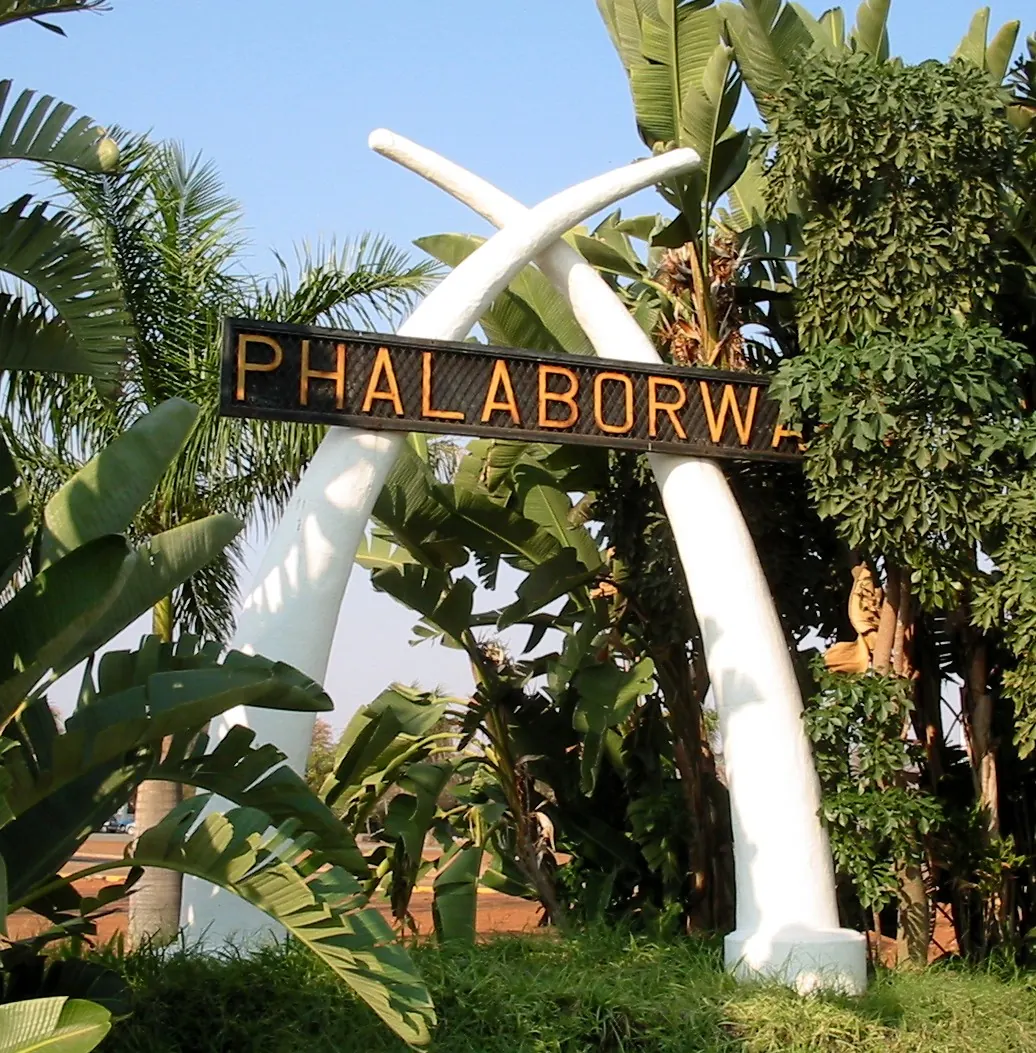
Phalaborwa
Hot Lowveld mining town in Limpopo, the only one in South Africa that borders Kruger, used mainly as the entry point to the park's central and northern sections.
Short answer
Phalaborwa is in Limpopo, South Africa. This page lists 14 places to stay, 6 places to eat and drink and 3 sights. The nearest park with an entry fee on this site is Kruger National Park, about 38 km away, where international adults pay from R692.

- Places to stay
- 14
- Eat and drink
- 6
- Sights
- 3
- Park fee nearby: Kruger National Park
- US$40 €36 · R692about 38 km away
In and around Phalaborwa
23 places listedWhere to stay in Phalaborwa 14
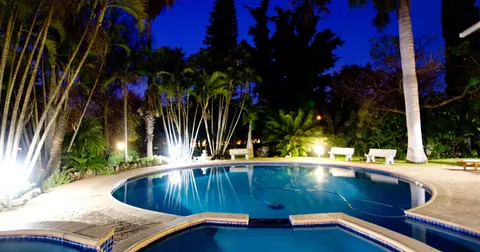 HotelLoerie LodgeSekelbos Crescent, Phalaborwa+27 15 781 7237loerielodge.com
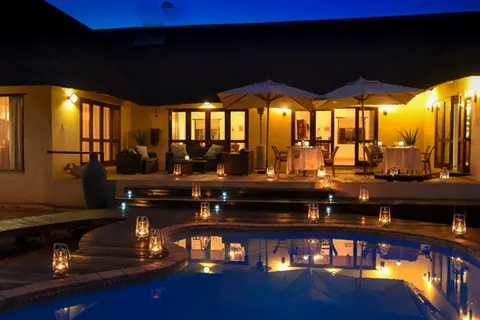 HotelMatimba Bush Lodge+27 76 986 9281matimbalodge.com
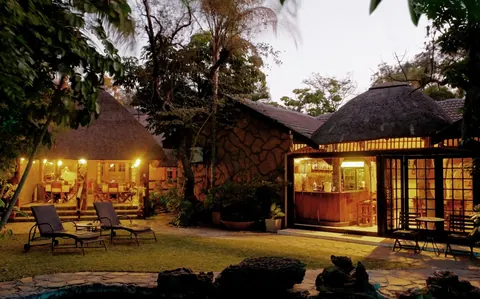 Guest houseKaia TaniBoekenhout Street+27 15 781 1358kaiatani.com
- 23.94°S 31.15°EGuest houseWagon WheelsMonna Street, Phalaborwa+27 71 711 2431
- 23.93°S 31.13°EGuest houseLa Lechere GuesthouseSysie Avenue
- 23.95°S 31.16°EResortPhalaborwa Safari ParkHendrik van Eck Avenue, Phalaborwa
- 23.95°S 31.16°EResortForever Resorts
- 23.95°S 31.15°EGuest houseSefapane Lodge
- 23.95°S 31.13°ECampsiteCamp Phalaborwa
Show all 14 places to stay
- Elephant Walk Accommodation · Hostel
- Hans Merensky Hotel & Estate · Hotel
- Silonque Bush Lodge · Hotel
- Sunbird Lodge · Guest house
- Villa Luso Lodge & Restaurant · Guest house
Sights 3
- Olifants River SafarisAttractionolifantsriversafaris.co.za
- HouseAttraction · Bosvlier Street, Phalaborwa
- PMC viewpointViewpoint
Restaurants and cafes 5
- Big Five Pub & GrillRestaurant · african, regional, burger, bar and grill, grill · Lekkerbreek Street, Phalaborwa+27 15 781 0573
- Buffalo Grill & BistroRestaurant · steak house, steak · Raasblaar Avenue, Phalaborwa+27 15 781 0829
- Bean Around Coffee ShopCafe · coffee shop · Appelblaar Street, Phalaborwa
- Bollanto CaféCafe · coffee, cake, tarts
- GholovanRestaurant · pizza, burger
Bars and pubs 1
- PitstopPub
Phalaborwa is a mining town in the Limpopo Lowveld where the Ga-Selati River meets the Olifants, and it is the only town in South Africa that shares a border with Kruger National Park. Most visitors treat it as a gateway: you sleep here and drive through the Phalaborwa Gate into the park. The town itself is clean and practical, and it grew up around an open-pit mine said to be the widest hole dug anywhere in Africa.
Getting there
By road, the R71 runs from Polokwane through Magoebaskloof and Tzaneen to Phalaborwa and ends at the Kruger gate just east of town. Polokwane to the gate is about 210 km (around 2 hours 40 minutes) and Johannesburg about 500 km (around 5 hours 30 minutes). The local airport, Hendrik Van Eck, sits right next to the park, but Airlink stopped scheduled flights on 10 June 2020 and the airport has handled only charters since. Older guides still list a Johannesburg flight, so check before you plan around it.
When to go
It is hot. Winter days still average up to about 26°C with nights near 9°C, and summer is hotter still; the town recorded 50°C in December 2018. Rainfall is low, around 529 mm a year. Winter is the comfortable season for game drives, and Kruger gate times shift through the year: roughly 05:30 to 18:30 in high summer and 06:00 to about 17:30 or 18:00 in winter. Plan your drive back to the gate around those times.
What to do
Kruger is the reason to be here. The Phalaborwa Gate opens onto the central and northern parts of the park. The north carries less game than the south but is known for its birds. Letaba Rest Camp is the main camp on this side, sitting on the Letaba River, and its Elephant Hall is a museum about elephant life. On the way in, the Masorini picnic site, about 12 km from Phalaborwa, has an Iron Age archaeological site, which fits with the history here: people mined and smelted copper and iron in this area by around 400 AD.
Back in town, the Hans Merensky golf course borders Kruger, and giraffe and warthog wander across the fairways. Lion and leopard have been seen on the course after dark, which is why the hotel drives guests to their rooms by golf cart at night. The Hans Merensky Nature Reserve on the Great Letaba River can mostly be walked on foot, and the Letaba Ranch reserve is known for elephant and buffalo.
Good to know
All of Kruger is a malaria area, so speak to a doctor about tablets before you come and use repellent and long sleeves in the evenings. The Palabora Mining open pit is close to 2,000 m across. Inside Kruger, speed limits are 50 km/h on tar and 40 km/h on gravel. The Blyde River Canyon viewpoints, including God’s Window and Bourke’s Luck Potholes, are within day-trip range.
History and culture
Phalaborwa looks like a modern mining town, and it is one, but people have been digging copper and iron out of these hills for well over a thousand years. The metal was traded towards the Indian Ocean coast long before any European arrived, and the same ore body is still worked today, right on the edge of Kruger.
- Around AD 800
Carbon dates put the start of mining here in the early Iron Age, around AD 800, when only copper was taken out; iron was worked alongside it much later. Archaeologists have found about 53 old metal working sites around Phalaborwa, many of them on hills. source
- 10th to 13th centuries
At Shankare, a hill next to the old Lolwe mine, digs show intense copper and iron working between the 10th and 13th centuries, along with Asian glass beads and cowrie shells from the Indian Ocean coast. Phalaborwa sat on the trade routes between the coast and the interior, in the same centuries that Mapungubwe, further north, rose as southern Africa's first state (about 1220 to 1300). source
- Early 1800s
Masorini, a hill village of the Ba-Phalaborwa (a north-eastern Sotho people) who lived by smelting and forging iron, came to an end in the upheaval that followed the rise of the Zulu kingdom. Its ruins are now inside Kruger, about 11 km from the Phalaborwa Gate. source
- 1937 and mid 1940s
Hans Merensky, the son of a German missionary and one of the best known prospectors in the country, heard of a large vermiculite deposit near Phalaborwa in 1937 and developed it into one of the richest in the world. After the Second World War, at 75, he set up a camp here and supervised the drilling of the phosphate deposits, and the government bought the claims and set up Foskor to mine them. source
- 1951
The state's Industrial Development Corporation founded Foskor here in 1951 to mine phosphate for South African farming. source
- 1959
Namakgale was founded in 1959, during apartheid, as a township (a separate residential area for Black South Africans) 12 km outside Phalaborwa. It had 36,365 people at the 2011 census. source
- 1965
Palabora Mining Company began mining copper ore in 1965, in what became the great open pit on the edge of town. source
- 2002 to 2012
The open pit reached its final economic depth in 2002, and an underground mine built between 2001 and 2004 took over. In December 2012 Rio Tinto and Anglo American agreed to sell their 74.5% stake to a consortium led by China's state owned Hebei Iron and Steel, with South Africa's Industrial Development Corporation as a partner. source
- Languages
- The town and the district around it speak very differently. In Phalaborwa town Afrikaans was the first language of 51% of people at the 2011 census, then English, Xitsonga and Sepedi (Northern Sotho). Across the wider Ba-Phalaborwa municipality, which takes in the big townships and villages, Xitsonga (47.7%) and Sepedi (38.1%) lead and Afrikaans is about 5%. source
- Marula season
- Namakgale holds a marula festival every February and March, when the fruit of the marula tree ripens and marula beer is brewed. Mopane worms (caterpillars that live on the mopane tree) are harvested and eaten here too, first in March and April and again in December. source
For German visitors: Hans Merensky (1871 to 1952), who developed Phalaborwa's vermiculite and drilled its phosphate, was born at Botshabelo, the Berlin Missionary Society station founded by his father Alexander Merensky, the noted German missionary. The family went back to Germany in 1882 and Hans was educated there before returning to South Africa in 1904. source
Main sights in Phalaborwa
2- Masorini
A rebuilt Ba-Phalaborwa hill village just inside Kruger, about 11 km from the Phalaborwa Gate, with stone walls, grinding stones and a 19th century smelting furnace. The smelters lived on the lower terrace and the higher status forgers above them, and it is the easiest place to see the area's ironworking past.
South African History Online: Masorini - Elephant Hall, Letaba Rest Camp
A small elephant museum at Letaba, the nearest main Kruger camp to the Phalaborwa Gate. The draw is the skulls and tusks of the Magnificent Seven, big tuskers that lived in the park in the 1970s and 1980s, and since a 2017 renovation the tusks of Mandleve, the largest ever recorded in Kruger.
Wikivoyage: Kruger National Park
Did you know?
- The name is usually explained as "better than the south", given by Sotho people who moved up here from the south. source
- Old Phalaborwa copper was cast into long thin rods called marale (one is a lerale), about 50 cm long and just over a centimetre thick, with a flattened cone at one end. source
- The open pit is close to 2,000 m across and is often called the widest man made hole in Africa. source
- Palabora is the only copper mine still producing in South Africa. source
- Phosphate rock mined here goes by rail to Foskor's plant at Richards Bay, about 800 km away on the KwaZulu-Natal coast. source
- Dale Steyn, the fast bowler who played Test cricket for South Africa from 2004 to 2020, was born in Phalaborwa in 1983. source
Checked 7 October 2026.
Guides for Phalaborwa
Map of Phalaborwa
See every place on this map as a list