City · KwaZulu-Natal, South Africa
uMnambithi
Short answer
uMnambithi is in KwaZulu-Natal, South Africa. This page lists 4 places to stay, 7 places to eat and drink and 4 sights. The nearest park with an entry fee on this site is uKhahlamba / Drakensberg Park, about 98 km away, where international adults pay from R180.

- Places to stay
- 4
- Eat and drink
- 7
- Sights
- 4
- Park fee nearby: uKhahlamba / Drakensberg Park
- US$10 €9 · R180about 98 km away
In and around uMnambithi
15 places listedWhere to stay in uMnambithi 4
- 28.57°S 29.78°EGuest houseLelo's Bed and BreakfastSchool Street, uMnambithi+27 74 141 4157
- 28.55°S 29.77°EHotelDurnford's LodgeFrancis Road, uMnambithidurnfordslodge.co.za
- 28.59°S 29.76°EHotelPlatrand Lodge+27 36 631 0204platrandlodge.co.za
- 28.56°S 29.78°EHotelCrown Hotel RestaurantKing Street, uMnambithi
Sights 4
 Burgher MemorialMemorial
- Imperial Light Horse MemorialMemorial
- Ladysmith Siege MuseumMuseum
 Long Tom CanonAttraction
Restaurants and cafes 7
- BarcelosRestaurant · Murchison Street, uMnambithi+27 36 637 4181
- Coffee PondokkieCafe · uMnambithi+27 36 637 5280
- The Coffee ShopCafe · uMnambithi+27 36 631 2895
- Corner CafeRestaurant · Egerton Road, uMnambithi+27 36 631 0940
- The Office CafeRestaurant · uMnambithi
- TugelaRestaurant
- Santa Catalina SpurRestaurant · steak house · uMnambithi+27 36 631 1260spursteakranches.com
History and culture
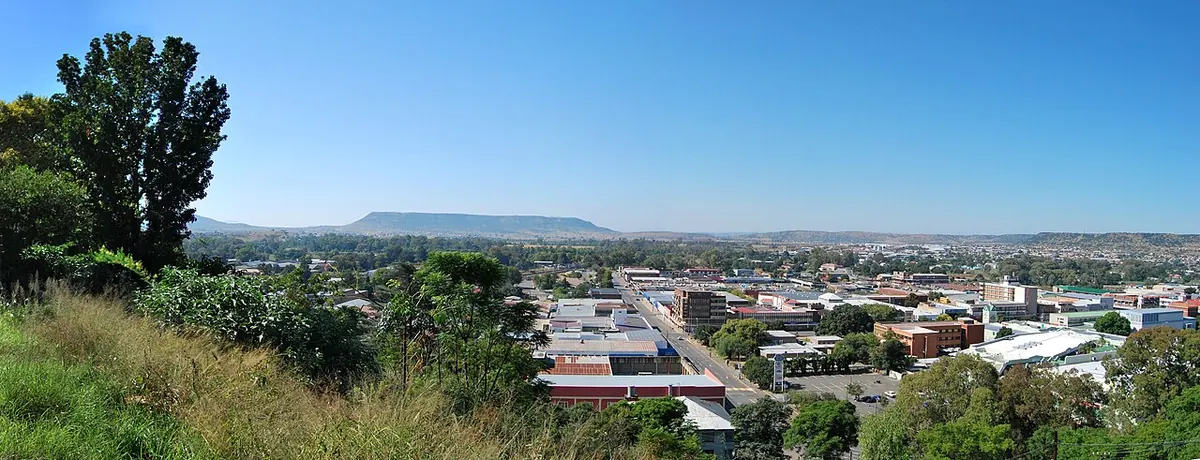
uMnambithi (still widely called Ladysmith) is a working KwaZulu-Natal town on the Klip River, about an hour from the Drakensberg. Its name went round the world in 1899 and 1900, when Boer forces besieged a British army here for 118 days, and the hills around town are still dotted with forts, graves and memorials. It is also the home town of Ladysmith Black Mambazo, the choir Paul Simon took to the world on Graceland.
- 1847
Boers (Dutch-speaking settler farmers) bought land here from the Zulu king Mpande and set up the short-lived Republic of Klip River. Britain annexed it the same year. source
- 1850
The British laid out a township called Windsor in June 1850 and renamed it Ladysmith that October, after Juana María de los Dolores de León Smith, the Spanish wife of Cape governor Sir Harry Smith. A fort followed in 1860. source
- 1899 to 1900
In the South African War (the Anglo-Boer War) General Sir George White fell back on Ladysmith, which he called a place of primary importance because of its railway junction, and the Boers surrounded it from 2 November 1899. Townsfolk and soldiers lived under shellfire, short of food and sick with enteric fever (typhoid), until General Redvers Buller's relief column rode in on 28 February 1900 after defeats at Colenso, Spioenkop (Spion Kop) and Vaal Krantz. source
- 6 January 1900
The Boers made one big attempt to storm the town at Platrand (Wagon Hill) to the south. The British held on, losing 175 killed and 249 wounded that day. source
- Early 1980s
Under apartheid, Ezakheni township was set up outside town inside the KwaZulu "homeland" (a territory apartheid set aside for Zulu speakers), to house and control Ladysmith's Black workforce and their families. A survey for the Surplus People Project's 1983 report on forced removals put its population at about 50,000, and in 1982 it was earmarked as an industrial development point. source
- 2024
After a community vote that began in November 2023, in which residents chose between Ladysmith and uMnambithi, arts and culture minister Zizi Kodwa approved uMnambithi and it was published in the government gazette in March 2024. source
- Isicathamiya music
- Joseph Shabalala formed the choir that became Ladysmith Black Mambazo in December 1960, with relatives from the farm where he grew up. They sing isicathamiya, the soft, tiptoeing Zulu a cappella style (its 1960s slang name meant "tiptoe boys"), and made their name at the Saturday night choir competitions in workers' hostel halls in Durban and Johannesburg. The name joins the family's home town, the black ox (the strongest farm animal) and mambazo, Zulu for axe, because they chopped down the competition. source
- Faiths
- For a small town it has a striking mix of places of worship: the Anglican All Saints Church built in 1902 from local flagstone, the Soofie Mosque on the Klip River (1969), and the Sanathan Dharma Sabha Hindu temple, whose temple and hall date from 1916 and which was declared a national monument in 1990. source
For American visitors: Paul Simon recorded with Ladysmith Black Mambazo for Graceland (1986), on songs like "Homeless" and "Diamonds on the Soles of Her Shoes", and brought them to New York for Saturday Night Live. He then produced their first US album, Shaka Zulu, which won a Grammy in 1988. The group has won five Grammys, and you may also know them from Coming to America and Michael Jackson's Moonwalker. source
For German visitors: In August 1990 Ladysmith Black Mambazo sang with the Cologne band Bläck Fööss in front of Cologne Cathedral. source
Main sights in uMnambithi
5- Siege Museum
Housed in the 1884 market building and open as a museum since 1995. It is the best place to start, with the story of the siege and the relief battles, and it holds around 60,000 documents on the siege and the war.
Wikipedia: Ladysmith, KwaZulu-Natal - Long Tom replica at the Town Hall
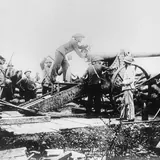
Next to the town hall is a replica of a Long Tom, one of the French-made Creusot 155 mm siege guns the Boers fired into Ladysmith from Pepworth Hill and Bulwana Hill. It is a copy, not an original. Castor and Pollux, the two howitzers, stand in front of the same building.
Wikipedia: 155 mm Creusot Long Tom - Burgher Memorial, Platrand (Wagon Hill)
On the ridge south of town where the Boers attacked in January 1900. The 1979 memorial, a sculpture of six hands pointing up and one pointing down, honours 781 Boer fighters killed in the Natal battles, and a crypt holds the remains of 310 of them.
Wikipedia: Ladysmith, KwaZulu-Natal - Imperial Light Horse and other Platrand memorials
The same ridge has British memorials to the Imperial Light Horse, the Devonshire Regiment and others who fought off the Wagon Hill attack, so you can see both sides' monuments in one visit.
Wikipedia: Ladysmith, KwaZulu-Natal - Gandhi statue, Lord Vishnu Temple
A statue of Gandhi stands at the Lord Vishnu Temple. Gandhi served as a stretcher-bearer during the battles to relieve Ladysmith.
South African History Online: Ladysmith
Did you know?
- Near the end of the siege the garrison was eating its own horses and draught oxen, much of it as a meat paste they nicknamed "chevril", a pun on the beef extract Bovril. source
- Two future world figures were here for the relief: Winston Churchill as a young war correspondent for The Morning Post (he had been captured by the Boers earlier in the war and escaped), and Mohandas Gandhi with the Indian stretcher-bearer corps he had set up. source
- Both sides agreed to a neutral hospital camp at Intombi, about 5 km outside town. It grew from 100 beds to more than 1,900 and took in 10,673 patients during the siege. source
- The two old 6.3 inch howitzers outside the town hall, Castor and Pollux, have long been described as British siege guns. A researcher checking serial numbers found that only one was British. The other is an identical gun the Boers used, so the old enemies now stand side by side. source
- The relief of the siege was big news across the Empire: in 1900 a Vancouver Island town in Canada was renamed Ladysmith to celebrate it, and still carries the name. source
Checked 7 October 2026.
Map of uMnambithi
See every place on this map as a list