Town · Western Cape, South Africa
Worcester
Breede River Valley farming and wine town 120 km from Cape Town on the N1, with a succulent botanical garden, an open-air farm museum and brandy cellars.
Short answer
Worcester is in Western Cape, South Africa. This page lists 11 places to stay, 16 places to eat and drink, 7 sights and 3 hiking trails. The nearest park with an entry fee on this site is Tygerberg Nature Reserve, about 83 km away, where international adults pay from R40.

- Places to stay
- 11
- Eat and drink
- 16
- Sights
- 7
- Park fee nearby: Tygerberg Nature Reserve
- US$2 €2 · R40about 83 km away
In and around Worcester
42 places listedWhere to stay in Worcester 11
- 33.49°S 19.47°EMountain hutConradie Hut
- 33.55°S 19.44°ECampsiteFive Rivers Camp
- 33.63°S 19.44°EHotelGolden Valley
- 33.73°S 19.50°ECampsiteKlipkrans Bushcamp
- 33.74°S 19.49°ECampsiteKlipkrans Campsites
- 33.74°S 19.49°ECampsiteKlipkrans Lapa
- 33.66°S 19.63°EGuest houseNuy Valley Guestfarm
- 33.77°S 19.46°ECampsiteQuaggaskloof Water ski club
- 33.77°S 19.52°ECampsiteRivierplaas Camp
Show all 11 places to stay
- Thomas Hut - MCSA · Mountain hut
- Worcester Yacht Club · Caravan park
Sights 7
- Worcester Museum (Kleinplasie)Museumworcestermuseum.org.za
- De Wet CellarAttraction
- Hex River CellarAttraction
- Meiring's MemorialMemorial
- Nelson MandelaMemorial
- VoortrekkerMonument
- WindpumpViewpoint
Hiking trails 3
- Shale TrailHiking trail · 1 kmsanbi.org
- Grysbokkie TrailHiking trail · 3.4 kmsanbi.org
- Heuweltjie TrailHiking trail · 4.6 km
Restaurants and cafes 16
- Kokerboom RestaurantRestaurantsanbi.org
- Bersig Servise StationRestaurant · regional
- Cafe HugoCafe
- Conradie WinefarmRestaurant · regional
- DamasRestaurant · coffee shop, sandwich, regional
- MokshRestaurant · indian
- StarparkRestaurant · sushi
- The BarnRestaurant · regional
- Cafe (Coke sponsored)Cafe
- Kleinplasie RestaurantRestaurant
- Nuy on the HillRestaurant
- PanarotisRestaurant
Show all 16 restaurants and cafes
- Phat Food and Wine · Restaurant
- Willow Creek Cafe · Cafe
- San Diego Spur · Restaurant · steak house · Worcester+27 23 342 3540spursteakranches.com
- Nando's · Restaurant · chicken, portuguese · Mountain Mill Road, Worcester
Wineries, breweries and distilleries 5
- BC WinesWinery+27 23 340 4215bcwines.co.za
- Aan De Doorns CellarWinery
- Cape WinelandsWinery
- Du Toits Kloof brewery?Brewery
- Nuy WineryWinery
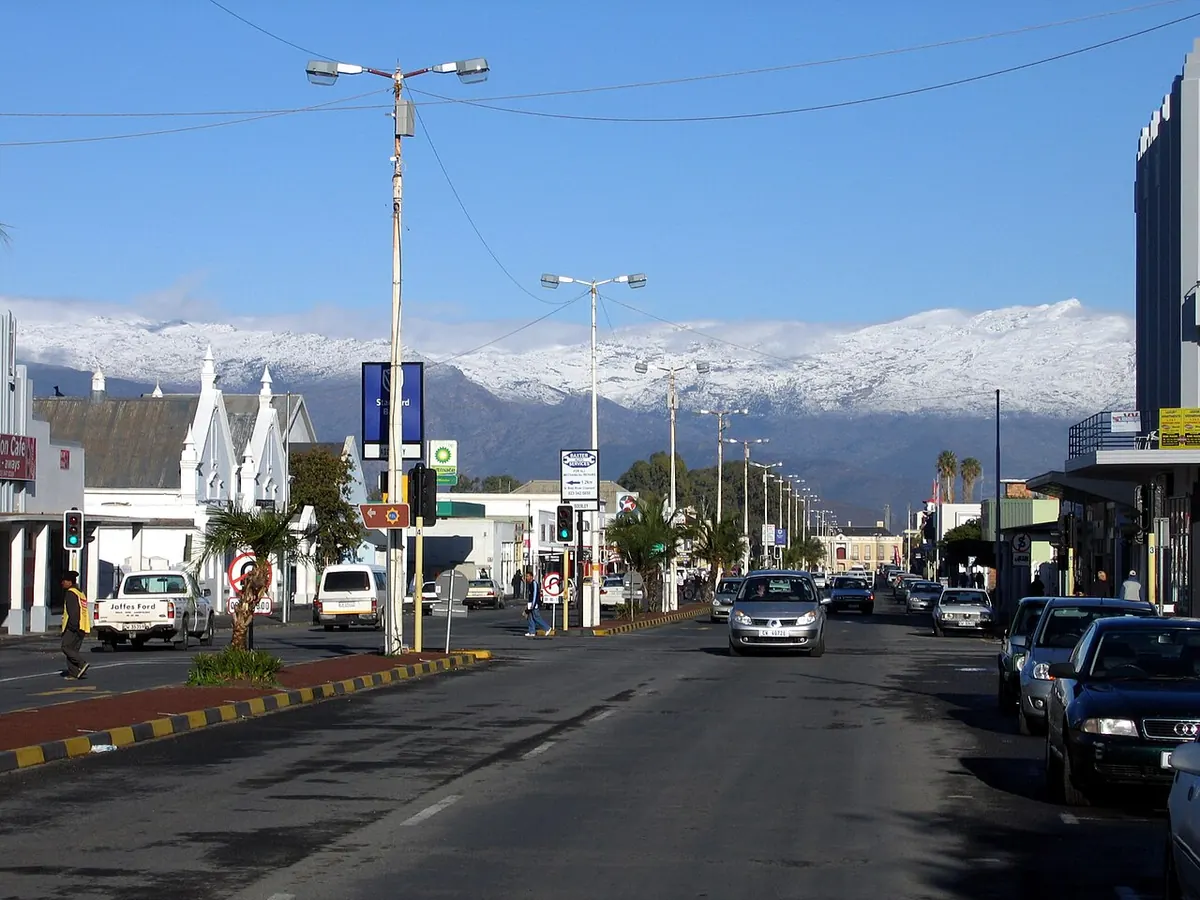
Worcester is the main town of the Breede River Valley, a big agricultural and wine district on the far side of the mountains from Cape Town. It sits on the N1 in the Cape Winelands district. It is not a pretty village in the Franschhoek mould, but it is worth a stop or a night for its desert botanical garden, a working open-air farm museum and the valley’s wine and brandy cellars.
Getting there
Worcester is about 120 km from Cape Town on the N1, through the Huguenot Tunnel. The slower but more scenic alternatives are the Du Toitskloof, Bainskloof and Hex River passes. The town has been a railway junction since the line arrived on 16 June 1876, and it still has a daily commuter train from Cape Town and long-distance trains to Johannesburg a few times a week. Once there, a car makes the cellars and the botanical garden much easier.
When to go
Expect real heat in summer. Afternoons usually sit in the low 30s °C, February can push past 40°C, and there is little rain. Winter is the wet season and it gets properly cold: days of 10 to 17°C, nights close to freezing and snow on the high ground above about 1,500 m. That snow is the reason to drive the Hex River Pass then. Rain is very uneven across the valley. The Slanghoek side can top 1,500 mm a year, while the Nuy area to the east gets about a fifth of that.
What to do
Start with the Karoo Desert National Botanical Garden on Roux Road, under the Hex River Mountains. Its 154 hectares are given over to plants from dry country, and SA-Venues goes as far as calling it the only true succulent garden in the southern hemisphere. It is set up for wheelchair users.
Kleinplasie, a kilometre out of town and part of the Worcester Museum, shows how Cape farmers lived from the early 1800s to the 1940s. Go in the morning, when staff bake bread, roast coffee, roll tobacco and make soap and candles. The Hugo Naudé House and the Jean Weltz gallery cover the art side.
The Breede River Valley produces about a quarter of South Africa’s wine. The Worcester Wine and Olive Route has a dozen cellars plus the Willow Creek olive estate, and the KWV and Olof Bergh Solera brandy cellars are both in the area. There is a farmers’ market on the first Saturday of each month and a set of mountain bike routes around town, including the Apiesklip route of about 14 km.
Good to know
The town was laid out in 1820 and named by Lord Charles Somerset after his brother, the Marquis of Worcester. It is also home to long-established schools for deaf and blind people, founded in 1881. The neighbouring Breedekloof valley around Rawsonville and the Hex River Valley around De Doorns, known for export table grapes, are easy side trips.
History and culture
Worcester was laid out in 1820 as a new seat of government for the farmers beyond the mountains, and it grew into the working capital of the Breede River Valley. Its past is a mix you do not always expect in a country town: freed slaves and a German mission, Pomeranian farm hands and Lutheran pews, wagon makers, diamond-rush travellers, and some of the harder chapters of apartheid.
- Before 1700s
The valley was home to San hunter-gatherers and Khoi (Khoekhoe) herders. Dutch East India Company hunters came for elephant ivory, settler farmers got grazing rights "over de Breede Rivier" from 1709 and brought enslaved people to work their farms, and smallpox brought by the newcomers hit the Khoi hard. source
- 1820
On 28 February 1820, the town's official founding date, 89 of 144 plots were sold on two farms bought for a new magistracy. Governor Lord Charles Somerset named it after his eldest brother, the Marquis of Worcester, and Captain Charles Trappes laid out the unusually wide streets and squares. source
- 1830s and 1840s
After slavery was abolished in 1834, freed slaves settled south of Durban Street, and in 1840 plots were set aside for them. The town's first mission church opened in 1832, and the Rhenish Missionary Society, a German Protestant mission, started a mission school in 1835 and shaped that community for over a century. source
- 1876
The railway from Cape Town opened on 16 June 1876. While the line was being pushed north to Kimberley, travellers to the diamond fields spent the night in Worcester, and Cecil Rhodes, Barney Barnato and Alfred Beit all stayed over here. source
- 1900 to 1901
During the South African War (the Anglo-Boer War, Britain against the two Boer republics), about 10,000 people came to a mass meeting about the war in Worcester on 6 December 1900, chaired by Samuel Cronwright-Schreiner, husband of the writer Olive Schreiner. On 3 January 1901, with Boer commandos (mounted militia units) close by, martial law was declared in the Cape Colony, Worcester included. source
- 1950s to 1985
Under apartheid the town's communities were fully segregated. Coloured families (the apartheid label for South Africans of mixed descent) were housed in Esselen Park, Roodewal and Riverview, Indian traders were forced to move their businesses out of areas declared white, and Black residents were housed in the Zweletemba township (a separate area built for Black workers) and not treated as permanent residents. In 1985 police shot students protesting against Afrikaans in schools, and one student, Nkosana Nation Bahumi, was killed. source
- 1996
On Christmas Eve 1996 white supremacist members of the AWB (Afrikaner Weerstandsbeweging) bombed a Shoprite supermarket in Worcester, killing four people, three of them children. All four men were convicted of murder. source
- Language
- Worcester is mostly Afrikaans speaking. At the 2011 census 73.1% of residents of Worcester and Zweletemba gave Afrikaans as their first language, 19.1% isiXhosa and 3.7% English. I could not find town-level 2022 figures. source
- A mixed town
- Scottish artisans came early, then German farm workers and railway builders, Jewish traders from the 1880s (the synagogue in Durban Street was consecrated in 1904), the first Greek residents in the early 1900s, and a Muslim community descended from freed slaves, who started using a mosque in Durban Street in 1881. source
- Wine, brandy and raisins
- The valley used to dry much of its grape crop as raisins. When demand fell after the Second World War most farmers switched to wine grapes and co-operative cellars sprang up, and the Breede River Valley now produces close to a quarter of South Africa's wine. The first distillery opened in Porter Street in 1895, and the KWV, founded in 1918, took it over. source
- Deaf and blind schools
- The Dutch Reformed Church opened schools for deaf and blind children here in 1881, and they grew into two well known institutions. The school for the blind carries on today as the Pioneer School. source
- Art
- The Austrian born architect Jean Welz, who had worked with Adolf Loos in Paris, became principal of the Hugo Naudé Art Centre in 1941 and stayed in Worcester for 28 years. He turned to painting here and became one of the most influential South African artists of his day, with a big retrospective in Cape Town and Johannesburg in 1970. source
For German visitors: Farm workers from Pomerania arrived from the 1860s and helped turn the valley from stock farming to orchards and vineyards. A second group of German artisans came in the 1870s to build the railway, got land at Goudini Road in 1880 and set up a Lutheran congregation whose church was finished in 1883. source
For German visitors: The Afrikaans poet C. Louis Leipoldt was born in Worcester in 1880 into a family of German missionaries: his grandfather Johann Gottlieb Leipoldt founded Wupperthal in the Cederberg, and his mother's father, Louis Esselen, was the Rhenish missionary in Worcester. source
For German visitors: Hugo Naudé studied at the Munich Academy of Fine Arts from 1890 to 1894 under the portrait painter Franz von Lenbach and went back to Munich for more study in 1913. source
Main sights in Worcester
6- Worcester Museum (Kleinplasie)
An open-air farm museum laid out like an old Cape farmyard, with wagons and farm tools, and live demonstrations of bread baking in a brick oven, smithing, tobacco rolling, soap and candle making on weekdays (bread baking only on Saturdays). Open Monday to Friday 08:00 to 16:00 and Saturday 08:00 to 13:00; adults R15, children R5, free on Tuesday, Wednesday, Friday and Saturday (last checked 7 October 2026).
Worcester Museum - Karoo Desert National Botanical Garden
Started in 1921 near Matjiesfontein as the second national botanical garden after Kirstenbosch, then moved to Worcester in 1945 because water was short at the old site and the national road was being rerouted. Some of the quiver trees the first Worcester curator replanted here, watering them from a bucket balanced on his bicycle, are still alive near the lower car park.
SANBI: Karoo Desert National Botanical Garden, History - Dutch Reformed Church, Church Street
A Gothic cruciform church: the congregation dates from 1821 and the church was consecrated in 1832, with a pulpit carved by two De Vos brothers. Under the Rev. William Murray the congregation founded the town's girls' school and its schools for deaf and blind children.
Wikipedia: Dutch Reformed Church, Worcester - St James the Great Anglican Church
Designed by Sophy Gray, wife of Robert Gray, the first Anglican bishop of Cape Town. The foundation stone went down in 1852, building only started in 1855, and it opened for services in January 1859.
Wikipedia: St James the Great, Worcester - Rhenish Church Complex, Adderley Street
The old mission church at 46 Adderley Street, a declared national monument, stands with its thatched Cape Dutch parsonage next door (front gable dated 1840) and the old school building in what is called the Rhenish Church Complex, a group of buildings the heritage register describes as unique. The church is still in use.
Wikipedia: List of heritage sites in Worcester, Western Cape (SAHRA register) - Hugo Naudé House
The painter Hugo Naudé built this mainly neo-classical house at 115 Russell Street in the early 1900s as his home and studio, and lived here until his death on 5 April 1941. Check opening times locally before you go, as I could not confirm them.
Wikipedia: List of heritage sites in Worcester, Western Cape (SAHRA register)
Did you know?
- Worcester sauce was made in Worcester, South Africa. The Union Vinegar Company, founded here in 1913, made it alongside vinegar, pickled onions and piccalilli, and was the first factory in the country to produce beetroot salad. source
- The Springboks' green jersey goes back to the final test (international match) of 1896, when captain Barry "Fairy" Heatlie, born on a farm in the Worcester district, kitted his team out in green jerseys from the Old Diocesan club. South Africa won 5 to 0. source
- By 1892 three Worcester men had founded the Mountain Club, the first of its kind in South Africa. One of them, the pharmacist Izak Meiring, confirmed Matroosberg as the highest peak in the Western Province, and Meiring's Plateau on the Brandwacht mountains is named after him. source
- J. M. Coetzee, the Nobel prize winning novelist, lived in Worcester as a boy, and Boyhood (1997), his fictionalised memoir, is set mostly in the town, with an unflattering picture of small-town life in the apartheid era: bullying at school, beatings and racial injustice. source
- In 1961 the Hex River power station at Worcester electrified the railway from Cape Town to Beaufort West, then the longest electrified stretch of line in Africa. The power station was demolished in 1990. source
Checked 7 October 2026.
Map of Worcester
See every place on this map as a list