Place to stay · North-West District
Nguma Island Lodge
Family-owned tented lodge and campsite on a lagoon at Etsha 13, in the north-west of the Okavango Delta. Known for tigerfish, birding and the first fibreglass mokoros.
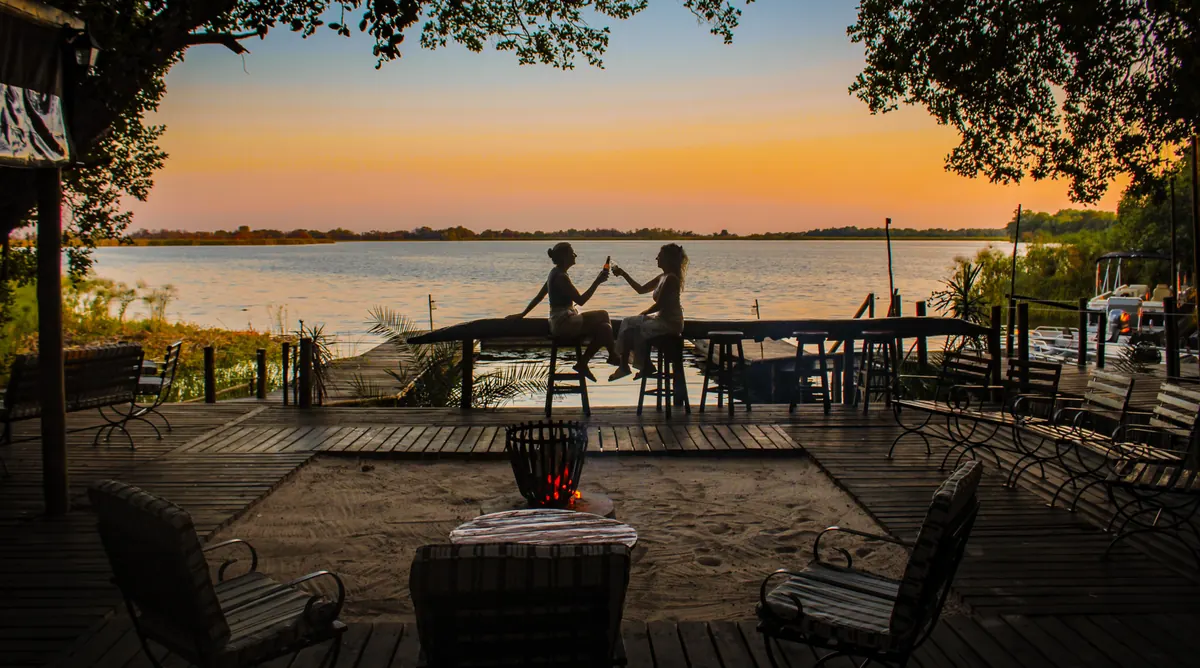
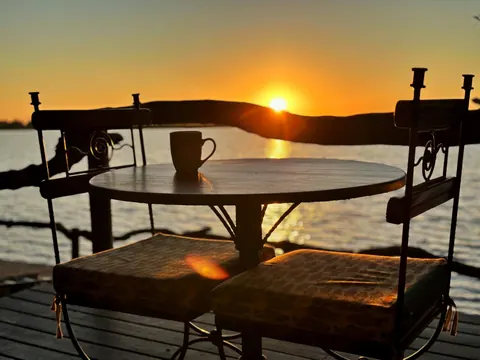
Nguma Island Lodge is on the edge of a large lagoon in the north-western Okavango Delta, with Etsha 13 as its address. It takes both lodge guests and campers, which suits self-drivers. People come for the water: fishing, birding and mokoro trips.
What to expect
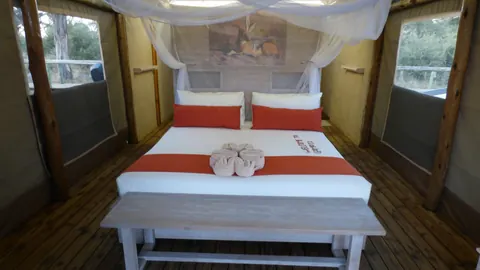
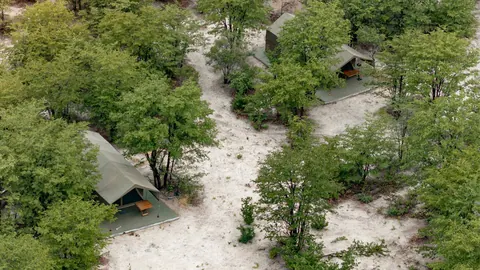
The lodge has 20 Meru-style tents on wooden platforms under big trees, joined to the main building by raised walkways. Each has its own shower and toilet, a veranda with table and chairs, and enough power for lights and charging a phone. The lodge itself calls its comforts basic.
Campers get five sites with shared ablutions and prep areas. Tents, stretchers and sleeping bags can be hired, and there is a serviced tent option if you ask ahead. Lodge and campsite each have a pool.
Practical details
- Phone: +267 687 5432 (landline) or +267 74 520 686 (WhatsApp). Email info@ngumalodge.com.
- The lodge has its own licensed airstrip, and offers 30 minute scenic flights from it.
- Internet is by Starlink.
- Activities are mokoro trips, sunset cruises on the lagoon, day boat trips with lunch on an island, fishing trips with rods supplied, and walks.
Good to know
The mokoros here are fibreglass, and there is a story behind that. Geoff Randall built the first fibreglass mokoro on Nguma Island in the early 1990s so that mature trees no longer had to be felled for dugouts. His family still owns the lodge.
For anglers, September is the start of the catfish run, when tigerfish feed on the shoals moving through the channels. The delta has a closed fishing season each year, so check dates with the lodge before planning a trip around a rod. Birders are promised more than 400 species, and the shy sitatunga antelope lives in the reeds here.
Last updated 12 October 2026. Sources: Nguma Island Lodge, Nguma Island Lodge, accommodation, Nguma Island Lodge, about, Nguma Island Lodge, the mokoro story, Nguma Island Lodge, fishing season.
The lodge with two names and a plastic canoe
Chris McIntyre, who wrote the Bradt guide to Botswana, visited a new place on this lagoon for an early edition and filed it as Guma Island Lodge. Then he added a puzzled note. Since writing it up he had seen the same camp called Nguma Luxury Lodge and Nguma Island Tented Lodge. The muddle is still there. The lodge spells it with an N, while the camp barely a kilometre to the north-east is Guma Lagoon Camp, on the same water.
Opened in June 2000, with eight tents
McIntyre gives the opening as June 2000 and the owners as Geoff and Nookie Randall, who had by then lived in the area for years. He counted eight tents on high decking, joined by walkways built tall enough to stay clear of a big flood. Guy and Beverley Lobjoit had started the neighbouring camp the year before, and the guidebook noted drily that the two outfits did not work together much.
The fibreglass mokoro is older than the lodge. The family’s account is that Geoff made a promise to his daughter Sharon that he would find a way to stop old sausage trees being felled for dugouts, and they put the number of trees spared since at more than 7,000. That figure is theirs alone. McIntyre is more measured and says Geoff played an important part in starting fibreglass canoe building in the area. Either way, a mokoro in the Okavango Delta today may well be moulded, not carved.
Etsha 13 is the last of thirteen
The village where you leave the tar was not always there. In the late 1960s and early 1970s more than 4,000 Hambukushu people came over from the war in Angola and were settled along the western edge of the delta in thirteen villages, numbered Etsha 1 to Etsha 13. David Potten wrote it up in 1976 under the title “Etsha: A Successful Resettlement Scheme”. The Hambukushu are the best known basket weavers of this region, and McIntyre thought the baskets and craftwork in the lodge’s main building beat the stock of most curio shops. By tradition they were also river people who sat and paddled their canoes in deep water. The standing poler of the delta photographs was a Bayei habit.
From the village it is about 13 km of soft sand, with side tracks that come and go with the water level. Both lagoon camps will fetch guests who arrive in ordinary cars, if asked beforehand.
What lives in the papyrus
Do not come for big game. The lodge lists elephant, zebra, impala and red lechwe, but this is deep water walled in by papyrus, and McIntyre warns that anyone expecting herds in the Panhandle will be disappointed. Hippo and crocodile are close to certain. Sitatunga are the prize. They lie up in the reeds through the heat and move just after dawn and in the last hour or two of light, so the early and late boats give the best chance. At Nxamaseri, a lodge further up the Panhandle, Expert Africa’s travellers reported sitatunga on roughly a third of stays.
Pel’s fishing owl is in the riverine trees, roosting by day on a big branch. The male’s boom carries up to 3 km. African skimmers come to the Panhandle sandbanks from about September to December, when low water exposes them, and carmine bee-eaters arrive in September or October. The main Thaoge channel is 40 to 45 minutes by motor boat.
September, when the catfish run
The catfish run starts as the flood drops, around September, and goes on into November. Shoals of catfish push along the channels and the tigerfish go after them. McIntyre observed that campers here are often serious about their fishing. The lodge gives January and February as the closed season.