Sight · North-West District
Elephant Havens
Botswana's only elephant orphanage, on the Gomoti River roughly 45 km north-east of Maun, with hour-long public visits at 9am and 4pm every day of the week.
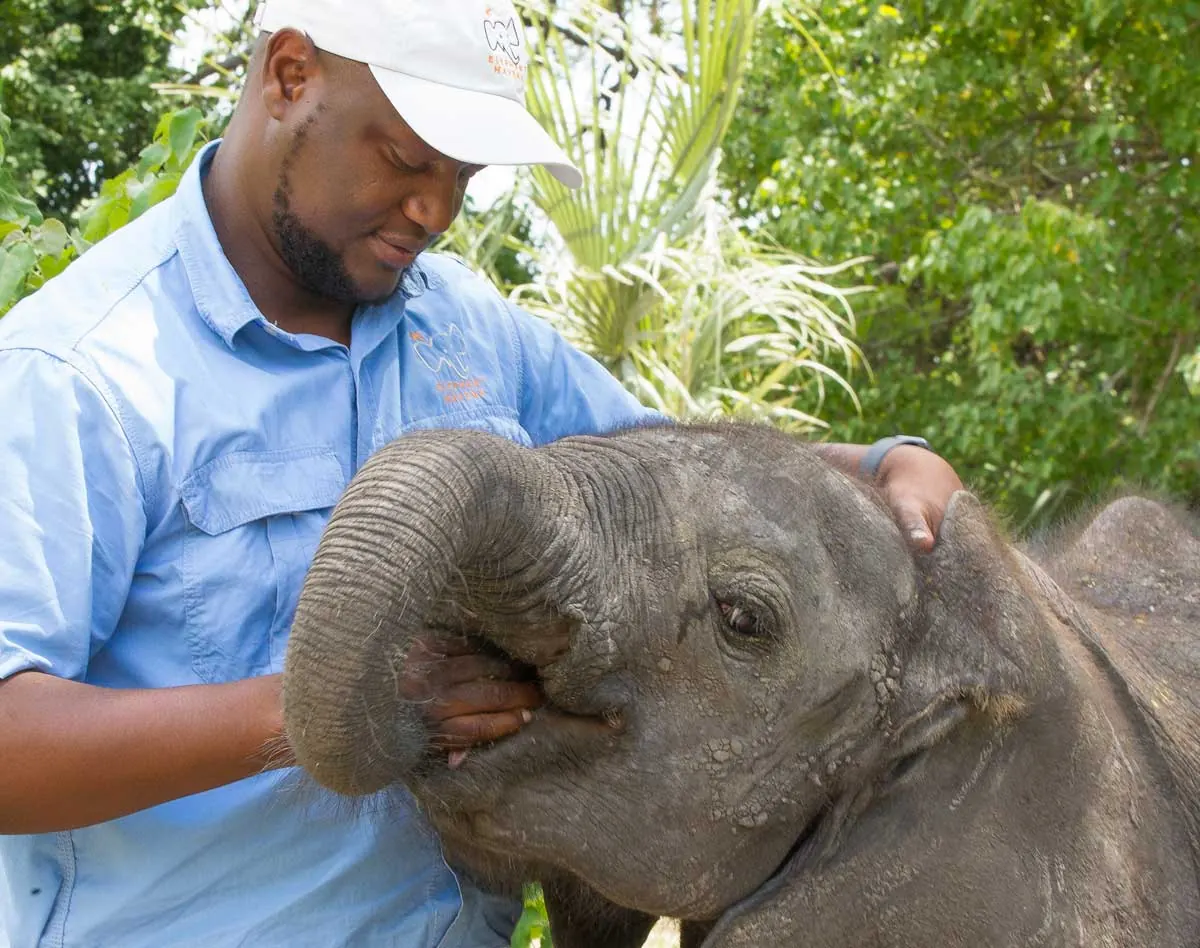
Elephant Havens is an orphanage for elephant calves on the Gomoti River, at the edge of the Okavango Delta and roughly 45 km north-east of Maun. It describes itself as the only one in Botswana. Calves that have lost their mothers are bottle-fed and looked after by handlers who stay with them day and night, with the aim of releasing them later as a herd.
What to expect
The public visit lasts an hour. You get a tour of the orphanage, a talk from the handlers with time for questions, and a meeting with the young elephants, which you can feed treats and photograph. Visitors stand inside a fenced boma and the elephants are outside it, free to wander off if they lose interest.
There are two longer options, both of which must be booked ahead for at least two people: an extended tour that adds a two-hour walk with the handlers while the calves forage, and a three-hour private tour with lunch or tea.
Practical details
- Public visits start promptly at 9am and 4pm, seven days a week, and end at 10am and 5pm whatever time you arrive. No reservation is needed.
- Entry is by a set minimum donation per person. Arrive early, as there is paperwork to fill in first.
- From Maun take the Sir Seretse Khama road and follow the orphanage’s signs.
- Wear proper shoes for the walks, which cross thorny acacia scrub and sand.
Good to know
The orphanage’s own pages give the distance from Maun as anything from 42 to 46 km and the drive as anything from one hour to two, so allow the longer time for a 9am start. The site covers 140 acres, up from 45 when it began, and its buildings run on solar power. The founders are Boago Poloko, Debra Stevens and Scott Jackson, and local school children are brought in for lessons.
Last updated 12 October 2026. Sources: Elephant Havens Wildlife Foundation, Frequently Asked Questions, Elephant Havens Wildlife Foundation, The Orphanage, Elephant Havens, visiting information 2026 and 2027, Elephant Havens Wildlife Foundation, History, Elephant Havens Wildlife Foundation, Contact Us.
The orphans who walk ten kilometres and lose their names
The elephant behind this place never lived here. Naledi was a calf at Abu Camp, deep in the Okavango, who lost her mother at six weeks old. The camp’s handlers took her out of the herd and raised her on the bottle, and one of them was Boago Poloko, known to everyone as Bee, a third-generation elephant handler. A Dallas picture framer called Debra Stevens met the calf on safari in 2013, when Naledi was six months old, and kept coming back to see her. Paul Allen, the Microsoft co-founder who owned Abu, had a documentary made about the calf in 2016. A year later Bee told Stevens and her husband that Botswana needed an orphanage, that he knew how to build one, and that he had no money.
Five days between the permit and the first calf
The wildlife department signed off on 18 December 2018. On 23 December the team was called out to fetch an orphaned calf, and she arrived to a camp where the staff slept in tents and the kitchen was a hot plate under a tin roof. She was just over a year old and had been found at Sekondomboro. They called her MmaMotse, a name chosen to mark her as the herd’s future matriarch. The orphanage says it was months before she trusted anyone enough to wander the property with them, yet by 2020 the Botswana Daily News was describing her as matriarch of a family of four.
Who you meet, and who you don’t
MmaMotse is not there any more, and nor are the other early names. Early in 2023 she was walked out with the first graduating class, Tsholofelo, Bonolo and Lerumo (“Bullet”, who came in with a shotgun hole through her trunk beside her dead mother), to a 1,000 acre reserve ringed by nearly five miles of electric fence. A second group of four followed in late January 2024, on foot, 10 km, with the earlier graduates waiting at the gate. The foundation’s own report says these elephants have “lost their names” and that anyone who goes out there will rarely see them. That is the point of it.
So the calves at a public visit are the young ones, 28 of them by April 2026. A female called Bokamoso took over as matriarch in 2024. Ask the handlers for Rosie, picked up starving near Sekanduko outside Shakawe in 2025 after a 12 hour drive: she is leucistic, with white hair and eyelashes, pink behind the ears and khaki eyes instead of brown. Tsi Tsi has no tail. Hyenas took it, and by the orphanage’s account (theirs alone) she turned up outside the camp with three wild bulls walking beside her.
October is when the calls come
Rescues bunch at the end of the dry season. In six weeks of October and November 2024 the team brought in eight calves, some stuck in wells, some holding up traffic on the roadside. The annual report lists helicopter time, crane trucks and, where the flood had cut the tracks, boats. The herd went from 18 to 31 that year, counting the ten in the reserve. Not every story is drought: Matsaudi, named after the village 25 minutes away, lost her mother to a row with a farmer, and Bee heard the commotion from his own house and came out to find people and dogs chasing her off.
Selinda, 2027
The first ten are due to go properly wild in 2027, trucked north to the Selinda Reserve, a Great Plains Conservation concession. The orphanage’s plan, set out before a site was chosen, was to move them once the rains stop and before the flood arrives. The wildlife department approved the release in 2025, and a field team based in the reserve is to track them for five to ten years. Whether a herd raised on bottles holds together out there is still an open question.