Place to stay · North-West District
Hideaways Mankwe Tented Retreat
Ten raised tented suites in mopane woodland on the NG43 concession east of Moremi Game Reserve, open all year and reachable by road from Maun.
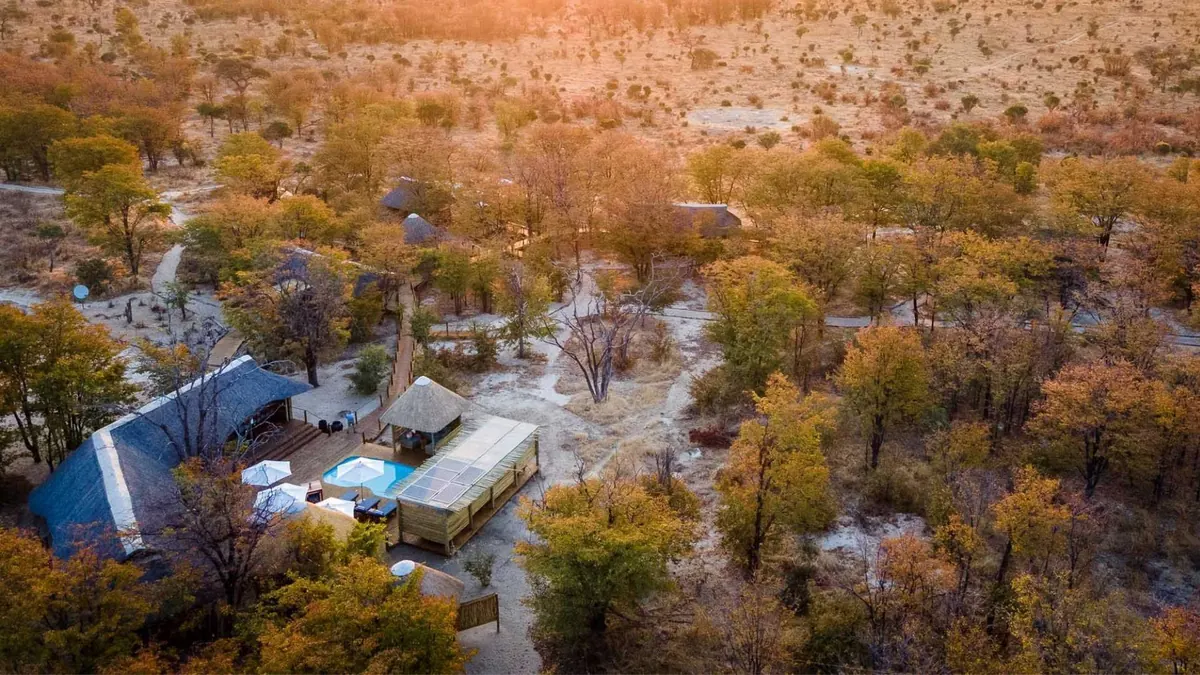
Mankwe Tented Retreat is in NG43, a private concession of 85,000 hectares east of Moremi Game Reserve. The name means “mother leopard”. It is dry mopane country, not a water camp, and its real use is as a base: drives on the concession where only Mankwe’s vehicles operate, and full days out to Moremi and Khwai. It stays open all year.
What to expect
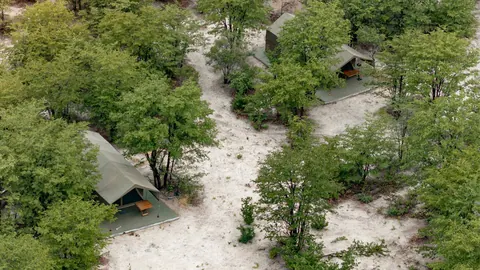
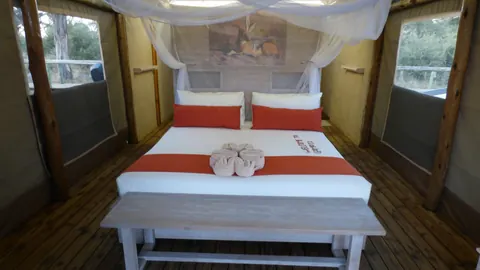
Ten Meru-style tented suites on raised wooden platforms under the mopane, each with a private balcony, king or twin beds, a bathroom with shower and twin basins, and a small desk. Power is solar. Raised walkways join the suites to two pools, two lounges, a spa and an open-air boma where Setswana food is cooked over the fire. Wifi is in the business lounge only.
Each day you choose between two shared concession drives, morning and afternoon, or one full-day drive to Moremi, Khwai or the southern Chobe side. A mokoro outing is part of the stay when the water is up. The operator names elephant, buffalo, lion, leopard, cheetah and wild dog for the concession, and Pel’s fishing owl for birders.
Practical details
- Road transfer from Maun airport takes 2 hours 30 minutes to 3 hours. The operator’s page gives the distance as both 85 km and 92 km.
- A helicopter from Maun takes about 30 minutes and lands on the concession. Light aircraft use Khwai Private Airstrip, about 3 hours 30 minutes away by road.
- GPS from the operator: 19°21’45.1”S 23°53’48.1”E.
- Children from age 7.
Good to know
The dry months of May to October are the operator’s pick for game, but by September and October days can pass 40°C, which is when the two pools earn their keep. November to March is the rainy season, good for birds and young animals. Camelthorn Bush Camp, on the same concession, is the simpler and seasonal alternative.
Last updated 12 October 2026. Sources: Hideaways Africa, Mankwe Tented Retreat, Hideaways Africa, Camelthorn Bush Camp.
Mankwe: a leopard's name and a wild dog pack at the pool
The Hideaways name over the door is recent. On 1 December 2009 a member in London on the 4x4 Community forum passed on an emailed special from “Mankwe Bush Lodge”, sold in one breath with Mogotlho Safari Lodge and Mboma Boat Station. When a volunteer put the place on OpenStreetMap in October 2014 it went in under that same name, as a guest house, and nobody touched the entry until a Hideaways account renamed it in September 2026. I found no dated record of when the lodge changed hands, so I am not going to guess at one.
A stop on the way to Chobe
Self-drivers had it on their maps early. About a kilometre south of the lodge is a campsite that was mapped in January 2012 as Mankwe Mopani Camp, and the 2009 email took the trouble to leave camping out of its offer. In January 2019 a forum member planning a return to the Delta summed up an earlier trip as Maun, Mankwe Lodge, Chobe, Kasane. That is still the lodge’s geography in one line. Maun is behind you, Moremi is to the west, and the nearest village is Sankuyo, under 10 km to the south, which had 372 people at the 2001 census.
The same leopard as Pilanesberg
Nkwe is the word for leopard in Setswana, Sesotho and Northern Sotho (two or more are dinkwe), and the operator gives Mankwe as “mother leopard”. South Africans will know the name from somewhere else. Mankwe Dam is the biggest water in Pilanesberg, built by the Boer farmers who took up the land there in the 1860s and called Houwater before it was renamed.
Do not book on the strength of the name. Leopard is on the operator’s species list for the concession, but the one dated account of a stay I could find does not mention seeing one.
Nine dogs and a stick
That account is on the operator’s own blog, written by the Hideaways staff member who hosted four travel agents, so read it as what happened once, not as odds. The group landed by helicopter on 23 October 2025 and was being walked round camp when wild dogs trotted past the plunge pool. Later that afternoon they watched the pack, nine of them, for almost half an hour while the pups tumbled about with a stick.
The timing fits. Wild dogs in southern Africa mostly breed between April and July, and a pack gives up its den once the pups are eight to ten weeks old and can follow the adults. At Mogotlho, the same operator’s lodge on the Khwai, pups were born in the third week of May 2026 and the pack was expected to stay around the den until September. By late October the young are out and moving. Wild dogs in the Okavango have been studied since 1989, when the Botswana Wild Dog Research Project began. It is now a programme of Wild Entrust, founded by J. W. McNutt and Lesley McNutt, which counts more than 120 scientific papers.
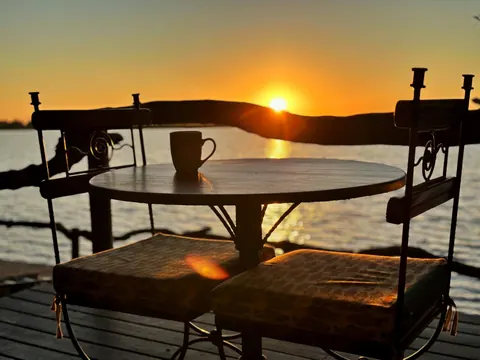
Her lions were not on the concession at all. They came on the full day in Moremi: two fed males asleep under a tree, and four lionesses with a cub keeping to the shade. The evening drive at Mankwe with a guide called MG ended at a sundowner on an open pan, and she names no animal from it.
That silence is easy to believe. A mopane leaf is shaped like a butterfly, two leaflets on one stalk. On sandy ground the trees are single-stemmed and 10 to 15 metres tall. On clay the same species is many-stemmed scrub of one to three metres, and you look into it, not through it.