Place to stay · North-West District
The Dune Camp
Bush Ways camp in the 43,000 hectare Deception Valley Private Reserve, on the north-eastern boundary of the Central Kalahari Game Reserve. Game drives and walks with San guides.
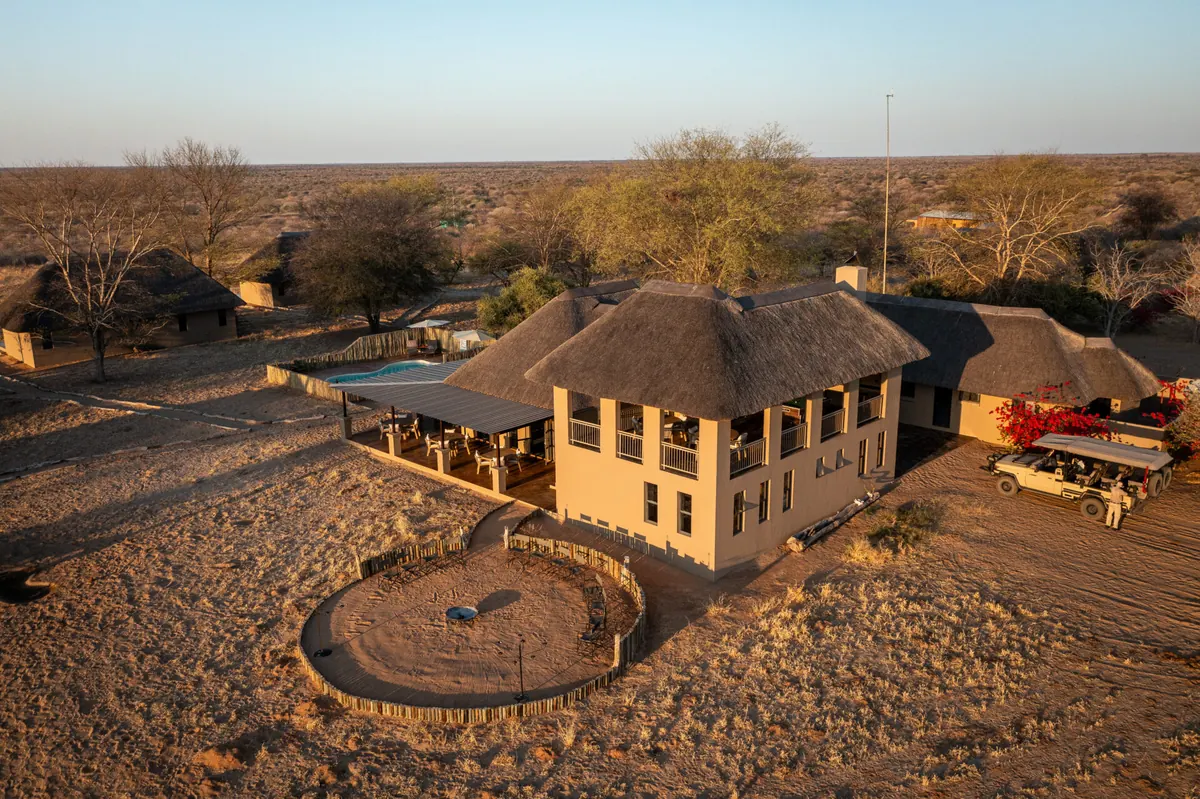
The Dune Camp belongs to Bush Ways, the Maun safari company that has been running trips since 1996. It stands in the Deception Valley Private Reserve, 43,000 hectares of private Kalahari on the north-eastern boundary of the Central Kalahari Game Reserve. The same reserve holds its sister property, Deception Valley Lodge. You stay here for dry-country animals and for time with San guides.
What to expect
The reserve is vegetated dunes, natural pans and a valley, with waterholes and hides set up for viewing. Drives go out by day and at night. Bush Ways names black-maned lion, cheetah and leopard among the predators, with brown hyena and pangolin as the harder ones to find. Springbok and oryx gather in large herds after rain.
The second activity is a walk with Naro-speaking San guides, who show how they track, which plants they use as medicine and how they hunted. The San have lived in this part of the Kalahari for thousands of years, and this is their knowledge, told by them.
Practical details
- Phone: +267 686 3685 (Bush Ways office, Maun).
- The camp can be reached by road or by air. Transfers from the reserve’s own airstrip are part of the stay.
- Stays are full board with activities and laundry included.
- Bush Ways also puts the camp at the start of its longer lodge itineraries north to Chobe and Victoria Falls.
Good to know
The Kalahari turns green in the rains, from December to April, and that is when the herds gather on the grass and the predators follow. In the dry months the animals spread out and the land turns bare.
Last updated 12 October 2026. Sources: Bush Ways, The Dune Camp, Bush Ways, Kalahari and Deception Valley Private Reserve, Bush Ways, Deception Valley Lodge, Wikipedia, Central Kalahari Game Reserve.
Eight cattle farms and a gate with a hyena on it
The last landmark on the road to The Dune Camp is a gate with a tall pole beside it and a brown hyena sign on top. Before that you follow big black tyres painted with the name of Dinaka, another private reserve out this way. The reserve’s own directions use them as markers from the first one, about 15 km out of Maun on the Samedupi road: roughly 70 km of gravel towards Somelo, then sand through cattle fences to Dinaka’s gate and along the reserve’s own fence. Bush Ways allows four hours for the 160 km.
Eight farms with the fences pulled out
Those cattle fences explain the place. This strip along the top of the Central Kalahari Game Reserve is the Hainaveld, and the reserve’s owners say it was cut into cattle farms in the 1960s. The owners are three Dutchmen, Bart Kramer, Berry Hooijer and Jamal Attari. By their own account they bought Deception Valley Lodge in 2017 with three old farms round it, 15,000 hectares, and added five more farms and 28,000 hectares in 2019. Then the wire between the farms came out.
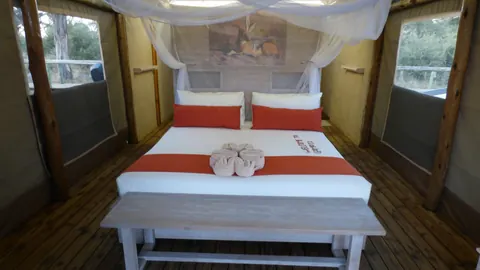
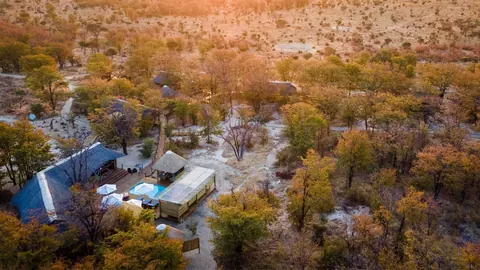
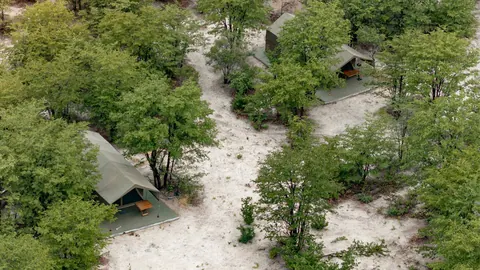
The lodge was there long before them. A Kalahari man called Braam Badenhorst built it with San friends, and Expert Africa has guest reports from it going back to 2007. The Dune Camp is the second camp on the same land: thatch on a sand ridge, four chalets and two family units, two waterholes in view from the deck.
One thing the brochures skip. Expert Africa points out that every private reserve on this boundary still has a fence round the outside, so the herds cannot come and go with the rain as they do in the park. What is inside stays inside all year, and the animals are easiest to find from about July to October, with the grass down and little water about. The park itself peaks in the wet summer.
What walks up to the water
Expert Africa has had its guests at Deception Valley Lodge log sightings since mid-2018. Every species scores either 100 per cent or nothing, which points to a short pile of reports. Lion, giraffe and brown hyena are in all of them. Cheetah, leopard, elephant and pangolin are in none. At Dinaka the hyena is in about one report in seven.
Lions are the safer bet. The reserve published one guest’s account of two nights at The Dune Camp in which a lioness and four nearly grown young walked past the dinner table, drank, chased a porcupine and lay down in front of the rooms. It is a single account, on the reserve’s own site, but it fits the neighbours. Expert Africa warns that lions move through the unfenced lodge regularly, and Dinaka strung low electric wire under its decks after lions took to lying beneath the chalets.
That guest also wrote of a lone leopard on a morning drive and elephants at the waterhole, neither of which is in Expert Africa’s lodge records. The elephants are no fluke, though. Deception Valley Lodge keeps a low electric fence round its pool so they don’t drink it.
Expert Africa’s own team found the game thin on their drive. What held them was at the pans: the better part of an hour of red-billed quelea, a flock they put at a million, with falcons, eagles and even vultures diving through it.
Twenty-eight clicks, not thirty-seven
The reserve’s website gives the trackers’ language, which it spells Naru, 37 clicks. The click table drawn from Hessel Visser’s Naro dictionary of 2001 has 28: four clicks, each made seven ways. Around 10,000 people speak Naro, and the dictionary was published by a language project the Reformed Church started at D’kar in the 1980s. The lodge next door carries a Naro name: Gham Dhao means lion tracks.
Expert Africa describes the walk as run from the lodge: the trackers bring their families, everyone wears traditional dress and a translator interprets. Its writers liked that nobody pretended to live the old way any more. The trackers carry no rifle, and an armed guide comes only if you ask for one.