Place to stay · Keetmanshoop
Quiver Inn Guesthouse
A self-catering guesthouse at 8 Pastorie Street in central Keetmanshoop, with kitchenettes in every room, family units with full kitchens, a pool and breakfast on request.
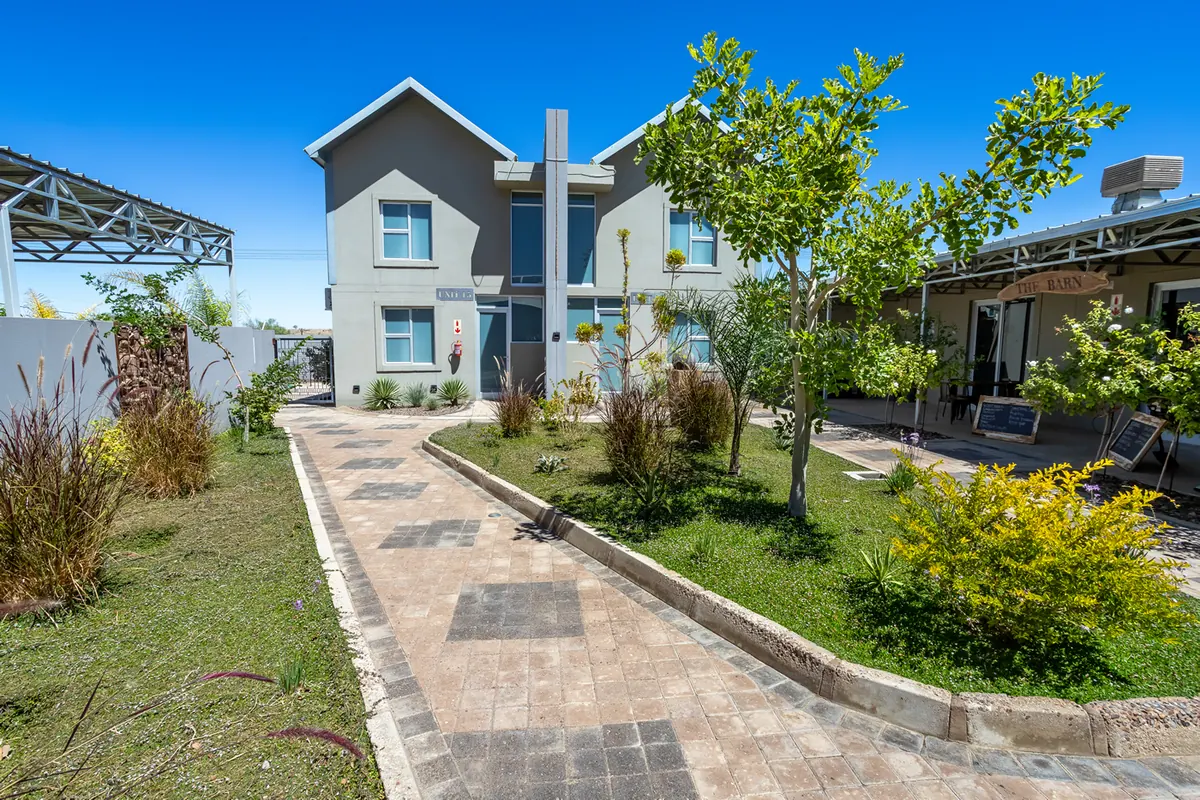
Quiver Inn is a guesthouse at 8 Pastorie Street, in the middle of Keetmanshoop, the main town of the ǁKaras Region (Karas). It suits people who like to cook for themselves, as every room has a kitchenette and the bigger units have full kitchens. It is listed with the Namibia Tourism Board. Families and groups breaking the long B1 drive between Windhoek and South Africa are the obvious fit.
What to expect
Rooms run from singles with a three-quarter bed up to twins, doubles and family rooms. Each has an en-suite bathroom, a TV, air-conditioning and its own kitchenette. For larger groups there is a family apartment with a living room and full kitchen, and a duplex unit with sleeping areas on two floors, a kitchen and a braai area. Breakfast (buffet and hot) is available if you ask for it. There is a swimming pool, a courtyard garden, a small bistro serving light meals, and parking on the premises.
Practical details
- Address: 8 Pastorie Street, Keetmanshoop.
- Phone +264 81 855 3835, email info@quiverinnguesthouse.com or quiverinn@gmail.com.
- Book online through the guesthouse website.
- Wi-Fi is free.
Good to know
You are in the middle of town, so the museum in the old Rhenish Mission Church and the old German-style town centre are on your doorstep. The Quiver Tree Forest is about 15 km out on the M29, with the Giant’s Playground a few kilometres beyond it. The guesthouse also suggests the Fish River Canyon as a day trip, which makes for a long day, so start early.
Last updated 7 October 2026. Sources: Quiver Inn Guest House, Quiver Inn Guest House, Quiver Inn Guest House, Quiver Inn Guest House, Namibia Tourism Board, Wikivoyage.
A stone from Solomon's quarry, five minutes from your room
Some time before 1945 a Dutch Reformed minister called S. van der Spuy went to a quarry in Jerusalem, the one said to have supplied King Solomon’s temple, and cut out a block of stone with his own hands. He brought it back to Keetmanshoop. It became the cornerstone of the Dutch Reformed church, about 400 metres north of Quiver Inn.
The story comes from a newspaper clipping kept among the papers of the architect Gerard Moerdyk at the University of Pretoria. It has no date on it, but it calls the congregation barely twenty years old (it was founded in 1924), says the stone was to be laid the following weekend and mentions that ds. J. R. Holzapfel had just arrived, which puts it at about 1944 or 1945. Van der Spuy had been the minister here from 1938 and was already the former one when the paper went to press. How and when he came to be in Jerusalem, the clipping does not say.
A workshop before a tower
The congregation started out in a converted workshop, a smithy by one account and a wagon-maker’s by another, handed over by the mother congregation at Gibeon. In 1934, short of money, it asked every member for a tenth of their income, and from November 1941 it collected for a proper building meant to seat 1,200 people. The pulpit was paid for by the Sunday school and the church’s youth society. When the church was finished it was the first Dutch Reformed one in the territory with a tower, and stayed the only one until Windhoek’s opened in March 1951. Its pipe organ, 35 stops, came into use in November 1950.
Pastorie is Afrikaans for a parsonage, so the street the guesthouse stands on is a church street by name.
The club at the end of the street
Quiver Inn calls itself modern and its website has nothing to say about the past. Its street does. Pastorie Street is about half a kilometre long, and at its south-western end, on the corner with Cathedral Street, is the Schützenhaus. The marksmen’s club there dates from 1907 (the photographer Hugh Bland gives 1905 to 1907 for the clubhouse) and is usually described as the oldest German club in southern Africa. It stayed a club for most of a century. Now it takes guests and feeds them. Bland photographed German flags there, and a picture captioned Springboks 1953.
An eagle, a bandstand and a shepherd
A few minutes’ walk north instead brings you to the small park beside the old post office. The obelisk in it carries a bronze imperial eagle. Nobody recorded when it went up, only that it was after 1907. Its plaques remember German dead from 1897, from the Bondelswarts rising of 1903, and the soldiers and settlers of the district killed between 1904 and 1907. Volunteers who photographed the memorial in May 2025 recorded two Second World War plaques as well. Each November there used to be a service here, and now and then a Nama brass band played from the bandstand next to it.
The post office was drawn in 1908 by Gottlieb Redecker, the colonial government’s builder, and came into service on 1 August 1910. The broad tower on its gable was not for show. It held the telegraph antenna.
Just south of the park, on Fifth Avenue, is a two-metre bronze of a Nama shepherd holding a newborn lamb, a grown karakul at his side. Christina Salvoldi, a Windhoek-born sculptor who was 23 at the time, made it, and it was unveiled on 13 September 2007 by the agriculture minister, Nickey Iyambo. Why a town would put up a statue to a sheep is on our Keetmanshoop page.