Park · Northern Cape, South Africa
Mokala National Park
Young, malaria-free, predator-light park south-west of Kimberley where the Kalahari meets the Karoo, kept for rare roan, sable, tsessebe and both rhinos.
Short answer
At Mokala National Park, international visitors pay R306 (about US$17.50, €16 or £13.50) per adult and R156 per child per day. The rates apply from 1 November 2026 to 31 October 2027.
- Daily fee, international adult
- US$18 €16 · R306
- Malaria
- Mokala is malaria-free, so no tablets are needed.
- Places to stay
- 6
- Where
- Northern Cape, South Africa29.11°S 24.38°E
Mokala National Park fees 2026/27
Checked South African National Parks tariffValid 1 November 2026 to 31 October 2027, per person per day, in rand.
| Who | Adult | Child |
|---|---|---|
| International visitorsUS, Europe and everyone else | US$18 €16 · R306 | US$9 €8 · R156 |
| SADC nationals | R135 | R67 |
| South African residents | R66 | R33 |
- These rates apply from 1 November 2026.
- Adults are 12 and older. Child rate applies to ages 2 to 11; children under 2 enter free.
- Members of the SANParks WILD loyalty programme (Wild Card) do not pay daily conservation fees if they show ID and their card on arrival.
- Wild Card holders do not pay daily fees. Is the Wild Card worth it for you?
- Fees are set by South African National Parks. Official tariff · Seen a new rate? Tell us
US$1 = R17.47 · €1 = R19.20 · £1 = R22.93 (ECB rate, 20 Nov 2026). Converted amounts are approximate; you pay in rand.
How we got these figures
- Checked against the official SANParks tariff on 7 October 2026. Before that these figures came from published reports (places.co.za). They matched the official sheet.
- SANParks conservation fees 2026-11-01 to 2027-10-31 (official tariff) · official · checked 7 Oct 2026
Mokala is one of South Africa’s youngest national parks (only Meerkat, declared in 2020, is newer), proclaimed in June 2007 to replace Vaalbos after that park was lost to land claims. It lies about 75 km south-west of Kimberley in the Northern Cape, in the overlap between Kalahari thornveld and Nama Karoo: red sand and camel thorns in the north, rocky koppies and open grass plains in the south. The name is Setswana for the camel thorn tree. It was set up as a breeding ground for rare antelope, so there are no lions or other big cats, which makes it unusually relaxed.
Getting there
There are two gates. For Lilydale, drive the N12 from Kimberley towards Cape Town for about 37 km, turn at the Lilydale signboard near Ritchie and follow 16 km of gravel. For Mosu, drive about 57 km south-west from Kimberley to the Hayfield or Heuningneskloof crossing and follow 21 km of gravel to the gate. The park sits right on the N12 between Johannesburg and Cape Town, so it works as a stopover.
When to go
Autumn (April and May) and spring (around September) are the comfortable months. Midwinter has clear sunny days, but June and July are the coldest months and nights can drop to minus 4. Summer (December to February) runs 33 to 36 degrees and has peaked at 44, with thunderstorms. Those storms matter: the gravel road between Mosu and Lilydale often closes after heavy rain in that period. It is malaria-free year round.
What to do
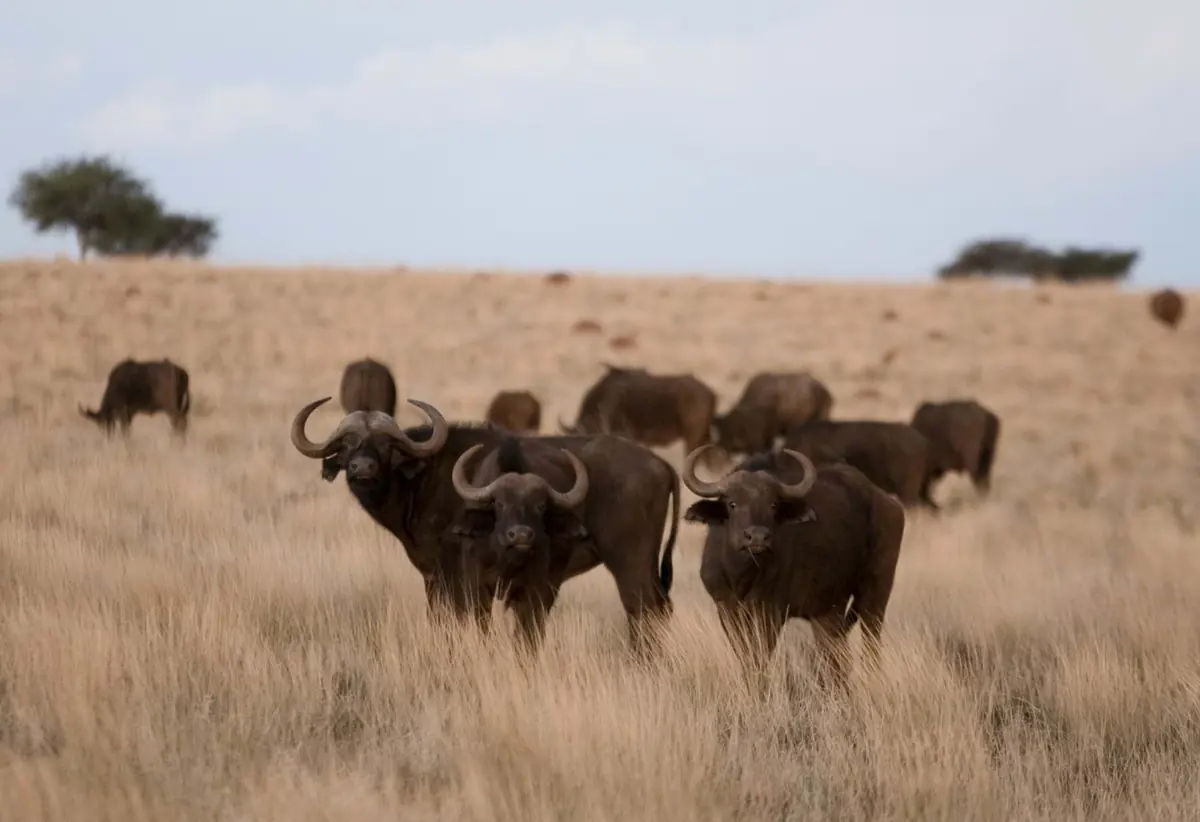
Self-drive game viewing on the gravel road network is the main event. The animals to look for are roan, sable and tsessebe, which are hard to see anywhere else in the country, plus black and white rhino, buffalo, giraffe, eland, kudu, gemsbok, red hartebeest, both wildebeest species and zebra. Smaller things stand out because nothing bigger is hunting them: aardvark and aardwolf after dark, bat-eared fox and pygmy falcon by day. At least 139 bird species are recorded, including white-backed, lappet-faced and Cape vultures.
Guided early-morning and sunset drives go out from the camps. A guided heritage tour visits San rock engravings in the park. The Riet River at Lilydale allows catch-and-release fly fishing for yellowfish. The Stofdam bird hide is the best sit-and-wait spot.
Good to know
- No fuel and no shop in the park. Fill up before you turn off the N12 and bring all your food.
- High clearance is strongly advised; a low sedan struggles on some roads, especially after rain.
- Camps are Mosu Lodge, the main camp (pool; reports differ on whether its restaurant is open, so ask the park on 053 204 8000 before counting on a meal), Lilydale Rest Camp (12 self-catering cottages on the river, pool), the Haak-en-Steek cottage at a waterhole, the Motswedi campsite (six sites, each with its own ablutions), a sleep-out bird hide at Stofdam, and the Kameeldoorn tree house, which the park itself calls Kameeldoring (no electricity) with a two-night minimum.
- Phone signal is poor. One network (MTN) works at Lilydale and intermittently at Mosu reception; expect nothing elsewhere.
Wildlife you might see
15- likelyTsessebeWaterholes at Mosu camp, Haak-en-Steek and Motswedi campsitesource
- likelyBuffaloMosu camp waterhole and the Motswedi campsite waterholesource
- likelyRed hartebeestMosu camp waterholesource
- likelyKuduMosu camp waterhole and the Stofdam bird hidesource
- likelyPlains zebraHaak-en-Steek and Motswedi waterholessource
- likelyGiraffesource
- possibleRoan antelopeStofdam bird hide is a good place to waitsource
- possibleSable antelopeStofdam bird hidesource
- possibleBlack and white rhinoThe Matopi Loop is a good drive for bothsource
- possibleBat-eared foxsource
- possiblePygmy falconsource
- possibleVultures (white-backed, lappet-faced, Cape)source
- rareAardvarkGuided sunset and night drives. After darksource
- rareAardwolfGuided sunset drives. After darksource
- rareBrown hyenasource
Likelihood is for a normal visit of two or three days, from the sources linked. Nothing is guaranteed in the wild.
Staying safe in Mokala National Park
- Malaria
- Mokala is malaria-free, so no tablets are needed. There are mosquitoes in summer, so pack repellent anyway. source
- Stay in your car
- Rhino and buffalo roam the park and can be very dangerous if surprised or made to feel threatened. Stay in your car on game drives and never walk up to an animal. source
- Gravel roads after rain
- Roads inside the park are sand and gravel and can be in poor shape. After heavy summer storms (December to February) some roads, including the link between Mosu and Lilydale, may close, and a low sedan can struggle. High clearance helps. source
- Heat and cold
- December and January are the hottest months and can reach 44 degrees, while June and July nights can drop to minus 4. Carry water, a hat and sunscreen in summer and warm layers in winter. source
Tips from travellers
- There is no fuel in the park, so fill up before you get there. Modder River (Modderrivier) is the closest place to refuel. several sources
- There is no shop in the park either. If you are self-catering or camping, bring all your food and drink with you. one source
- Phone signal is thin. Only MTN works, at Lilydale and on and off at Mosu reception, so download maps and bookings before you arrive. one source
- Give it at least two nights. Autumn (April and May) and spring (September) are the most comfortable months; midsummer and midwinter are extreme. official
- The Stofdam bird hide and the Kameeldoorn tree house are booked by phoning the park directly (+27 53 204 8000), not through the usual online system. one source
- Book a guided sunset drive if you want a real chance at aardvark and aardwolf, which are hard to find on a self-drive. one source
Checked 7 October 2026. Conditions change, so confirm with the park or venue before you go.
In and around Mokala National Park
9 places listedWhere to stay in Mokala National Park 6
- 29.04°S 24.50°EChaletLilydale Rest Camp Mokala
- 29.15°S 24.31°EChaletHaak-en-Steek Cottage
- 29.10°S 24.41°EChaletKameeldoring Treehouse
- 29.17°S 24.37°EResortMofele Lodge
- 29.17°S 24.35°EResortMosu Lodge
- 29.15°S 24.34°ECampsiteMotswedi Campsite
Sights 3
- Grootbek Fishing SpotAttraction
- Lilydale Hide / Lookout pointAttraction
- Rhino toiletViewpoint
Quick answers
How much is the entry fee for Mokala National Park?
International visitors pay R306 (about US$17.50, €16 or £13.50) per adult and R156 per child per day. These rates apply from 1 November 2026 to 31 October 2027 and are set by South African National Parks (SANParks).
Do South Africans and SADC citizens pay less at Mokala National Park?
South African residents pay R66 per adult and SADC nationals pay R135 per adult per day. You need ID or a passport to get the lower rate.
When were these Mokala National Park fees last checked?
We last checked them on 7 October 2026 against 1 published source. We re-check every two weeks, but always confirm with South African National Parks (SANParks) before you travel.
What animals can you see in Mokala National Park?
You have a good chance of seeing tsessebe, buffalo, red hartebeest, kudu, plains zebra and giraffe. Aardvark, aardwolf and brown hyena are there but rarely seen.
Mokala and the parks nearest it
| Park | International adult | Distance | Where |
|---|---|---|---|
| Mokala National Park | US$18 €16 · R306 | · | Northern Cape |
| Barberspan Nature Reserve | US$16 €14 · R275 | 305 km | North West |
| Camdeboo National Park | US$13 €12 · R227 | 349 km | Eastern Cape |
| Mountain Zebra National Park | US$20 €19 · R358 | 359 km | Eastern Cape |
Where the Mokala fees come from
Open data: all park fees (CSV) · JSON (CC BY 4.0)
Cite as: Travel Africa Guide, "Mokala National Park fees 2026/27", checked 7 October 2026, https://travelafrica.guide/south-africa/mokala-national-park/
Map of Mokala National Park
See every place on this map as a list