Town · Western Cape, South Africa
Oudtshoorn
Ostrich capital of the Klein Karoo, an hour or so inland from the Garden Route. Base for the Cango Caves, meerkat tours at dawn and the gravel Swartberg Pass.
Short answer
Oudtshoorn is in Western Cape, South Africa. This page lists 34 places to stay, 28 places to eat and drink and 10 sights. The nearest park with an entry fee on this site is Karoo National Park, about 148 km away, where international adults pay from R358.
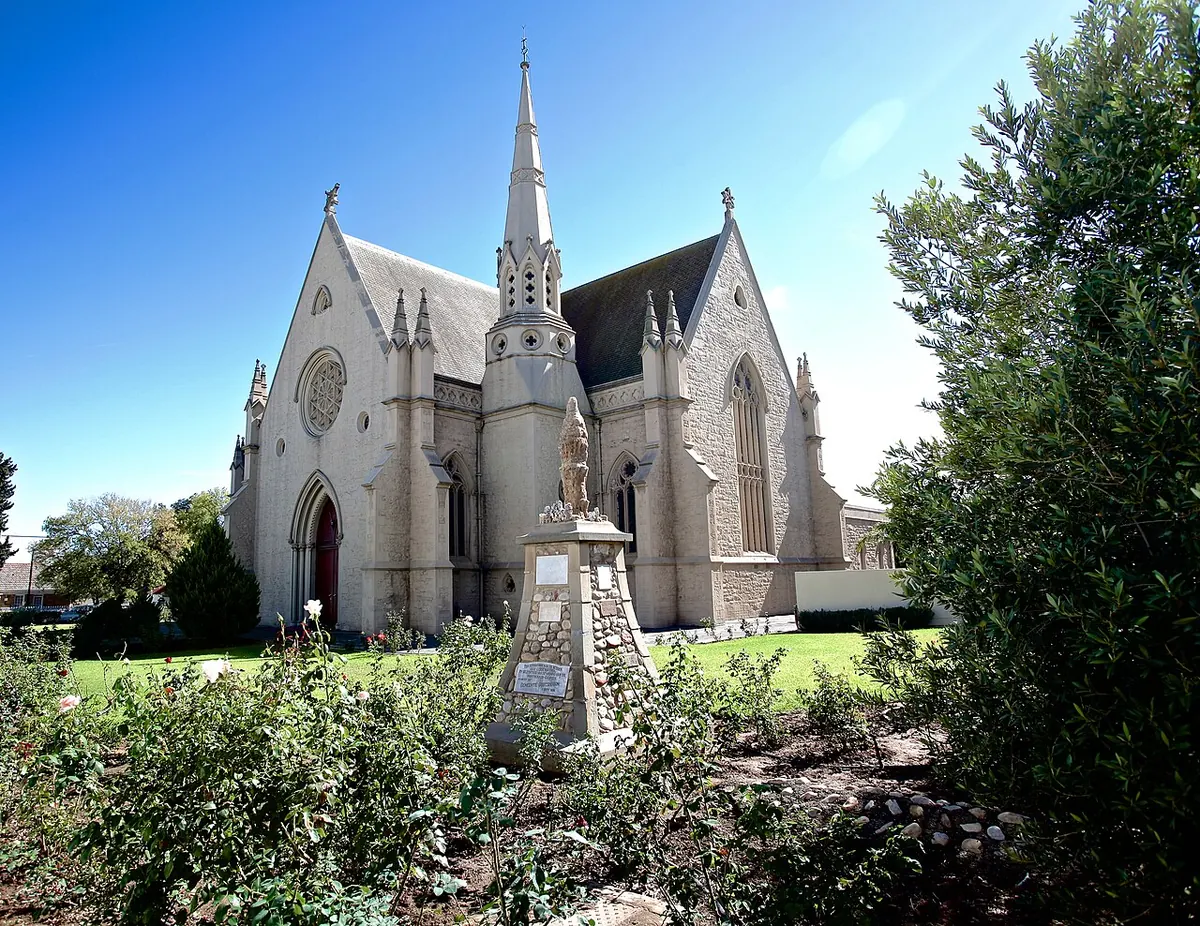

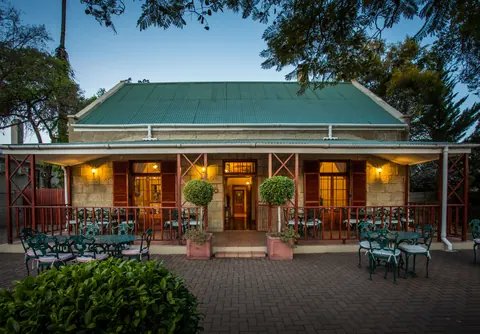
- Places to stay
- 34
- Eat and drink
- 28
- Sights
- 10
- Park fee nearby: Karoo National Park
- US$20 €19 · R358about 148 km away
In and around Oudtshoorn
72 places listedWhere to stay in Oudtshoorn 34
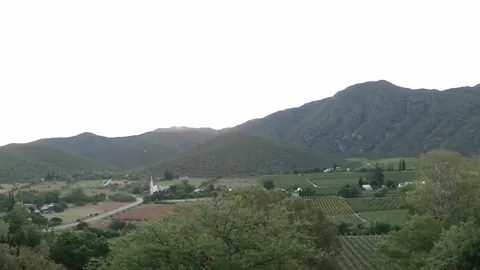 Guest houseAltes Landhaus+27 44 272 6112alteslandhaus.co.za
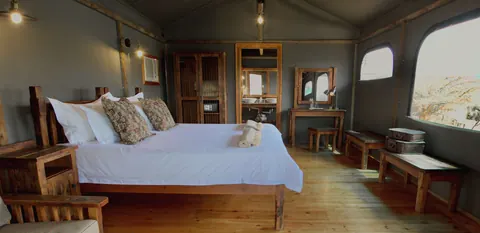 HotelBuffelsdrift Game Lodge+27 44 272 0000buffelsdrift.com
- 33.59°S 22.19°EGuest houseBisibee Guest HouseChurch Street+27 44 272 4784bisibee.co.za
 Guest houseEarthbound Guest HouseNaude Street, Oudtshoorn+27 44 272 7902earthboundbb.co.za
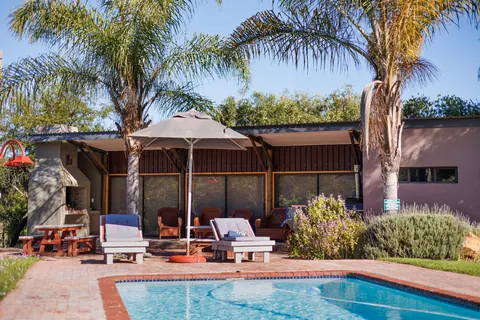 MotelKranskloof Country Lodge+27 44 272 3568kranskloof.com
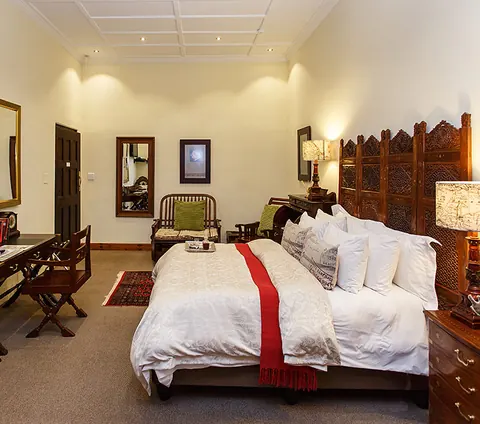 Guest houseRiverside Guest Lodge+27 44 272 6424riversideguestlodge.co.za
- 33.57°S 22.20°EHotelSonas Boutique HotelAlphen Rijn Street, Oudtshoorn+27 67 304 1929sonaswesterncape.co.za
- 33.46°S 22.25°EGuest houseOld Mill Country Lodge+27 83 900 7970deoudemeul.co.za
Show all 34 places to stay
- ArtKaroo Stay · Guest house+27 74 481 6517artkaroo.co.za
- The Gumtree Guest House · Guest house · Church Street
- Best Little Guest House · Guest house
- Surval · Hotel · regional
- AfriCamps Klein Karoo · Hotel
- Backpackers Paradise · Hotel
- Berluda · Guest house
- Boulders Lodge · Hotel
- Cango Caves Estate Manor House · Guest house
- Chandelier Game Lodge · Hotel
- De Opstal Country Lodge · Hotel
- Frischgewaagd B&B · Guest house
- Guest House Esterer · Guest house
- Kangoo Bergort · Chalet
- Kangoo Campsite · Campsite
- Karoo Retreat · Guest house
- Kleinplaas · Chalet
- NA Smit · Chalet
- Oakdene Guest House · Guest house
- Oasis Shanti · Campsite
- Oppi Dam · Campsite
- Oudtshoorn Guest House · Hotel
- The Baron · Hotel
- The Pearl · Hotel
- Protea Hotel Oudtshoorn Riempie Estate · Hotel · Baron van Reede Street, Oudtshoorn+27 44 272 6161
Sights 10
 Cango Ostrich FarmAttraction+27 44 272 4623cangoostrich.co.za
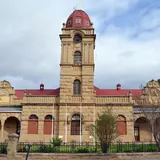 CP Nel MuseumMuseum
- Cango Wildlife RanchZoo+27 44 272 5593cango.co.za
- Ma Betty's Cultural VillageAttraction+27 92 693 2944mabettys.co.za
- Cango Caves ZiplineAttraction · at Cango Caves Estate, R328
- Le Roux Town HouseMuseum
- Ostrich farmAttraction
- Safari Ostrich FarmAttraction
- ViewpointViewpoint
Restaurants and cafes 28
- Beansie Coffee CafeCafe · coffee shop · Baron van Reede Street, Oudtshoorn+27 82 380 2984beansaboutcoffee.co.za
 Bella CiboRestaurant · italian · Saint Saviour Streetbellocibo.co.za
 Karusa Winery & Micro BreweryRestaurant+27 44 272 8717karusa.co.za
- The Beans CaféCafe · coffee shop · Kerk Street, Oudtshoorn+27 82 380 2984beansaboutcoffee.co.za
- Beans about Coffee OudtshoornCafe · coffee shop · High Street, Oudtshoorn+27 82 380 2984beansaboutcoffee.co.za
- Tall Goose - Beans About CoffeeCafe · coffee shop · Rademeyer Street, Oudtshoorn+27 82 455 4695beansaboutcoffee.co.za
- De Oude Meul RestaurantRestaurant · regional, pizza, burger+27 83 900 7970deoudemeul.co.za
- NostalgieRestaurant · african+27 44 272 4085
- The SpekboomRestaurant · regional
- Jemima's RestaurantRestaurant · Baron van Reede Street+27 44 272 0808
- Corner Deli & Take AwaysRestaurant+27 83 727 2908
- Ebony & IvoryRestaurant · Baron van Reede Street, Oudtshoorn
Show all 28 restaurants and cafes
- Route 62 · Restaurant · barbecue
- Wilgewandel · Restaurant
- Barista's coffee chop · Cafe
- Café Brûlé · Cafe
- De Oue Werf · Cafe
- Esterer Restaurant · Restaurant
- Headlines · Restaurant
- La Dolce Vita · Restaurant
- Mugg And Bean · Restaurant
- Pancake Bizarre · Cafe
- Plato · Cafe
- Santa Fe · Restaurant
- Signature Divine · Restaurant
- Su Casa · Restaurant
- The Black Swan · Restaurant
- Ocean Basket · Restaurant · seafood
Oudtshoorn is the biggest town in the Klein Karoo, a dry valley between the Outeniqua Mountains to the south and the Swartberg to the north. It got rich twice on ostrich feathers, in the 1860s and again before the First World War, and the feather palaces built by the feather barons are still there, mostly on the west bank of the Grobbelaars River. Today it is about ostrich farms, the Cango Caves, meerkats and the mountain passes, and it makes a good two-night break from the coast.
Getting there
From George the N12 climbs over the Outeniqua Pass; the drive from Wilderness takes about an hour and twenty minutes. From Cape Town it is roughly five hours, usually via the R62 through Montagu, which is the better road for scenery. There is no airport; George is the nearest. Coaches and minibus taxis connect with George. You need a car for everything outside town.
When to go
This is semi-desert. Summer highs are around 29°C and often well above; winter lows drop to about 6°C with cold nights. Rainfall is only about 370 mm a year, so it is dry most of the time. The KKNK, South Africa’s largest Afrikaans arts festival, takes over the town in late March and early April, and accommodation goes early. Spring and autumn are the comfortable months. In summer do the outdoor things early and spend the afternoon by a pool.
What to do
The Cango Caves are about 30 km north in the foothills of the Swartberg and open from 09:00 to 16:00. There are two tours: the Heritage Tour, about an hour through the big chambers, and the Adventure Tour of around 90 minutes, which involves crawling through tight passages and is not for anyone who dislikes confined spaces. Book ahead in season. Meerkat Adventures takes small groups out before sunrise (around 05:30) to sit roughly 10 m from a habituated meerkat family as it emerges; on cold, cloudy or windy mornings the animals come out late or not at all, so bring warm clothes and patience. Highgate, Safari and Cango are the ostrich show farms. Buffelsdrift runs game drives and meerkat visits, and Cango Wildlife Ranch has big cats and reptiles.
The Swartberg Pass is the great drive. Thomas Bain’s gravel road climbs to 1,585 m and drops to Prince Albert in about an hour and a half; come back on the tarred road through Meiringspoort via De Rust to make a four-hour loop. The CP Nel Museum in town covers the feather boom.
Good to know
The Swartberg Pass closes after heavy rain or snow, so ask before you set out. Oudtshoorn is on Route 62 and the Klein Karoo is one of the richest succulent regions anywhere, with around 3,800 plant species. The tourism office is at 80 Voortrekker Street. Afrikaans is the first language of almost everyone here, though English is understood everywhere that deals with visitors.
History and culture
Oudtshoorn is the main town of the Klein Karoo (Little Karoo, the dry valley between the Swartberg and the coastal mountains). Its story is the ostrich: twice, in the 1870s and again before the First World War, feathers for European fashion made farmers here very rich, and twice the market crashed. The feather palaces and the synagogue inside the museum go back to those booms. The townships of Bridgeton and Bongolethu go back to apartheid's forced removals.
- Prehistory
Cave paintings and stone tools in the Cango Caves show that people used the caves over a very long period in the Middle and Later Stone Age, long before any farmer arrived. source
- 1750s
Settler farmers from the Cape Colony moved into the valley from the 1750s and were well established by 1800, keeping livestock and growing wheat, tobacco and vines for wine and brandy. Some of them owned slaves. From 1811 the area fell under the magistrate of George. source
- 1847 to 1863
In 1847 a farmer, CP Rademeyer, got the Cape government's permission to turn part of his farm into a town, and 476 plots were surveyed. He named it in memory of Geesje van Reede van Oudtshoorn, who was married to a magistrate of George and was a granddaughter of Baron van Reede van Oudtshoorn, second in command at the Cape under Dutch rule. It became a self-governing town with its first council on 26 August 1863. source
- 1860s to 1885
The first feather boom. Ostrich plumes became the fashion in Europe, and in the late 1870s a pair of birds could sell for as much as 1,000 pounds. Overproduction brought the price down suddenly in 1885. source
- 1901
During the South African War (the Anglo-Boer War of 1899 to 1902), Boer commandos (mounted guerrilla units of the Afrikaans-speaking republics) under Commandant Gideon Scheepers were sighted near Oudtshoorn on 25 August 1901. The town was strongly defended and they moved on. source
- 1902 to 1914
After the war came a second and bigger boom, when the feather barons built the grand houses known as feather palaces, most of them on the west bank of the Grobbelaars River. The market collapsed in 1914 with the start of the First World War, overproduction and the fashion for open-topped cars, and about four in five ostrich farmers went bankrupt. source
- 1943 to 1947
About 500 Polish children, most of them orphans, came to Oudtshoorn in 1943 at the invitation of Prime Minister Jan Smuts. Their families had been deported to Siberia by the Soviet Union after the German invasion of Poland and the Soviet annexation of eastern Poland in 1939. They lived in converted army barracks, with a school set up for them, until 1947. source
- 1961 to 1971
Apartheid's Group Areas Act (the law that reserved each part of a town for one race) was applied to Oudtshoorn on 21 February 1961, and thousands of Coloured and Black African people were moved out of town. By December 1961, 325 families had been moved to Bridgeton. In 1966 the township of Bongolethu was proclaimed and the shack settlement of Klippies Eiland was demolished. Removals went on until 1969, and in nearby Dysselsdorp they turned violent in 1971. source
- Language and people
- This is Afrikaans country. In the 2011 census 87.8% of people in Oudtshoorn gave Afrikaans as their first language, 7.4% isiXhosa and 2.6% English. Most residents are Coloured (the South African term for people of mixed descent), about 71%. source
- KKNK arts festival
- The Klein Karoo Nasionale Kunstefees (KKNK) is an Afrikaans arts festival that takes over the town every March with theatre, music and art. The 2027 festival runs from 23 to 27 March. source
- The Jewish community
- Lithuanian Jewish families fleeing Tsarist persecution came during the first feather boom and played a big part in the feather trade. The town had two synagogues (1888 and 1896) and was nicknamed the Jerusalem of Africa. The community numbered 1,073 in 1918 but had fallen to 555 by 1936. source
Main sights in Oudtshoorn
5- CP Nel Museum
Housed in the sandstone Boys' High School of 1906 to 1907, it covers ostrich farming and the feather trade, and it is one of very few secular museums anywhere with a synagogue inside, a rebuild of the St John Street synagogue as it was in 1896. Since 2014 it also tells the story of the town's forced removals under apartheid.
Wikipedia: CP Nel Museum - Le Roux Town House
A town house on High Street kept exactly as it was when the Le Roux family, well-off farmers from Bakenskraal outside town, stayed there on their trips to town every two weeks. At least 15 other old buildings in the same block, between Church Street and St Saviour Street, are marked with heritage plaques.
Oudtshoorn and De Rust Tourism: a town steeped in history - Arbeidsgenot
CJ Langenhoven's home, where he died in 1932. It is kept as it was when his family lived there, with furniture, some of it made by Langenhoven himself, who was a keen carpenter.
Oudtshoorn and De Rust Tourism: a town steeped in history - Cango Caves
Limestone caves in the Swartberg foothills north of town, used by Stone Age people long before a farmer found them in 1780. The first official guide, Johnny van Wassenaer, is said to have walked for 29 hours underground looking for the end of the caves in 1898.
Wikipedia: Cango Caves - Swartberg Pass
Thomas Bain's road over the Swartberg to Prince Albert, built by convicts between 1883 and 1888 and still gravel today. It is a piece of Victorian road building you can drive.
Wikipedia: Swartberg Pass
Did you know?
- CJ Langenhoven, who wrote Die Stem van Suid-Afrika in 1918, lived in Oudtshoorn. It was the national anthem under apartheid, and parts of it are still sung in today's anthem. source
- Langenhoven made up an imaginary elephant called Herrie for his stories, and in 1929 he carved its name on a boulder beside the road in Meiringspoort. The stone is now a provincial heritage site. source
- The first Hebrew school in South Africa opened in Oudtshoorn in 1904. source
- Bird flu has hit the industry hard. In 2011 an outbreak led to 38,000 ostriches being culled and an EU import ban, yet in January 2012 the area still had over 200,000 birds and produced about 80% of the world's ostrich products. source
- A farmer named Jacobus van Zyl is credited with finding the Cango Caves in 1780, and the first big chamber is still called Van Zyl Hall. Only about a quarter of the cave system, over 4 km long, is open to visitors. source
Checked 7 October 2026.
Map of Oudtshoorn
See every place on this map as a list