Town · Western Cape, South Africa
Robertson
Wine town in the Breede River Valley on Route 62, about an hour and a half from Cape Town. Dozens of cellars, river cruises, roses and a hot, dry summer.
Short answer
Robertson is in Western Cape, South Africa. This page lists 15 places to stay, 12 places to eat and drink, 5 sights and 1 hiking trail. The nearest park with an entry fee on this site is Bontebok National Park, about 61 km away, where international adults pay from R227.

- Places to stay
- 15
- Eat and drink
- 12
- Sights
- 5
- Park fee nearby: Bontebok National Park
- US$13 €12 · R227about 61 km away
In and around Robertson
41 places listedWhere to stay in Robertson 15
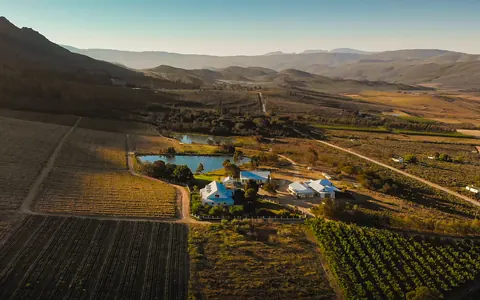 ChaletLangdam Farm+27 23 614 3497langdam.co.za
- CampsiteLangdam Farm+27 23 614 3497langdam.co.za
- 33.80°S 19.89°EGuest houseGUBAS DE HOEKReitz Street, Robertson+27 23 626 6218gubas-dehoek.com
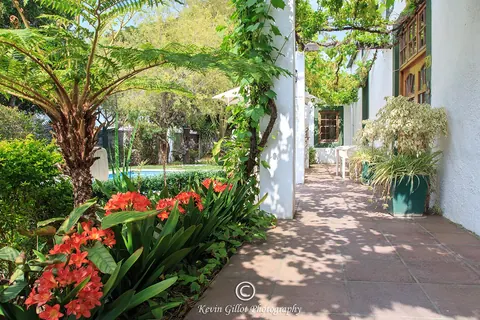 HostelRobertson Backpackers+27 72 447 5991robertsonbackpackers.co.za
- 33.80°S 19.89°EGuest houseArnheimPolack Street, Robertson+27 63 236 1773arnheim.co.za
- 33.84°S 19.75°ECampsiteRivierzicht ResortGoree/Riverside Road, Robertson+27 23 626 2013rivierzicht-resort.com
- 33.72°S 19.88°EMountain hutArangieskop hut+27 23 615 8038
- 33.81°S 19.89°EGuest houseCedar LodgeCedar Avenuecedarlodge62.co.za
- 33.81°S 19.89°EGuest houseThe LemonTree House
Show all 15 places to stay
- De Hoop Cottages · Guest house
- Goedereede Guest House · Guest house
- Little France · Guest house
- Robertson Small Hotel · Hotel
- Skurwekop · Caravan park
- Wederom, Hanepoot Huisies · Guest house
Sights 5
- Birds ParadiseZoofacebook.com
- Sophies ChoiceGallery · Paul Kruger Street
- Bon Cap WineryAttraction
- early house ruinRuins
- Pear StopViewpoint
Hiking trails 1
- Arangieskop TrailHiking trail · 23.5 km
Restaurants and cafes 12
 Cafe MaudeRestaurant+27 23 626 6806boncourage.co.za
- PeckersCafe · regional · Paul Kruger Street, Robertson+27 23 626 4495
- RagazziRestaurant · De Hoop Street, Robertson+27 63 262 5558ragazzirestaurant.co.za
- Bon Rouge BistroRestaurant+27 23 626 1628boncaporganic.co.za
- SimplicityCafe · coffee shop
- Bourbon StreetRestaurant · Voortrekker Avenue
- Pot-luckRestaurant · cape malay
- Reuben's at the Robertson Small HotelRestaurant · regional
- Bodega de VinhoRestaurant
- Cafe RosaCafe
- Grand CafeCafe
- Ou Meul RobertsonCafe
Wineries, breweries and distilleries 8
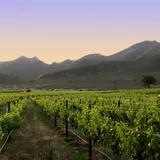 Orange Grove Farm Reception OfficeWinery · Noree, Robertson+27 23 100 0512orangegrovefarm.co.za
- SpringfieldWinery · Robertson+27 23 626 3661springfieldestate.com
- Bon CourageWinery+27 23 626 4178
- Klipdrift BrandyDistillery · Voortrekker Avenue, Robertson
- RobertsonWinery · Voortrekker Avenue, Robertson
- RoodezandtWinery · Voortrekker Avenue, Robertson
- Le Roux & Fourie VigneronsWinery
- Rooiberg WineryWinery
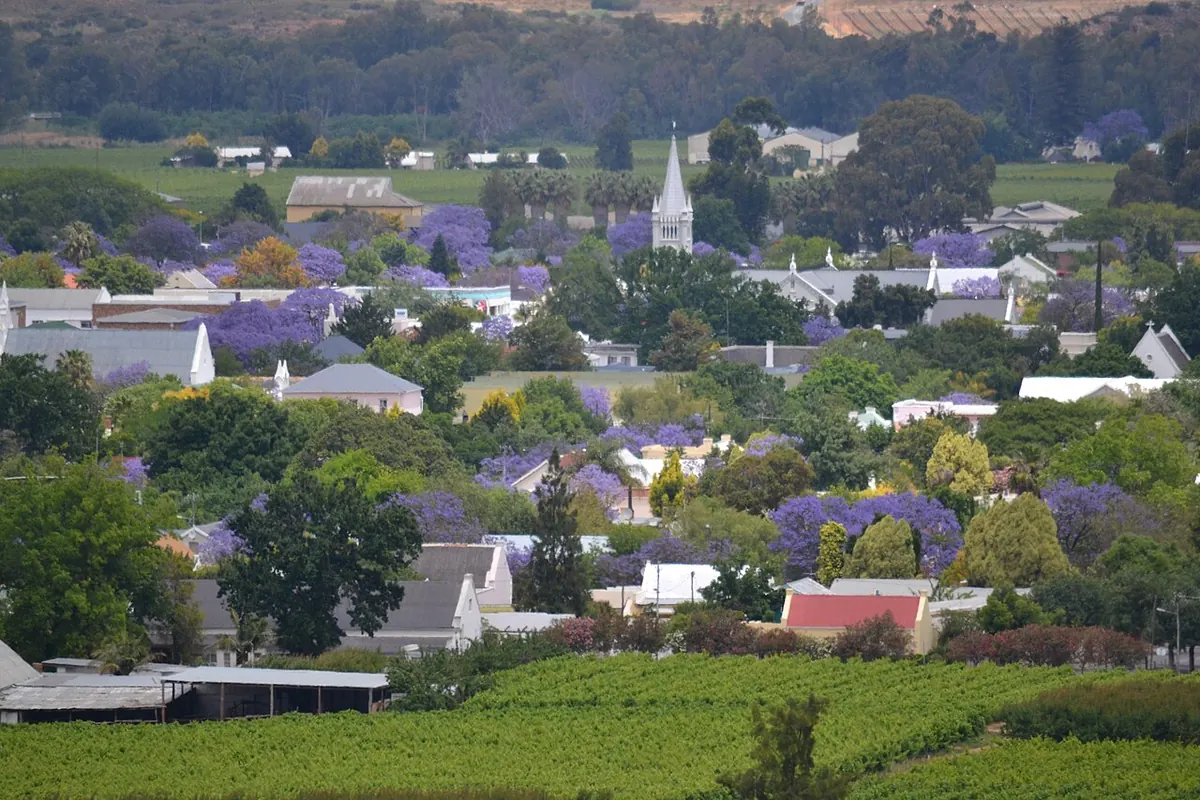
Robertson is a farming town of roughly 10,000 people in the Breede River Valley, between the Langeberg and Riviersonderend mountains, founded in 1853 and named after a Scottish minister, Dr William Robertson. It calls itself the valley of wine and roses, and the vineyards on the lime-rich soils are what people come for. The wine valley also takes in McGregor, Ashton, Bonnievale and Montagu. It is the Cape wine region with the least fuss and the most river.
Getting there
Robertson is about an hour and a half from Cape Town. Take the N1 through the Huguenot Tunnel to Worcester and then the R60 east. It sits on Route 62, the long inland road between the Cape and the Klein Karoo, so it works as a first night out of Cape Town on the way to Oudtshoorn, or as a detour on the way to the N2 via Swellendam. There is no useful public transport and the cellars are spread along farm roads, so you need a car or a driver.
When to go
The valley has hot, dry days and cold nights. Summer runs from December to February with daytime highs often near 30°C and little rain. Harvest is in February. Winter is cool, with the Wacky Wine Weekend in June the busiest few days of the year, when dozens of estates open their doors at once; book beds months ahead. The Robertson Slow festival is in the first week of August and Wine on the River in October. Spring and summer are best for the river and the roses.
What to do
Taste. South African Tourism counts 36 wineries on the route; the valley’s own association says more than 50 including garagiste producers who open by appointment. Names to look for include De Wetshof, Weltevrede, Bon Courage, Rooiberg, Bon Cap and Kranskop. The valley made its name on dessert wines and now does Chardonnay, Sauvignon Blanc and Cap Classique sparkling wine particularly well, with Shiraz and Cabernet Sauvignon growing in importance since the 1990s.
Away from the cellars, the Breede River is the thing: boat trips, river cruises and canoeing run from estates along the water, and there is hiking, golf, mountain biking and horse riding in the valley. Skydive Robertson, the oldest skydiving club in the country (founded 1972), jumps from the airfield. The town itself has the Pink Church of 1859, a museum in an 1860 building and streets of Victorian and Edwardian houses. McGregor and Bonnievale are the small villages of the valley and worth a slow afternoon each.
Good to know
Robertson is also horse-breeding country and you will pass stud farms on the valley roads. Estate opening hours vary, so check before you drive out. Carry water in summer: the heat here is dry inland heat rather than coastal. Share the tasting with a non-drinking driver or hire one for the day.
History and culture
Robertson is a church town that became a wine town. The Dutch Reformed Church bought a farm here in 1853 to build a village around a new congregation, and the money since has come from wagons, brandy, ostrich feathers, racehorses and, above all in the last century, wine. A good number of its Victorian and Edwardian buildings are still standing.
- 1853
The Dutch Reformed Church bought the farm Over het Roode Zand from Johannes van Zijl for 4,200 pounds, a very large sum then, and the first plots were auctioned on 4 May 1853. The town was named after Dr William Robertson, a Dutch Reformed minister at Swellendam, and the cornerstone of the first church was laid on 16 September 1853. source
- 1860 to 1865
The young town was hit hard by disease: an epidemic of measles and enteric (typhoid) fever in 1860 killed 89 people. Even so, Robertson had 715 residents by 1865 and 2,121 by 1891. source
- 1862 to 1902
Andrew McGregor, a Scot recruited for the Cape church by William Robertson, served as the town's Dutch Reformed minister for 40 years. The nearby village of McGregor (first called Lady Grey) is named after him. source
- 1880s to 1915
The district lived off wine, brandy, wagon building and ostrich feathers, which were then high fashion overseas. By 1891 the area earned between 30,000 and 40,000 pounds a year. The feather market collapsed in 1915 and ruined many farmers who had bet on it. source
- 1893 to 1907
The New Cape Central Railway, a private company, took over the work of the Cape Central Railways in 1893 to extend the line from Worcester, which ran through Robertson, all the way to Mossel Bay. War and floods held it up, and it only reached Mossel Bay on 25 July 1907. source
- 1899 to 1902
During the South African War (the Anglo-Boer War, fought between Britain and the two Boer republics) a British garrison was stationed in the town. By the end of the war the railway was carrying the goods that ox wagons used to, and Robertson's wagon-building trade was grinding to a halt. source
- 1905
The congregation built the large Dutch Reformed church that still stands in town, designed by the architect John Gaisford, at a cost of 17,000 pounds. source
- 1982 to 1994
Under apartheid local government was split by race. White residents elected the Robertson town council, Coloured residents had only a management committee under it, and Nkqubela, the township (an area set aside for Black South Africans, apart from the white town), had its own town council under the Black Local Authorities Act of 1982. In November 1994, after the first democratic elections, all three were replaced by one transitional council for Robertson. source
- Language and people
- Afrikaans is the main language. Across the wider Langeberg municipality, which includes Robertson, the 2011 census found 82.5% speaking Afrikaans as their first language, 10.7% isiXhosa and 3.1% English. The 2022 census counted 94,045 people there, 61.7% of them Coloured (South Africa's term for a long-established community of mixed Khoekhoe, slave, African and European descent, mostly Afrikaans speaking), 24.5% Black African and 12.9% white. source
- Horses
- Horses are a big part of local life. The Robertson Lenteskou (spring show), which the tourism office calls historic, is built around equestrian competitions, with food stalls, live music and fairground rides as well; in 2026 it ran from 30 September to 3 October. source
- Wine
- Chardonnay is a local strength. On 12 September 2026 the Chardonnay Association of South Africa held its festival at De Wetshof, on limestone hills outside town, with more than 30 producers from around the country. source
For American visitors: The New Cape Central Railway, which runs its steam trips from Robertson station, says it helped arrange the trains for the railway scenes in the American Paramount series 1923. source
Main sights in Robertson
7- Robertson Museum
The town museum covers the social and cultural history of Robertson. The tourism office lists it as open weekday mornings, 09:00 to 12:00, but marks the hours as to be confirmed, so phone 023 626 3681 first.
Robertson Tourism: Langeberg directory (PDF) - Dutch Reformed Church
The big 1905 church by John Gaisford is the centre of the town the church founded. Worth a look from outside for the scale alone, in a town this size.
Wikipedia (Afrikaans): NG gemeente Robertson - Old Library
An Edwardian building designed by the Cape Town firm Tully and Waters and opened on 28 December 1904. It is a provincial heritage site.
Wikipedia: List of heritage sites in Robertson and Montagu (from SAHRA records) - Powder Magazine
A small 1880 store built for gunpowder and blasting explosives, used until 1965.
Wikipedia: List of heritage sites in Robertson and Montagu (from SAHRA records) - Victorian streets
Van Reenen Street has some of the best houses, including a late Victorian house built in 1914 with a cast-iron verandah, and a double-storey Victorian house from the late 1800s, both provincial heritage sites. The old Wesleyan Church on Paul Kruger Street has provisional heritage protection.
Wikipedia: List of heritage sites in Robertson and Montagu (from SAHRA records) - New Cape Central Railway steam train
Trips leave Robertson station on Saturdays at 10:00 and run steam hauled along the valley on the old Cape Central line, with local wine for sale on board. In October 2026 a ticket was R670 for anyone 12 or older and R370 for children aged 3 to 12; under 3s ride free.
New Cape Central Railway - Prisoner of war museum at Wederom
Wederom, a guest farm in the Goree area of the valley, holds its wine tastings in a small Second World War prisoner of war museum, with drawings of the farm left by Giovanni Salvadori; the farm calls it its Italian connection. The tasting includes the museum and a cellar tour; phone ahead.
Robertson Tourism: Langeberg directory (PDF)
Did you know?
- On Weltevrede estate in the Robertson district there is a heritage-registered vineyard called Oupa se Wingerd (Grandpa's vineyard): 780 vines, all that is left of 16,000 red muscadel vines planted in 1926 by the estate's founder, Klaas Jonker. source
- Rietvallei, founded in 1864 by Alewyn Petrus Burger and still run by his descendants, makes a sweet wine it calls the 1908 Muscadel. The 2008 vintage won gold in the Museum Class, for well-aged wines, at the 2025 Veritas awards. source
- The Western Province Sport Parachute Club, founded in 1972 and the oldest skydiving club still running in South Africa, moved to Robertson airfield in 2008. source
- The town's powder magazine was built in 1880 by the firm Barry and Nephews and was used to store explosives until 1965. source
Checked 7 October 2026.
Map of Robertson
See every place on this map as a list