City · North West, South Africa
Rustenburg
Platinum mining city below the Magaliesberg in North West province, useful as a base for Kgaswane Mountain Reserve, Paul Kruger's old farm and the drive to Pilanesberg.
Short answer
Rustenburg is in North West, South Africa. This page lists 32 places to stay, 26 places to eat and drink and 1 sight. The nearest park with an entry fee on this site is Kgaswane Mountain Nature Reserve, about 8 km away, where international adults pay from R275.

- Places to stay
- 32
- Eat and drink
- 26
- Sights
- 1
- Park fee nearby: Kgaswane Mountain Nature Reserve
- US$16 €14 · R275about 8 km away
In and around Rustenburg
61 places listedWhere to stay in Rustenburg 32
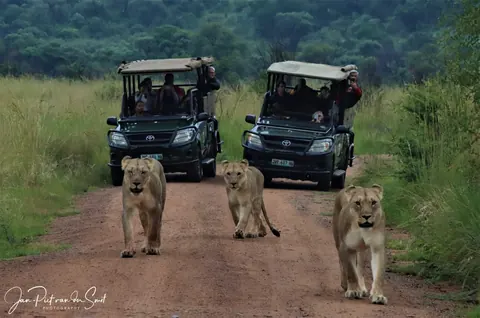 Guest houseBoubou Bed & BreakfastDoornlaagte, Kommissiesdrift, Rustenburg+27 83 457 9954boubou.co.za
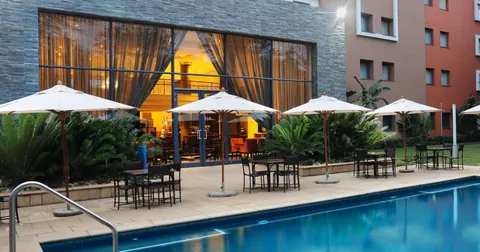 HotelStayEasy RustenburgCorner of N4 and R24, Rustenburg+27 14 537 6540southernsun.com
- 25.70°S 27.22°EHotelBoschdal GuesthouseWitstinkhout Avenue, Protea Park, Rustenburg+27 14 533 3783boschdal.co.za
- 25.68°S 27.19°EHotelKing's Gate Hotel+27 01 010 9094kingsgatehotel.co.za
- 25.67°S 27.24°EHotelKomodo Guest House+27 14 592 0915
- 25.64°S 27.20°EGuest houseMatshi B&BLesedi Street+27 14 789 9349
- 25.70°S 27.21°EGuest houseSunset Ridge Guest House
- 25.68°S 27.22°EGuest houseElrose Guest HouseKlopper Street, Rustenburg-Wes
- 25.67°S 27.24°EGuest houseMr. NiceKlopper Street
Show all 32 places to stay
- Palace Guest Lodge · Guest house · Klopper Street, Rustenburg
- Royal Majesty · Guest house · Klopper Street, Rustenburg-Wes
- Rustenburg · Hotel · Unie Street
- Travellers Inn · Hotel · Leyds Street
- Aasvoelkrans Resort & Predator Park · Resort
- African Delight · Guest house
- Bergheim Resort · Campsite
- Bergsig Lodge · Guest house
- Camp Konka · Resort
- Crystal Sands · Guest house
- Franka · Guest house
- Golden Side · Guest house
- Kona · Campsite
- Konka · Campsite
- Palm Lodge · Guest house
- Platinum Palace · Guest house
- Ronique's · Guest house
- Rusty Town Guest House · Guest house
- Seolwane Guest Hose · Guest house
- Symphony Guest House · Hotel
- T&T B&B · Guest house
- Vultures Valley Bush Lodge · Resort
- Waterberry Guest Lodge · Guest house
Sights 1
- Rustenburg CrossViewpointrsa.worldorgs.com
Restaurants and cafes 15
 Brauhaus am DammRestaurant · german+27 87 802 5519brauhaus.co.za
- Tandoori FlamesRestaurant · indian
- TswelopeleRestaurant · african
- AntonageRestaurant
- Excalibur Hotel and RestaurantRestaurant
- GezelligRestaurant
- Kenny Gee'sRestaurant
- Kloof CafeCafe
- Mahaleng Sports CafeCafe
- Orange Grove RestaurantRestaurant
- Repang Eating HouseRestaurant
- Rosirapa RestaurantRestaurant
Show all 15 restaurants and cafes
- Toledo Spur · Restaurant · steak house · Rustenburg+27 14 533 3112spursteakranches.com
- Ocean Basket · Restaurant · seafood · Howick Avenue, Rustenburg+27 14 537 2750
- Nando's · Restaurant · chicken
Bars and pubs 11
- American Jazz BarBar
- Biltong ShackPub
- Corner KissesPub
- Delgo'sPub
- Goddas InnPub
- Palladium Pub & Slot MashinesPub
- Randys TavernBar
- Sharp-Sharp TavernPub
- Shisa NyamaPub
- Skiny's TavernPub
- Zakes TavernPub
Wineries, breweries and distilleries 2
- UNB Tlhabane DepotBrewery · Lebone Street, Rustenburg
- Buffels BreweryBrewery
Rustenburg is a working city at the foot of the Magaliesberg, a little over 1,200 m up. It dates from 1851, and platinum has been mined here since 1929. Today no city on earth produces more of the metal, and mining accounts for about half of everything earned locally. It is a practical base for the mountains to the south and the game reserves to the north rather than a sightseeing town in its own right.
Getting there
Most visitors drive from Gauteng, about an hour and a half from either Johannesburg or Pretoria. From Pretoria, the quickest way is the tolled N4 (the Platinum Highway), which carries on west to Botswana. From Johannesburg, take the R24 through Krugersdorp. If you want to avoid tolls, the R104 runs roughly alongside the N4, but expect a slow, winding road with stops along the way. No passenger trains stop here and the local airfields take no scheduled flights, so fly into O.R. Tambo (roughly 140 km away) or Lanseria and hire a car. Pilanesberg International Airport is about 50 km north.
When to go
Summers, December to February, are warm and bring most of the rain, around 660 mm a year in total. Winters, June to August, are mild and dry. Malaria is only occasionally transmitted in North West province and antimalarials are not considered necessary, though insect repellent is still sensible.
What to do
Kgaswane Mountain Reserve starts about 5 km south-west of town. Sable are among its 800-plus antelope. Cape vultures breed here, and the reserve’s bird list runs past 300 species. For a short leg stretch there is the 2 km Vlei Trail or the Peglarae Trail of about 5.5 km. Serious walkers can sleep out on the Baviaanskrans (19.5 km) or Summit (25.3 km) routes. The North West Parks and Tourism Board manages it, with campsites, a cottage and a group camp.
Take the R565 towards Sun City for about 20 km and you reach Boekenhoutfontein, Paul Kruger’s farm. Four old houses survive as the Paul Kruger Country House Museum, and their floors were made with peach pips and cow dung. The Bronkhorst house, the oldest, goes back to around 1840. The museum is inside the grounds of Kedar Heritage Lodge.
Further north, Pilanesberg National Park fills the worn-down rings of a volcano that erupted about 1.2 billion years ago. The 572 km² park was old farmland until Operation Genesis brought in around 6,000 animals of 22 species, and today it has the Big Five. Sun City is on its southern boundary.
Good to know
Rustenburg hosted 2010 World Cup matches at the Royal Bafokeng Stadium. Wikivoyage reported no public bus routes as of 2012, so plan on a car.
History and culture
Rustenburg (Afrikaans for "town of rest") is North West's biggest city and the heart of South Africa's platinum belt. It was an early Boer town and Paul Kruger's home district, but the Bafokeng have lived at Phokeng next door for far longer, and their story of buying back their own land is the one I find most surprising.
- 350 to 600 AD
Iron Age farmers who worked copper and iron were living in the area by this time. Archaeologists see them as the likely ancestors of today's Batswana and Basotho, the Bafokeng among them. source
- Late 1600s to 1837
The Bafokeng settled at Phokeng, about 10 km north of today's city. In the Difaqane (the wars and upheavals of the 1820s) the area was overrun by Mzilikazi's Ndebele, who were driven out in 1837 by a coalition of Griqua, Tswana and Voortrekkers (Dutch-speaking farmers who had trekked inland from the British-ruled Cape). source
- 1851 to 1857
Rustenburg was founded in 1851 as the seat of a Boer farming district. The Volksraad (the Boer republic's parliament) met here in March 1852, and on 9 March 1857 the Vierkleur, the four-colour flag of the Transvaal, was raised for the first time in Rustenburg. source
- 10 February 1859
Under Dutch minister Dirk Postma, members who objected to singing hymns in church broke away and founded the Gereformeerde Kerk (Reformed Churches in South Africa), whose members are nicknamed Doppers. Paul Kruger was one of the founders. source
- Late 1800s
Black people were not allowed to buy land in their own names, so Kgosi (king) Mokgatle of the Bafokeng, who ruled until 1891, sent men to work on the Kimberley diamond mines and pooled the wages to buy farms back. The land was registered in the name of Lutheran missionary Christoph Penzhorn and held in trust. source
- 1899 to 1902
In the South African War (Anglo-Boer War) British troops under Baden-Powell occupied Rustenburg on 15 June 1900. The British ran concentration camps in the area for Boer women and children and for Black civilians, and Black people in the district took part on both sides as scouts, drivers and fighters. source
- 1920s to 1977
Under segregation and then apartheid, residents of Bethlehem, a settlement in the town, were moved to the township of Tlhabane in the 1920s, and the Group Areas Act later pushed the Indian community out of the town centre to Zinniaville. In 1977 Tlhabane and Phokeng were put into Bophuthatswana, a nominally independent homeland, and Black residents lost their South African citizenship. source
- 16 August 2012
At Lonmin's platinum mine at Marikana, near Rustenburg, police shot dead 34 miners during a wildcat strike (one called without union approval) and injured 78. It was the deadliest use of force by South African security forces against civilians since the Soweto uprising of 1976. source
- Language
- Setswana is the main home language in the Rustenburg municipality, spoken by about 54% of people in the 2011 census, followed by Afrikaans and isiXhosa at about 10% each. source
- The Royal Bafokeng
- The Bafokeng are a Setswana-speaking community with their own hereditary kgosi (king), currently Leruo Molotlegi, and their capital at Phokeng. Their totem is the crocodile, shown on their flag with its mouth shut, unlike other groups who draw it with jaws open. source
- Indian community
- Indian traders arrived from the 1870s. Fatima Bhayat came in 1877, lived to 102, and the main street was renamed after her in the 1990s. Her husband was a friend of Paul Kruger. source
For German visitors: Lutheran missionaries of the German Hermannsburg Mission Society worked among the Bafokeng in the 1800s. Christoph Penzhorn helped King Mokgatle buy land in the missionaries' names at a time when Africans could not hold title themselves. source
For German visitors: Kroondal grew from land bought in 1875 by a Hermannsburg missionary, which was split into plots and sold to German settlers from 1889. About 500 families live there today, and it still has its Lutheran church and a German school. source
For German visitors: German explorer Karl Mauch noted chrome along the Hex River near Rustenburg in 1865, the first record of chrome in the district. source
For German visitors: Hans Merensky, son of the German Berlin Mission missionary Alexander Merensky and trained as a mining geologist in Germany, found the platinum layer named after him, the Merensky Reef, in September 1924 (first in the Lydenburg district in the east). The reef runs for some 300 km through the Bushveld and is the largest platinum deposit ever found, and it is the reef Rustenburg's platinum economy was built on. source
For American visitors: The USA played two 2010 World Cup games at the Royal Bafokeng Stadium: a 1 to 1 draw with England on 12 June and the round of 16 defeat to Ghana, 2 to 1, on 26 June. A year earlier the US beat Egypt 3 to 0 here in the Confederations Cup. source
For American visitors: By the 1930s an African-American minister, Rev. Spooner, was living in Phokeng and had started a church separate from the German mission, which split the village's Christians. source
Main sights in Rustenburg
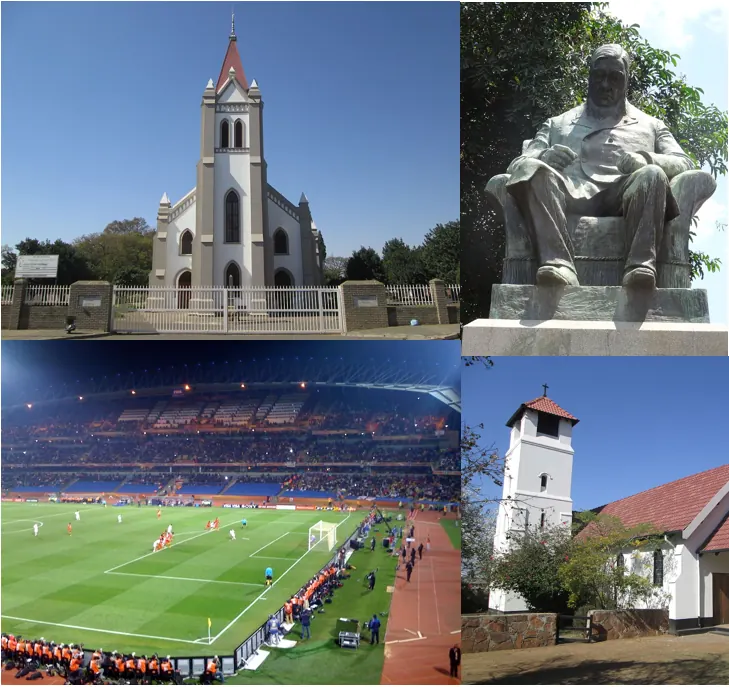
4- Paul Kruger Country House Museum (Boekenhoutfontein)
Kruger's farm Boekenhoutfontein on the R565, with his old farm buildings, his rifle, bibles and the bellows organ his wife played, and the family graves nearby. It was declared a national monument in 1971 and sits inside Kedar Heritage Lodge, which says it is open for tours but under restoration, so ask ahead.
Kedar Heritage Lodge: Paul Kruger Country House Museum - Syringa Tree Monument
A memorial marking the syringa tree under which the Gereformeerde Kerk was founded on 10 February 1859. It is a small spot, but it matters a lot in Afrikaner church history.
Wikipedia: Rustenburg - Kroondal Lutheran Church
Built by German master builder Karl Heyne and finished in 1896 for the German farming community at Kroondal outside Rustenburg.
South African History Online: Community histories of Rustenburg - Royal Bafokeng Stadium, Phokeng
Built by the Bafokeng themselves in the late 1990s and used for six games of the 2010 World Cup. Its seats were raised to about 44,500 for the tournament.
Wikipedia: Royal Bafokeng Stadium
Did you know?
- When Britain annexed the Transvaal in April 1877, Rustenburg was the first town where the British flag went up. source
- H. Rider Haggard visited around 1881 and took notes on a cave here that became the "pulpit" in King Solomon's Mines. source
- Because the Bafokeng had bought and registered their land, they could later claim royalties when platinum was found under it. A 1999 court settlement with Impala Platinum gave them a royalty and a stake in the company. source
- Bram Fischer, the anti-apartheid lawyer the newspapers called the "Red Pimpernel", went underground on 23 January 1965 rather than stand trial and lived for a while on a farm in Rustenburg. He was arrested that November and jailed for life. source
- Rustenburg Kloof was an open picnic spot used by locals until 1954, when it was closed off and turned into a resort for white people only. source
Checked 7 October 2026.
Map of Rustenburg
See every place on this map as a list