Province · South Africa
North West
Short answer
This page covers 4 parks and reserves and 8 towns and cities in North West. 3 of the parks have checked entry fees: international adults pay from R275 at Barberspan Nature Reserve to R748 at Pilanesberg National Park.
- Parks and reserves
- 4
- Towns and cities
- 8
- Places to stay
- 14
- Where
- South Africa26.37°S 25.24°E
Parks and reserves in North West
4Towns and cities in North West
8Written up in smaller places around North West
7


History and culture
North West is Setswana country, a dry bushveld province on the Botswana border that most visitors know for Pilanesberg and Sun City. Underneath that sits a much older story: the Taung Child fossil skull, a Tswana stone-walled town bigger than 1820 Cape Town, Boer republics, the siege of Mahikeng (then Mafeking) and the apartheid homeland of Bophuthatswana.
- late 1400s
The Bahurutshe, one of the main Tswana groups, build Kaditshwene in the hills north-east of Zeerust. It grows into a stone-walled town of metalworkers and traders. source
- 1820s
During the Mfecane (also called the difaqane), the wars and upheaval that spread across the interior, Kaditshwene is sacked in 1821 by the Batlokwa under their queen Mantatisi, then attacked again around 1823 by Sebetwane and the Bafokeng. The survivors flee west and the town is abandoned. source
- 1838
Voortrekker leader Andries Potgieter founds Potchefstroom, generally taken as the oldest Voortrekker town north of the Vaal River. Voortrekkers were the Dutch-speaking farmers (Boers) who left the British-ruled Cape in the 1830s, and Potchefstroom later served as capital of their South African Republic (the Transvaal). source
- 1850s and 1860s
Tswana chiefs such as Kgosi (chief) Mokgatle of the Bafokeng, who reigned from 1834 to 1891, collect cattle and money from their people to buy back land that had been taken as Boer farms, with help from German missionaries of the Hermannsburg Mission. That land later turns out to sit on platinum. source
- 1899 to 1900
Boer forces besiege the British-held town of Mahikeng (then spelt Mafeking) for 217 days, from 13 October 1899 to 17 May 1900, and the siege makes its commander, Colonel Robert Baden-Powell, a hero in Britain. About 300 Black Africans were armed to guard the perimeter, and in the last big Boer attack on 12 May 1900 armed Barolong men cut off the attackers' escape route. source
- 1977
Apartheid South Africa declares Bophuthatswana, a 'homeland' (bantustan) for Tswana people made up of scattered pieces of land, six at first and later seven, independent on 6 December 1977 under Lucas Mangope. No country apart from South Africa and the other homelands ever recognised it. Its capital was Mmabatho, now part of Mahikeng. source
- 1994
In early 1994 Mangope refuses to let the election take place in Bophuthatswana or to rejoin South Africa, and unrest breaks out. Armed members of the white supremacist AWB (Afrikaner Weerstandsbeweging) drive in, shooting at civilians, and are forced out by Bophuthatswana's own soldiers and police. South Africa removes Mangope on 12 March, and on 27 April 1994 Bophuthatswana ceases to exist; most of it becomes part of the new North West province. source
- Language
- Setswana is the home language of 72.8% of the province's 3.8 million people (2022 census), far ahead of Sesotho (5.9%) and Afrikaans (5.2%). A greeting of 'Dumela' goes a long way here. source
- Traditional kingdoms
- Traditional Tswana leadership is still very much alive. The Royal Bafokeng Nation at Phokeng, near Rustenburg, has its own king (kgosi), and a 1999 settlement with Impala Platinum gave it a 22 percent royalty on platinum mined from its land. source
- Bosman and mampoer
- Herman Charles Bosman, often called South Africa's greatest short-story writer, taught at a school in the Groot Marico district in the 1920s and set his Oom Schalk Lourens stories there, satire about Afrikaner farming life. The area is also known for mampoer, a strong home-distilled spirit made from fruit such as peaches or marulas. source
For American visitors: In 1985 Steven Van Zandt put together Artists United Against Apartheid to record 'Sun City', with Bruce Springsteen, Bob Dylan, Miles Davis, Lou Reed and Run-DMC among dozens of artists, all declaring they would not play the resort. Only about half of American radio stations played it, and some objected to its attack on President Reagan's policy towards South Africa. source
For German visitors: Lutheran missionaries from Hermannsburg in Lower Saxony worked in the Transvaal from 1857. At Phokeng a missionary named Penzhorn helped the Bafokeng buy their land, and Bethanie, north-east of Rustenburg, was founded as a Hermannsburg station in 1864. source
For German visitors: Kroondal, just outside Rustenburg, still has a German-speaking community, a Lutheran congregation of about 400 that is mostly German-speaking, and the Deutsche Schule Kroondal. source
Main sights in North West
6- Taung Skull Fossil Site
The old Buxton limestone quarry near Taung where the Taung Child was found in 1924; lime mining has destroyed much of the original spot. It was added to the Fossil Hominid Sites of South Africa World Heritage Site in 2005. The skull itself is kept at the University of the Witwatersrand in Johannesburg.
Wikipedia: List of World Heritage Sites in South Africa (with Wikipedia: Taung) - Kaditshwene ruins
Stone walls, house foundations, ash middens and metal-working remains of the Bahurutshe capital, about 25 km north-east of Zeerust. Declared a National Heritage Site in 2011.
Wikipedia: Kaditshwene - Paul Kruger Country Museum (Boekenhoutfontein)
The farm north-west of Rustenburg that Paul Kruger bought in 1863, years before he became president of the South African Republic, and a national monument since 1971. Its farmhouses hold some of his belongings, including a rifle and his bibles. Open for tours booked through Kedar Heritage Lodge, and under restoration.
Kedar Heritage Lodge: Paul Kruger Country House Museum (with Wikipedia: Rustenburg) - Potchefstroom museums
The Potchefstroom Museum and house museums such as the M.W. Pretorius House cover the town's years as a Boer capital. The town also has the Old Fort, where British troops were besieged for 95 days in 1880 to 1881, and in the South African War of 1899 to 1902 the British held Boer civilians here in what has been called the first and largest concentration camp in the Transvaal.
Wikipedia: Potchefstroom - Pilanesberg National Park
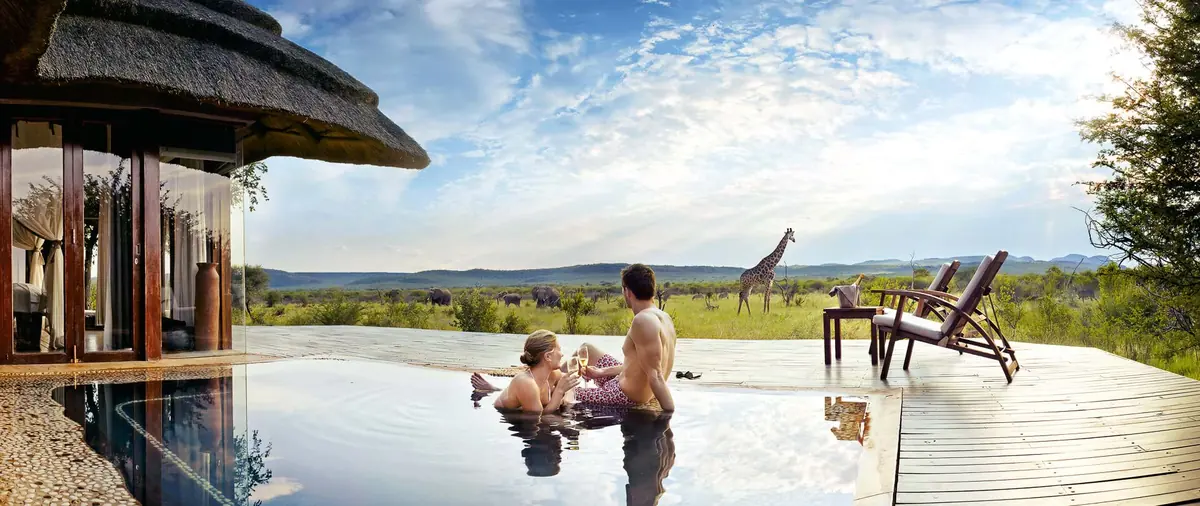
A 572 square km game reserve set in the eroded rings of an ancient volcano north of Rustenburg. Worth it for the geology as much as the game, and it borders Sun City.
Wikipedia: Pilanesberg National Park - Sun City
Sol Kerzner's resort opened on 7 December 1979 in Bophuthatswana, because the homeland could allow gambling and topless revue shows that were banned in South Africa. During apartheid it also tightly restricted Black South Africans from entering the area. Today it is a family resort and golf venue.
Wikipedia: Sun City, South Africa
Did you know?
- The Taung Child, a fossil skull found in a limestone quarry near Taung in 1924, was described by Raymond Dart in 1925 as a new species, Australopithecus africanus. The child was about three years old and died somewhere around 2.5 to 2.8 million years ago, and later research points to an eagle or other large bird of prey as the killer. source
- When the Scottish missionary John Campbell reached Kaditshwene in 1820 he found around 20,000 people living there, more than Cape Town had at the time. source
- Pilanesberg is the eroded remains of a volcano about 1.2 billion years old, which is why its hills form rings. After the park was set up in 1979, Operation Genesis moved about 6,000 animals of 22 species into it in the early 1980s, still described as the largest game translocation ever done. source
- Mahikeng (Mafeking) was the capital of the Bechuanaland Protectorate (today's Botswana) from 1894 until 1965, even though the town was outside that territory's borders. source
- The Mafeking Cadet Corps, boys of 12 to 15 who ran messages during the siege, was set up by Lord Edward Cecil and was later claimed as one of the inspirations for the Boy Scouts, which grew from Baden-Powell's Scouting for Boys in 1908. source
- Sol Plaatje worked as a court interpreter in Mafeking during the siege and kept a diary that was only published long after his death. He became the first general secretary of the South African Native National Congress (later the ANC) when it was founded in 1912, and wrote Mhudi, the first novel in English written by a Black South African. source
Checked 7 October 2026.
In and around North West
17 places listedWhere to stay in North West 14
 HotelLindbergh LodgeWolmaransstad+27 18 596 2048lindbergh.co.za
- 25.57°S 25.66°ECampsiteBotslano Campsite
- 25.67°S 26.43°EChaletJampot Nature Retreat
- 25.59°S 25.68°ECampsiteLegora Campsitze
- 25.56°S 25.73°ECampsiteLerako Campsite
- 25.56°S 25.72°ECampsiteMogobe Tented Camp
- 25.78°S 24.20°EHotelNot Operating
- 25.67°S 26.43°EChaletNyedi Bush Camp
- 25.67°S 26.44°EChaletNyedi Reception
Show all 14 places to stay
- Sefari Campsite · Campsite
- Sentry Hill · Campsite
- Thabana Safari Lodge · Hotel
- The Carousel Hotel · Hotel
- Wayside Hotel · Hotel
Sights 1
- Bataung MuseumMuseum
Restaurants and cafes 1
- Grootbosch Wedding VenueRestaurant+27 62 468 2428grootbosch.co.za
Bars and pubs 1
- Re A Leka TavernPub
Map of North West
See every place on this map as a list