Place to stay · Chobe District
Chobe Elephant Camp
Bush Ways camp on a ridge above the Chobe floodplain in the Chobe Forest Reserve, ten minutes from Ngoma Gate on the quiet western side of the park.
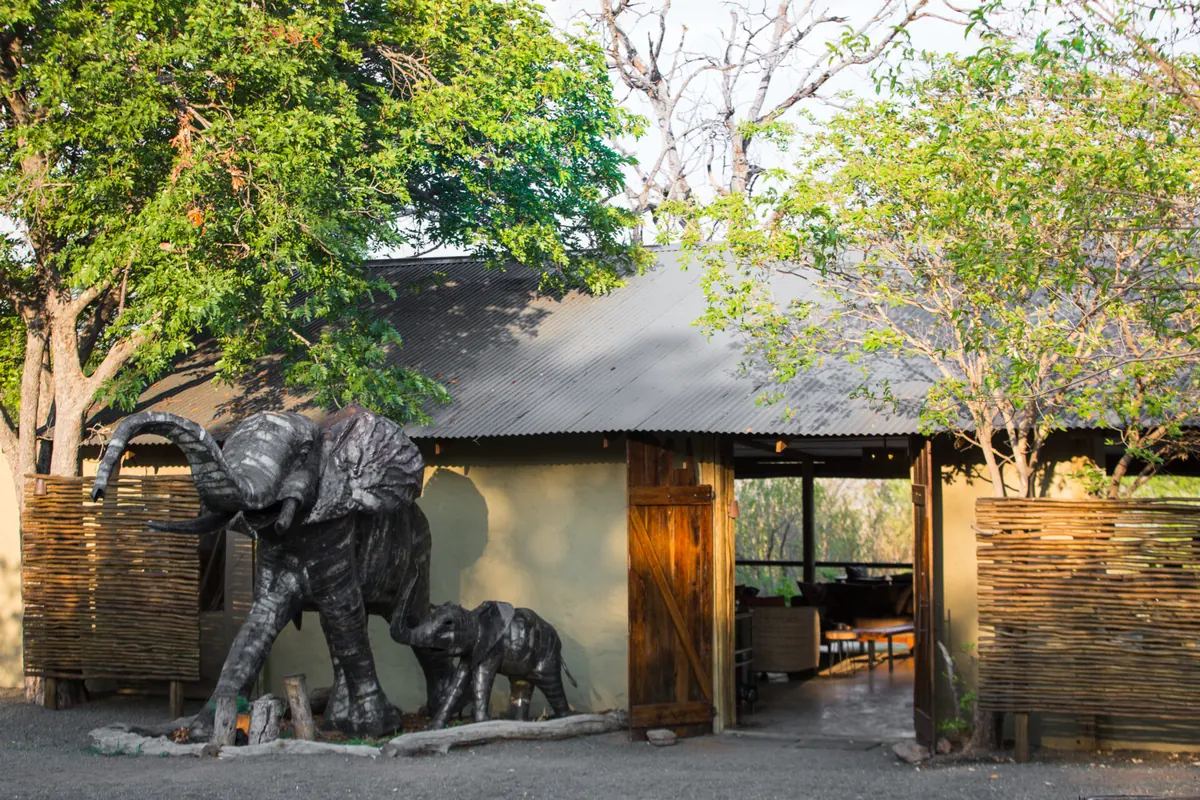
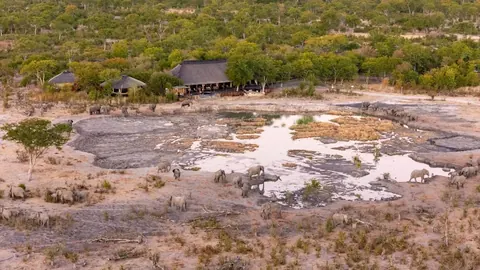
Chobe Elephant Camp stands on a ridge in the Chobe Forest Reserve, looking over the Chobe River floodplain on the western edge of Chobe National Park. Bush Ways, a Maun safari company, runs it. The point of staying out here instead of in Kasane is the Ngoma Gate, about ten minutes away, which gets you onto the riverfront without the queues at Sedudu Gate on the Kasane side.
What to expect
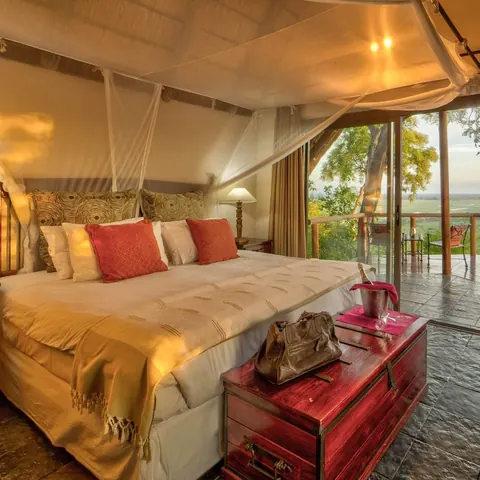
Expert Africa counts 18 chalets, two of them family units with separate bedrooms. The buildings are made of sandbags that have been rendered over, the floors are polished concrete, and each chalet has an indoor and an outdoor shower and a terrace facing the floodplain. There is a pool and a fire pit.
Game drives go into the national park in open 4x4s. The boat cruise is a full-day outing because the boats leave from near Kasane, around 50 minutes away by road. The morning goes on a game drive through the park to the boat, and the way back can be a quick run down the park’s tar road, because everyone has to be out of the park by sunset. Bush Ways also runs a visit to Mabele village.
Practical details
- About 50 minutes by tarred road from Kasane Airport.
- Solar power with a generator behind it. You can charge batteries in the room.
- Mobile signal usually works. Wi-Fi is limited to the main area.
- The camp is unfenced. Expert Africa says children are taken from age 6, families with under-12s must book a private vehicle, and it rates the camp best for ages 10 and up.
Good to know
Activities, park fees and transfers are not part of the Bush Ways room rate, so check what your quote covers. Chobe’s riverfront is at its busiest and best from June to October, and this end of it sees far fewer vehicles than the stretch near Kasane.
Last updated 12 October 2026. Sources: Bush Ways, Chobe Elephant Camp, Expert Africa, Chobe Elephant Camp.
Zebra that walk to Nxai Pan, and elephants at the chalet door
In September and October 2012 researchers put GPS collars on eight zebra mares on the Chobe floodplain, the flat strip between Botswana and Namibia that this camp looks down on. That December all eight crossed the river and walked south. They did not stop until Nxai Pan, about 250 km away. They stayed around ten weeks and then came back.
Robin Naidoo of WWF and his co-authors, among them Mike Chase of Elephants Without Borders in Kasane, published the tracks in the journal Oryx in 2014. In a straight line the round trip is 500 km, which made it the longest migration then recorded for any large land mammal in Africa. One mare covered 1,170 km on the ground. The trip down took about a fortnight and the trip home nearly three months. The same move south was recorded in December 2013. So the zebra below the ridge in the dry season are not residents. Their year turns round at Nxai Pan.
What guests have ticked off since 2019
Expert Africa asks its travellers to record what they saw, and 22 parties who stayed here between March 2019 and September 2026 have done so. Every one of them saw buffalo, giraffe, hippo and zebra. Nearly all saw elephant and lion, and roughly two in three saw leopard and sable. Roan came up for a little under half. Wild dog was seen by one party in five, cheetah by one in ten.
Given the name, the elephants can still let people down. A couple who came in November 2025, as heavy rain arrived, saw none at all. Elephants spread inland once the rains fill the pans, and numbers on the river only build back through the dry months to a peak around October. Early winter can be thin too: a guest in June 2022 wrote of very few, and a couple in late May 2025 saw so many more giraffe than elephant that they renamed the place Chobe Giraffe Camp. Then again, two parties in June and July 2024 watched a herd swim the Chobe on the boat day.
Elephants outside the bedroom
A guest in September 2017 woke in the night to two adults and a calf feeding right outside the chalet. A family the following May heard elephants thrashing about what seemed a few feet from their room, and logged 89 bird species in three nights.
The chalet walls are stacked sandbags under plaster, there as insulation. Bush Ways still describes the rooms as “tented suites”. They are not tents, and one 2024 guest who had expected canvas said so. The main building is open at the front, and a June visitor says to pack a warm jersey for the evenings. July guests mention the blankets and hot water bottles on the cold morning drives.
Ngoma, the name of the nearby gate and bridge, is the Subia word for a drum, and for dancing to one. Several guests over the years describe the staff singing at dinner.
Where the grumbles come from
This is the quiet end of Chobe National Park, but cats draw a crowd anywhere on the riverfront. Guests in 2022, 2024 and 2026 all complained of vehicles packing in around lions or a leopard, more than twenty in one account. The tracks are rutted, and one guest warns off anyone with a bad back or neck. The other regular complaint is the pace. Guests go straight out on an afternoon drive on arrival, and the boat trip takes a whole day out of camp. With only two nights, that leaves no time to sit on the ridge. Book three.
Bush Ways began in 1996 as Marc Germiquet and one vehicle, and had no fixed camp until 2010. It shows: guests keep calling the place rustic and the guiding excellent.