Place to stay · Chobe District
Muchenje Safari Lodge
Owner-run lodge on an escarpment above the Chobe floodplain, at the quiet western end of the riverfront, with night drives and walks in the forest reserve.
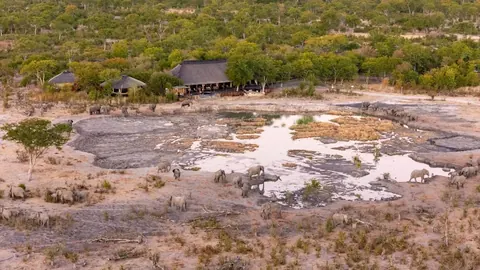
Muchenje stands on an escarpment in the Chobe Forest Reserve, looking down on the Chobe River floodplain and across to Namibia. It is at the western end of the riverfront, about 60 km from Kasane, where far fewer vehicles go. The lodge is independently owned. It took its first guests in 1995 and was formally opened in October 1996 by Festus Mogae, then Vice President.
What to expect
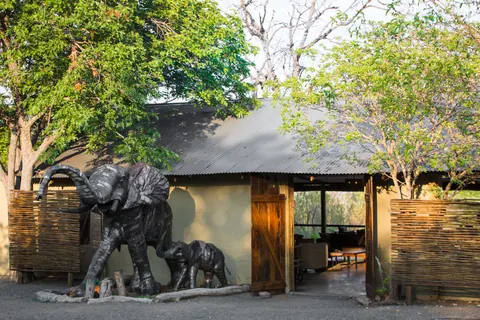
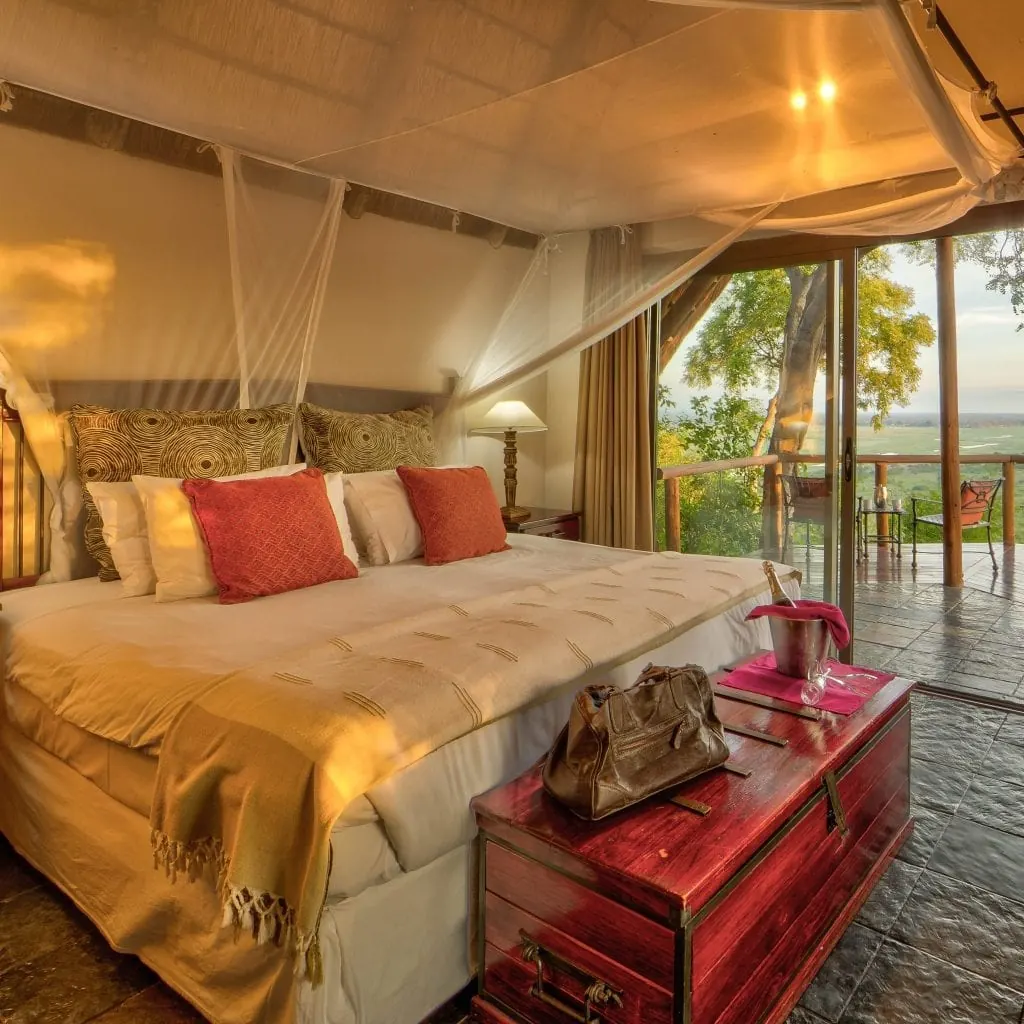
Around a dozen thatched cottages, one of them a family unit with a mezzanine and two bathrooms, each with a deck facing the floodplain. Rooms have air-conditioning, a ceiling fan and mosquito nets, by Expert Africa’s account. The main building has a bar, a shared dining table and a pool.
Because the lodge is outside the national park it can do what park lodges cannot: walks in the mornings and a night drive of about an hour after dinner, both in the forest reserve. Morning and afternoon drives go into western Chobe. The full-day outing drives to the Sedudu jetty near Kasane for a boat cruise with lunch on board, then returns through the park. The lodge also has its own jetty at Ihaha, used for a breakfast or lunch trip. Longer stays can include a visit to Mabele village.
Practical details
- About 45 minutes from Kasane International Airport and two hours from Victoria Falls.
- Vehicles are open Land Cruisers and Land Rovers, normally with no more than six guests.
- The grounds are unfenced and there are steep drops in front of some cottages, so small children need watching.
Good to know
Expert Africa makes a fair point about the full-day trip: it spends time in the busy eastern end near Kasane, so if quiet is what you came for, lean on the shorter western drives.
Last updated 12 October 2026. Sources: Muchenje Safari Lodge, Muchenje Safari Lodge, activities, Muchenje Safari Lodge, about us, Muchenje Safari Lodge, contact, Expert Africa, Muchenje Safari Lodge.
The radio engineers who built a lodge above the Chobe
Muchenje was not started by safari people. It was started by two broadcast engineers. Ted Makgekgenene was the government’s Director of Information and, by the lodge’s account, the most senior broadcasting engineer in the country, the man who put AM and FM radio across Botswana. Shaun Metcalfe worked in the same trade and had been turning over the idea of a lodge since the mid 1980s. They found this ridge in 1990. Building permission alone took two years, and the place was not finished until 1995.
Makgekgenene’s other project took longer. President Masire had first floated a television service in February 1984, and Botswana Television only went on air on 31 July 2000. The history of the station on Wikipedia has him calling in two BBC consultants to rescue the build, then resigning as director on launch day. Metcalfe’s family still has a small house on the property.
A place that has not been restyled
Expert Africa’s write-up says Muchenje feels “almost fixed in time”, and warns that people expecting luxury may be let down. I read that as a recommendation. Toff and Kiddy Hill live on site and run it, and the lodge describes Toff as an accredited bird expert. It hires only Batswana guides and names four of them, Ali, Lips, Rambo and KB. Many of the guides grew up in the villages nearby, and they skipper the boats as well as driving.
What guests have ticked off since 2018
Expert Africa asks its travellers to log what they saw, and the Muchenje answers go back to the middle of 2018. Everyone saw elephant and giraffe. Lion came up for 92%. Leopard is the figure to look at: 58%, better than even, which fits the rocky escarpment towards Ngoma. The same company puts leopard on those outcrops. Sable were seen by about half, roan by a third, wild dog by one party in four. Cheetah, 7%.
Two reports stand out, and each is one traveller’s word. A guest in November 2025 wrote of watching a leopard chase a cheetah. A Norwegian visitor two months earlier listed wild dog, puku and a rock python as firsts.
The after-dinner drive in the forest reserve is where the odd ones turn up. The lodge names genet, civet, porcupine and hyena, and Expert Africa’s own team came back from theirs with a hyena, three genets and a wildcat. Nearly one in five travellers has logged a brown hyena, a dry-country animal that few people connect with the Chobe.
The zebra on the plain under the cottages are seasonal. The lodge puts them here in their hundreds from May to November and quotes up to 15,000 for the whole movement (its figure, not a researcher’s). The eight mares that researchers collared along this stretch of the Chobe in 2012 walked off in December to Nxai Pan, 250 km south, and stayed about ten weeks, so in January and February expect a river on the rise and not many zebra.
The village the name is shared with
The nearest village goes by a double name, Mabele/Muchinje in the usual list of the district’s villages, and the lodge carries the second half. More than 40 people work here, all Batswana and most of them local, and many went to Mabele Primary School, which has about 176 pupils. The lodge has backed the school for over twenty years, and its donations list also covers the special unit at the primary school in Kachikau, the only one in the Enclave for children with disabilities, where the pupils board.
There is an awkward fact behind the photographic safari. Mabele is one of five villages that each get the same share of what the Chobe Enclave Conservation Trust pays out, and at its meeting in March 2026 the trust reported that about three fifths of the previous year’s income came from hunting quotas.