Place to stay · Kazungula
Chobe Bakwena Lodge
Chobe Bakwena Lodge is an owner-run lodge of 15 chalets on the Chobe River at Kazungula, on land replanted with riverine woodland since 2000, with its own boats and game vehicles.
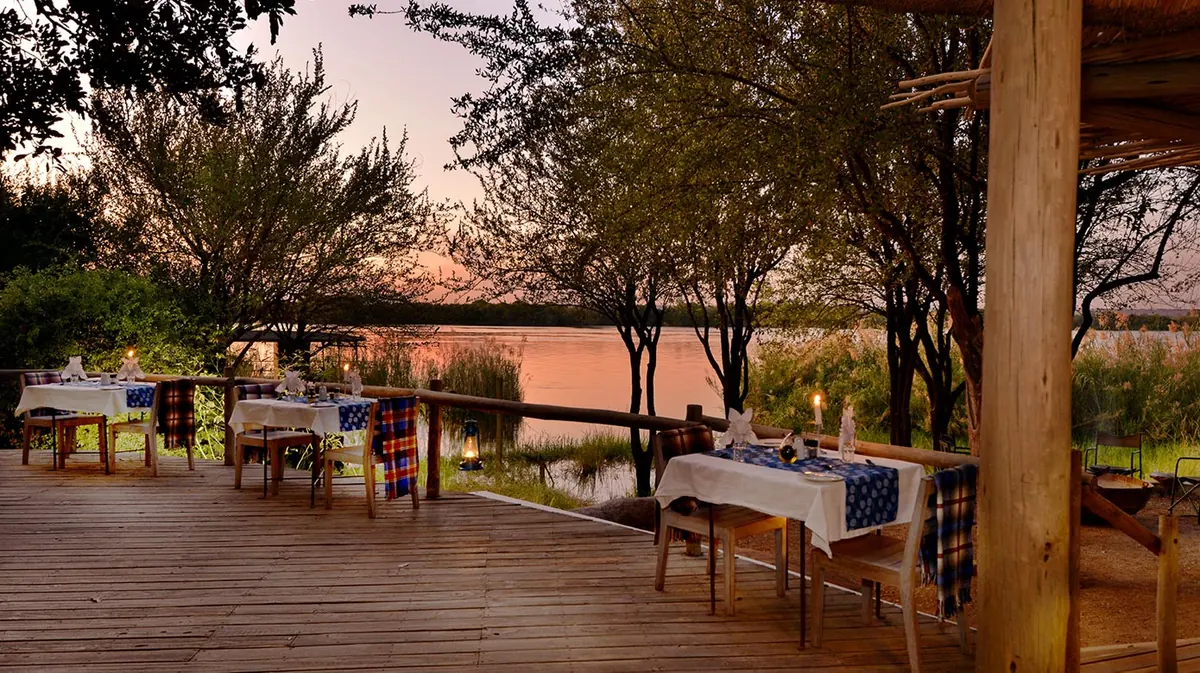
Chobe Bakwena Lodge sits on the Chobe River bank at Kazungula, outside the national park. Jenny and Adam Young bought the plot in 2000, when it was a bare soccer pitch, and replanted it with the riverine woodland that now hides the chalets. They still own and run it. Bakwena means “people of the crocodile” in Setswana, and it is also the name of one of Botswana’s biggest tribes.
What to expect
There are 15 chalets. Ten face the river, among them a family chalet for two adults and two children (aged eight and up) and a honeymoon chalet with its own lounge and a bath. The other five are treetop chalets raised about three metres on stilts, looking into the canopy, not at the water. All have air-conditioning, an indoor and an outdoor shower and a shaded deck.
Game drives and boat cruises into Chobe National Park are run in-house, with seven game vehicles and four boats, and full days in the park with a picnic lunch are offered on longer stays. The part that sets it apart is next door: a guided walk or bicycle ride through the neighbouring village, on one of the lodge’s 20 cruiser bikes, with school visits possible. A sundowner cruise runs from the lodge down to the point where four countries meet.
Practical details
- About 15 minutes’ drive from Kasane airport and roughly 90 minutes from Victoria Falls airport, according to Tribes Travel.
- Open all year.
- There is a small pool, a lounge bar and a deck with a boma and fire.
- Tribes notes that families with children under 11 have to book private activities.
Good to know
You are not in the park here. So drives start with the road to the gate, and the lodge itself admits Chobe gets busy in high season, which is why its guides go for longer drives and new parts of the park. If a river view matters, ask for a riverine chalet. The treetop ones trade the view for height and leaves.
Last updated 12 October 2026. Sources: Chobe Bakwena Lodge, Chobe Bakwena Lodge, About the lodge, Chobe Bakwena Lodge, Activities, Tribes Travel, Chobe Bakwena Lodge.
Sandbag walls and a pool with no chlorine
The walls here are full of sand. Agents who sell the lodge call the method ecobeam: a frame of poles with the gaps packed with sandbags, chosen because sand is slow to heat and a room built this way stays cooler through a hot afternoon. The timber was left free of the harsher chemical treatments and part of the furniture was made on the property. There is solar power too.
Jenny and Adam Young built it by hand. They had spent years managing other people’s bush camps and lodges and running their own safari company before they took on the old football pitch in 2000, and they have since called the lodge a “life-defining project”, twenty-odd years in the making.
No chlorine, and chickens on patrol
The pool is not hotel blue. Several operators describe the water as cleaned by plants, and two of them add a bed of gravel, with no chlorine anywhere in it. Garden pest control is a flock of chickens that wanders the grounds eating insects. The lodge calls them its insect patrol.
A southern name on a northern river
The address is Kwena Road. Kwena is the crocodile, and the Bakwena are the people who hold it as their totem, but their capital is Molepolole in the Kweneng, more than 700 km to the south. Their best-known chief, Sechele, ruled from 1831 to 1892 and was baptised by David Livingstone in 1848. By the count of Livingstone’s biographer Stephen Tomkins he was the only African the missionary ever converted. Along the Chobe the old river people are Subiya, not Kwena. So why the name? The lodge says the Youngs are both Bakwena themselves.
What uses the garden
Woodland planted on a river bank fills up by itself. Bushbuck sit among the trees, so still that the lodge admits they are easy to miss. Its own line, repeated by the agents, is that guests wake to a fish eagle and fall asleep to a hippo grunting.
Mongooses are part of garden life on this bank (Kubu Lodge, next door, lists them among its residents beside bushbuck and warthog), and the banded mongooses of Chobe District have a strange story. In 2000, the same year the Youngs got their pitch, Kathleen Alexander’s team found tuberculosis in them. Seven outbreaks later, in 2010, it was named as a new pathogen, Mycobacterium mungi. It gets in through broken skin on the nose, not through the lungs, and a sick animal is usually dead within two or three months. The troops affected lived in man-made structures and scavenged human waste, in the towns and in the park. A mongoose with a misshapen nose may well be a case. Leave the troop alone and do not feed it.
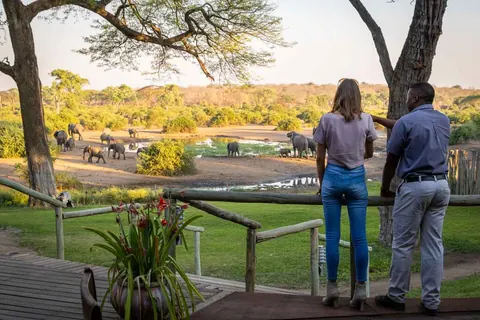
Elephants are another matter. The frontage looks at Namibia, not at the park: the far bank is Impalila Island, home to a few thousand people in about 25 villages with no road to the rest of their own country. They shop in Botswana and use the pula, as people do in Kasane and Kazungula. The big dry-season herds drink upriver, inside the park.