Sight · Dorob National Park
Regimental Badges
Regimental badges laid out in stones on a desert ridge east of Swakopmund by South African troops guarding the railway in 1915, now a national monument.
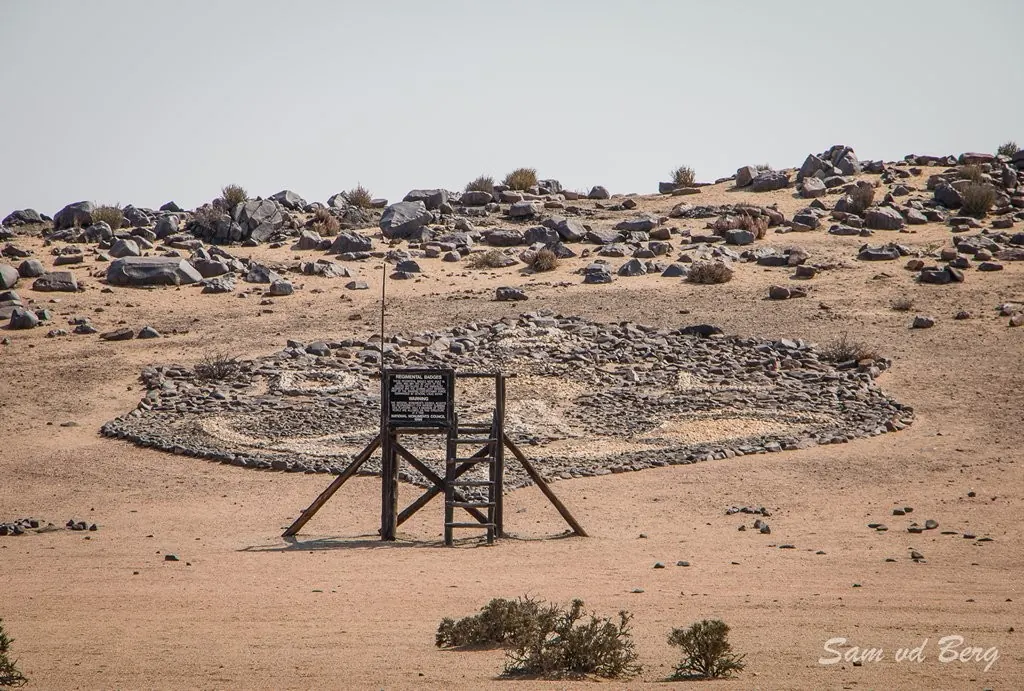
On a rocky slope between the railway and the main road east of Swakopmund, South African soldiers built their regimental badges out of stones in 1915. They were guarding the line between Swakopmund and Usakos against German sabotage during the First World War, with long, hot, dull weeks to fill. The badges are still there, and they are a national monument. Count on a short stop rather than an outing.
What to expect
The main group belongs to the second battalions of the Kimberley Regiment and the Durban Light Infantry. The Kimberley badge is a diamond shape laid in white quartz pebbles and framed by a wreath of brown stones, with “2 KR” in white. Below it is a “2” ringed by the letters “D L I”, and between them the word “TIT-BIT”, which was the name of a Kimberley Regiment mascot. The heritage council lists the site as the Regimental Badges at Farm Titbit.
The soldiers seem to have competed over whose badge was best, and the detail in the stonework shows it. Signallers working the heliograph stations on nearby high ground were part of the same force.
Practical details
- Location: about 27 km east of Swakopmund, between the railway line and the highway.
- There are no facilities that we know of. Take water and a hat, as there is no shade.
- Look, but do not move or take stones. The badges are protected under heritage law.
Good to know
A second national monument, the Regimental Badges at Farm Badges further inland near Trekkopje, was laid out by the Transvaal Scottish and the Durban Light Infantry between April and June 1915. If the Titbit badges catch your interest, the second site fits into the same drive towards Usakos. Both were declared monuments in February 1978.
Last updated 7 October 2026. Sources: National Heritage Council of Namibia, Wikipedia (German), Namibia Stays.
Tit-Bit, Fort Stagnation and a bored army's stonework
Nobody knows for certain what Tit-Bit was. When Bryan Cooke followed the railway east of Swakopmund for the SWA Annual in 1975, the word lay in letters four feet high between the two badges on this ridge, and neither the military archives in Pretoria nor the war museum in Johannesburg could tell him what it meant. The regimental associations eventually produced one old soldier of the 2nd Kimberley Regiment. He half remembered a mascot, “either a goat or a horse”, that begged scraps from the men. It died, or it was eaten when rations ran thin. Cooke could not say which. That is all the evidence there is: one veteran’s memory at sixty years’ distance.
Cooke also read the smaller badge as the work of D Company of the 2nd Durban Light Infantry, not of the battalion as a whole.
A battalion that had just been shelled
On 26 April 1915 the 2nd Kimberleys held the centre of the trench line at Trekkopjes siding, further up the same railway, when a German column under Major Ritter shelled the camp from about twenty to eight until late morning. A Transvaal Scottish captain in the next trench, D R Hunt, watched the Kimberleys’ built-up wall draw the German guns and wrote that they “stuck well to their position”. The Kimberley Regiment lost more dead than any other unit there. The heritage council dates the badges on this ridge to May 1915. If that is right, the stonework came within weeks of that morning.
Warm water and a German aeroplane
Guarding the line was the dullest job in Botha’s army. South African engineers were relaying the narrow German track in the wider Cape gauge as the infantry moved inland, and behind them blockhouses and water tanks went up roughly every 10 km, with every culvert and cutting patrolled day and night. The route is waterless, so a train hauled water up from the coast every day until the advance reached supplies from Usakos, and what came out of the corrugated iron tanks was brackish and tepid. Bully beef and biscuit, flies at every meal.
The best diversion was the German pilot who came over now and then to drop bombs, all of which missed. A 1916 history of the campaign by Rayner and O’Shaughnessy says nobody took cover: everyone, cooks included, grabbed a rifle and had a shot at him. The Kimberleys had already gone further, according to their colonel’s diary, and mounted a Maxim gun on a cart.
What Cooke found further up the line
Whoever started it, the craze turned into a contest, and it did not stop at badges. Below a sangar near Rössing Mountain Cooke recorded a soldier’s name, G. C. JACOBS, set out beside a metre-wide path. Under the heliograph station on the mountain the signallers of the South African Mounted Rifles had made a badge entirely in white quartz, which some well-meaning campers had since “tidied”, turning an S into an R. At kilometre 56, below one of two hilltop forts, a name was set out in framed letters up to five feet high: FORT STAGNATION. By the path to the other fort somebody had laid a heart ten feet tall in brown stone.
That was half a century ago and I have not found a later survey of those smaller pieces, so do not count on all of it still being there. Cooke closed his article hoping the monuments council would keep a promise to protect the best of the insignia. Three years later it proclaimed two sites: this ridge, and the one with the big Durban Light Infantry badge at kilometre 46.
Park fees
Regimental Badges is inside Dorob National Park. International visitors pay from US$17 €15 · N$280 a day. See all Dorob National Park fees