Place to stay · Karas
Dune Song Breathers
Three self-catering chalets and a small bush camp on a Kalahari dune farm 30 km north of Koës, in the quiet south-east of Namibia.
DuneSong Breathers is a small self-catering stay on the farm Onze Rust, 30 km north of the village of Koës in the ǁKaras Region. This is the Kalahari dune country of south-eastern Namibia, well off the main tourist loop, and the place is built around doing very little: walking, birding, watching the sky. It also sits on a route towards the Kgalagadi Transfrontier Park, so it can work as a stop on the way there.
What to expect
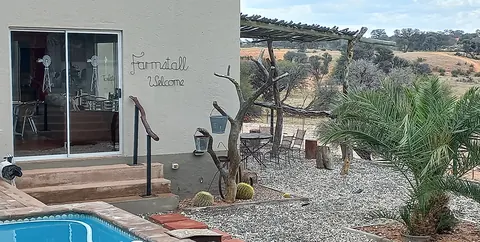
There are three four-bed chalets, fully equipped, with solar-heated showers and kitchenettes that have gas burners, an electric fridge and freezer, and a braai pit. A wood-burning stove is there for winter stays. You leave your car at the farmhouse and are driven to your chalet.
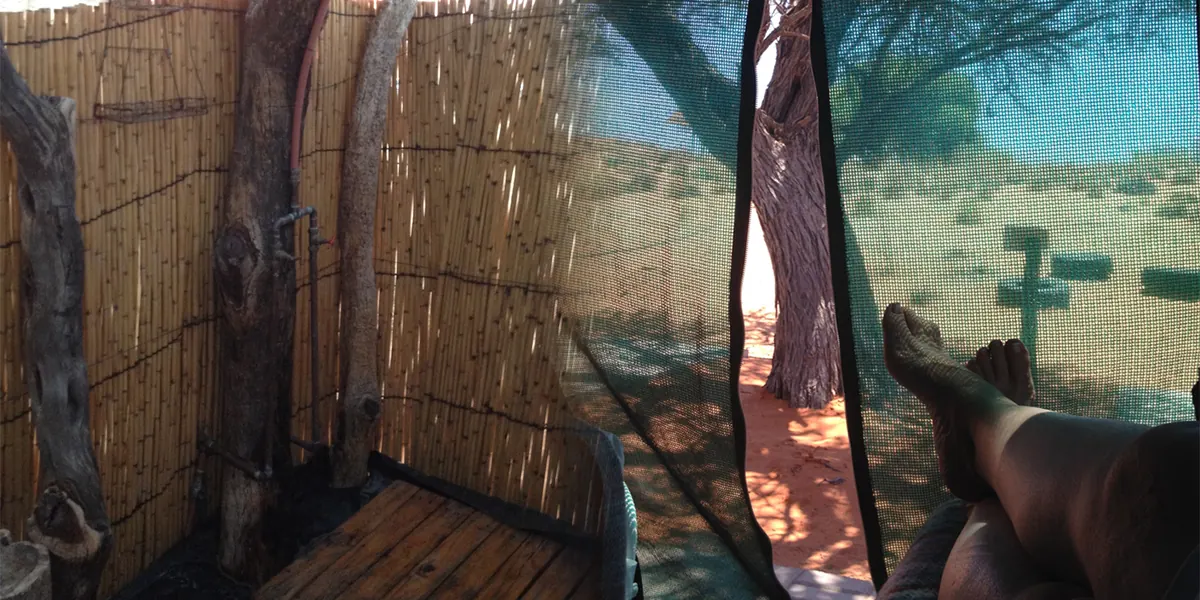
The second option is a bush camp: an enclosed lapa with a table that seats 12, a hot shower, a flush toilet, a solar power point (with a second point under a camel thorn tree), a mobile braai and firewood. Hosts Pieter and Marianne Nell farm here, and guests can go along with Pieter on his daily rounds. Otherwise the days are your own.
Practical details
- Phone: +264 81 777 6333. Email dunesong.nell1@gmail.com.
- From Koës, drive north for 20 km, turn left onto the D617 and carry on for about 10 km.
- No smoking inside or around the chalets.
- Ask about availability first, as there are only a handful of units.
Good to know
Bring everything you plan to cook. Koës itself is a village of a little over 2,000 people with a general dealer, a hotel and a coffee shop, so it covers the basics but not much more. The Koës Pan Rally, a do-it-yourself motorsport event running since 1985, takes place in the first week of July, so book early if your dates fall then.
Last updated 7 October 2026. Sources: DuneSong Breathers, DuneSong Breathers, location, DuneSong Breathers, self-catering chalets, DuneSong Breathers, bush camp, DuneSong Breathers, enquiries, Wikipedia, Koës.
Thirty-nine days of lockdown on a Kalahari dune
On Friday 10 July 2020 the front page of Republikein, Namibia’s Afrikaans daily, carried a photograph of a man in shorts sitting on a dead branch on a red dune, with a kitted-out vehicle, a tent and a solar panel behind him. He was Keith Tame, from Bossingham in England. He and his wife, Julie Osborne-Tame, had spent 39 days camped on this farm earlier that year.
The Tames keep a Land Rover in South Africa and fly out to drive it. They had landed there shortly before the 2019 Rugby World Cup final, meaning to wander the south of the continent and then drive the vehicle home through Africa. They were in Namibia when the state of emergency closed the borders. Offered a repatriation flight, they said no, and sat out the first stage of the lockdown (late March to early May 2020) on the dune at DuneSong instead. Keith is an engineer. He found the highest point of the dune, the one spot with reception, planted a pole there, hung a phone from it in a bag and ran it as a hotspot for everything else in camp. It says something about signal out here.
Nama builders and a pocketful of sand
The photojournalist Stephen Cunliffe called the chalets newly opened when he wrote them up for Travel Africa magazine’s Winter 2014 issue. By his account they were put up by local Nama builders and furnished by Marianne Nell herself, and he gave her motto for running the place: under-promise and over-deliver. She told him about a French couple she had caught the week before, stuffing handfuls of red sand into their pockets before they left.
Cunliffe went on about the lamb chops and the fresh bread that met him on arrival. The bread at least has a second witness: a family from Kathu wrote in the farm’s guest book that they ate too much of it. Guest books keep only the kind words, and this is old praise, so ask what is on offer now. The bush camp gets less press, though a 4x4 Community forum member who stayed in July 2018 said they could really recommend it. That is one traveller’s word.
Sand on the move, on and off, for 120,000 years
The dune under the chalets is one ridge in a field of long parallel ones that runs from here into Botswana and South Africa. Abigail Stone and colleagues at the University of Oxford took 48 luminescence dates from dunes further north-west in the same field and found it had been at least partly on the move through much of the past 120,000 years. Today the ridges wear grass and camel thorn, on 150 to 200 mm of rain in a normal year.
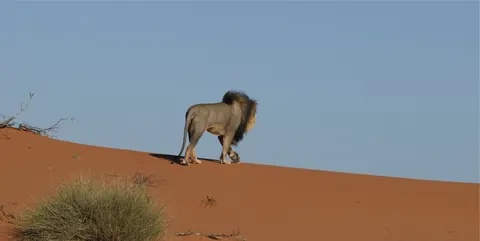
Do not come for game. This is a sheep farm, and the hosts’ own list of what you will hear is birdsong, crickets, sheep and the milk cows. Gemsbok do live on the farms of the district, and people who have driven the D503 dune road, south-east of Koës on the way to Mata Mata, report plenty of gemsbok between the ridges. A sighting from the chalets is luck.
A skirmish north of the village, March 1908
Two German soldiers’ gravestones stand in Koës. Klaus Dierks’s chronology ties them to 8 March 1908, when German troops fought Simon Kooper’s Fransman Nama at a place called Kubub, north of the village. Eight days later Captain Friedrich von Erckert, who had ridden into the Kalahari after Kooper with more than 700 camels, was shot dead at Seatsub, across the border in what is now Botswana. He was buried where he fell. When men went back months later to fetch the dead, they could not find the graves, so the stone with his name on it at Gochas stands over nothing.