Place to stay · Karas
Kalahari Game Lodge
Private game ranch on the Auob River 18 km west of the Mata-Mata border post, with eight chalets, six campsites in the riverbed and a self-drive 4x4 trail.
Kalahari Game Lodge is a private game ranch on the dry Auob River, right next to the Kgalagadi Transfrontier Park and 18 km west of the Mata-Mata border post. The ranch covers about 40,000 ha of red dunes and grass that used to be sheep and cattle farmland. The fences have come down and game has been brought back. It suits people who want Kalahari scenery and animals on the Namibian side, with the option of popping into the park.
What to expect
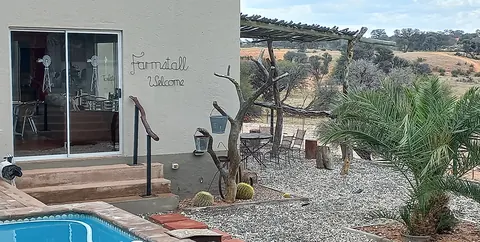
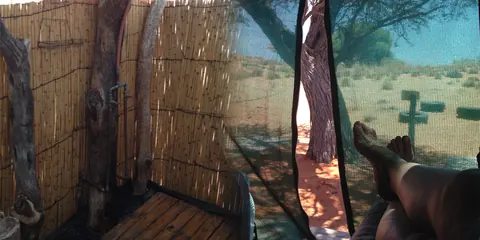
There are eight chalets with en-suite bathrooms, air conditioning, fans, mosquito nets and a small kitchenette, each with its own patio. Chalet stays include dinner and breakfast in the licensed restaurant. The six campsites sit about 100 m apart in the riverbed. Each one has a private ablution block with solar lights and a wood-fired donkey boiler, but no power points.
On the ranch you can join guided scenic and sundowner drives (minimum two people), take your own car along a 4x4 trail laid out over 3,500 ha, or walk the riverbed and up to a lookout deck. The lodge lists around 185 bird species, and brown hyena, giraffe, eland and gemsbok all live here.
Practical details
- Lodge and reservations +264 63 252 052, reservations@kalaharigamelodge.com.
- Route C15, Mata-Mata, postal address via Koës.
- Wifi at reception only. The pool is open to campers too.
Good to know
Besides Mata-Mata, the lodge is reachable from South Africa through Noordoewer, Nakop and Rietfontein. Crossing through the park needs at least two nights inside it. A 4x4 is recommended on the gravel, especially after summer rain.
Last updated 7 October 2026. Sources: Kalahari Game Lodge, about, Kalahari Game Lodge, accommodation and facilities, Kalahari Game Lodge, activities, Kalahari Game Lodge, wildlife and sustainability, Kalahari Game Lodge, reaching the lodge, Kalahari Game Lodge, contact.
Three lions called the Boss, Dark and the Youngest
In 2002 three lions were darted in the Kgalagadi Transfrontier Park, near Mata-Mata, and let go on the other side of the border, on this ranch. Namibia’s environment ministry had signed it off. The male was called N/oep, “the Boss”. The lionesses were N/hai (“dark”) and N/adi (“the youngest”).
A farm that brought lions back on purpose
That is an odd thing for a farm on this fence line to do. Lions that walk out of the Kgalagadi and kill livestock have long been killed for it. Paul Funston, who studied the park’s lions from 1998 to 2001, found that young lions in the prides along the boundary died at a high rate for exactly that reason, and that males were the likelier stock raiders. Caracals are drawn the same way. A spoor count by Melville and Bothma, published in 2006, found them keeping away from the Namibian border strip in the hot months and using it more in the cold season, when prey in the park is scarce and the farms’ sheep are close.
Hennie and Nettie Möller, who ran the lodge then, went the other way. Sven-Eric Kanzler wrote it up for the December 2004 edition of Travel News Namibia, riding along while Hennie climbed a dune with an aerial and a receiver to pick up the collar signals. The lodge was 24,000 ha at the time. The lions used about half of that, kept in by a 2.4 m electrified fence. Kanzler got to within 10 m of N/oep, then found the two lionesses with blood on their faces over a young gemsbok. Both females had been given contraceptive injections, which were not going to be repeated the following year, so cubs were expected. There were two cheetahs as well, Afri and Foundi, named for the AfriCat Foundation, which backed the project.
What one visitor found in December 2017
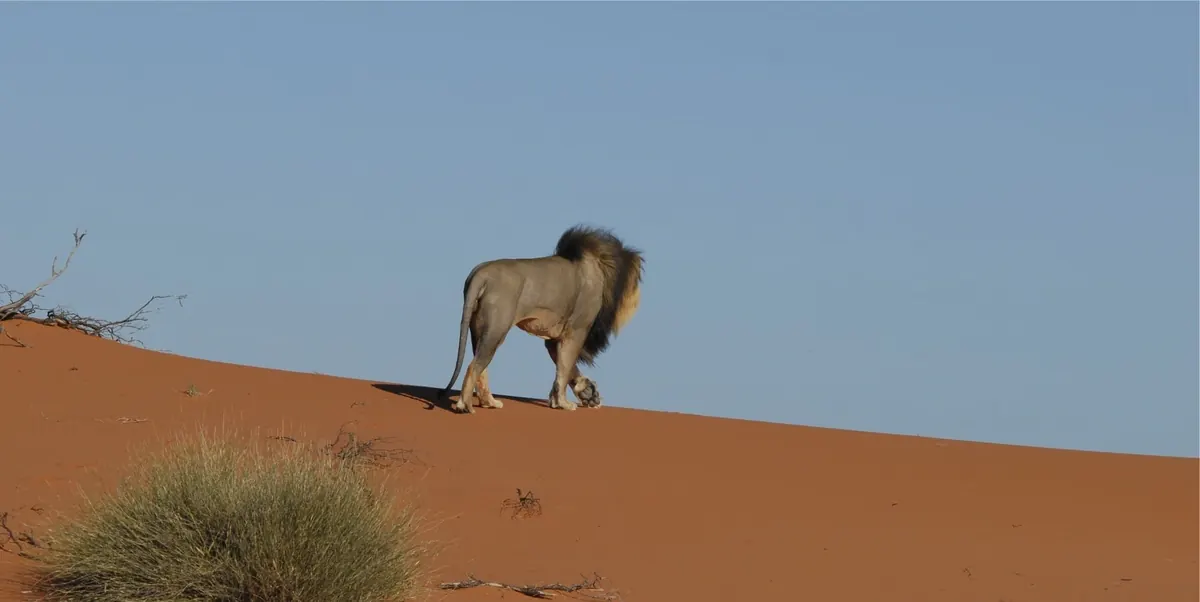
Thirteen years on there were cubs. A traveller who wrote up a tracking drive in mid-December 2017 counted two brothers, two lionesses and four cubs, every one of them asleep in the shade of a tree. The collars were not working that day, following spoor did not work either, and the tracker ended up radioing the lodge for GPS positions. One brother was blond. The dominant one had the black mane Kalahari lions are known for. This is a single account, so treat the numbers as that writer’s. The same visit included a night without power after lightning.
Ask about the lions before you book
Here is the catch. The lodge’s own website, as it stands in October 2026, does not mention lions at all. No tracking drive on the activity list, no lions among the species. At least two tour operator pages still say you can track lions here, one of them with GPS, and I suspect they have not been updated in years (the lodge’s own site still calls the 2007 border post “newly opened”). If lions are the reason you are coming, get an answer from the lodge in writing first. Otherwise the wild ones are in the Kgalagadi, through the Mata-Mata gate 18 km to the east.
What the ranch does list is the small, strange stuff: pangolin, African hedgehog, striped polecat, brown hyena. All four keep to the night and you should not expect any of them. Springbok and gemsbok are the safe bet. Pygmy falcons are on the bird list, and the summer migrants are in from November to April, which is also when pools stand on the sand flats after rain.