Park · Kgalagadi District, Botswana
Kgalagadi Transfrontier Park
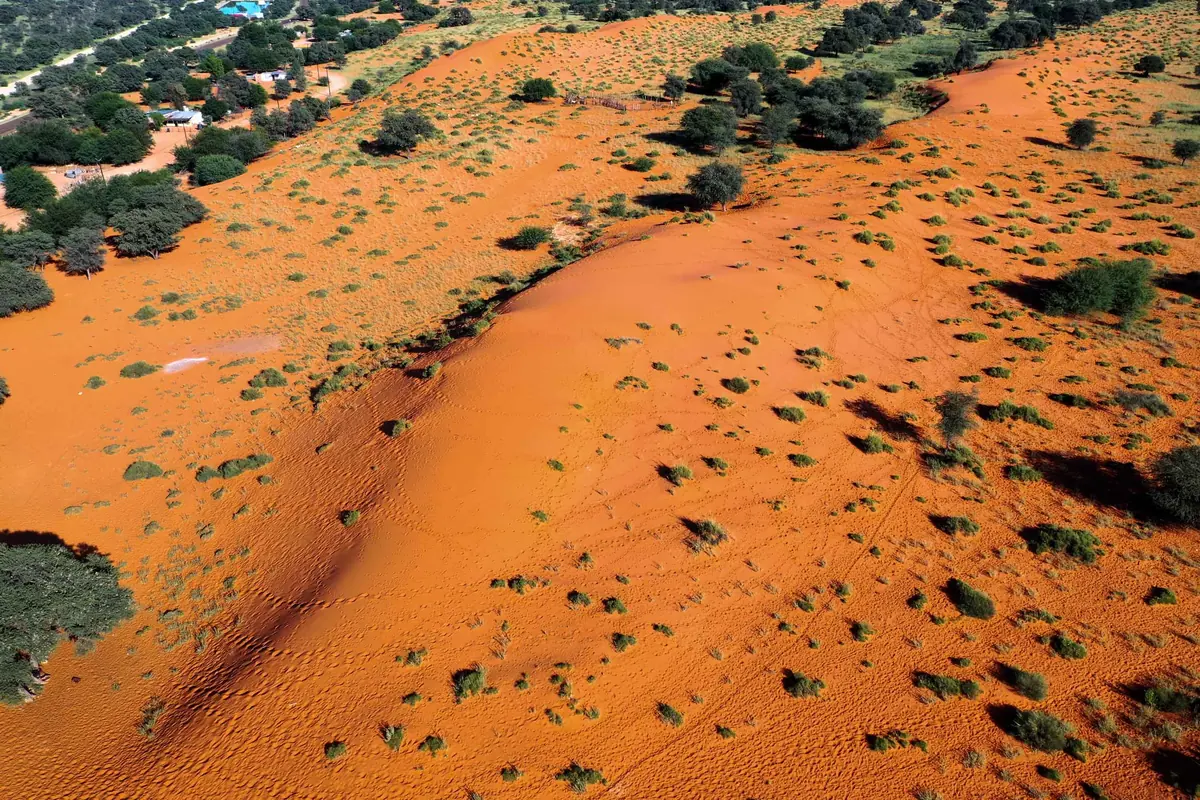
The Botswana three-quarters of the Kgalagadi Transfrontier Park: salt pans, red sand and unfenced campsites at Mabuasehube, where lions walk through camp. Deep sand, no fuel and no shops.
Short answer
At Kgalagadi Transfrontier Park, everyone pays P20 (about US$1.50, €1.50 or £1) per adult and P10 per child per day. The rates apply from 1 April 2022 to 31 March 2027.
- Daily fee, every adult
- US$1 €1 · P20
- Malaria
- The risk here is very low.
- Where
- Kgalagadi District, Botswana25.02°S 21.95°E
Kgalagadi Transfrontier Park fees 2026
Checked Department of Wildlife and National Parks (DWNP), Ministry of Environment and Tourism tariffValid 1 April 2022 to 31 March 2027, per person per day, in pula.
| Who | Adult | Child |
|---|---|---|
| All visitors | US$1 €1 · P20 | US$1 €1 · P10 |
- This is the fee on the Botswana side, which you enter at Mabuasehube or Kaa. Citizens, residents and foreign visitors all pay the same P20, the lowest park fee in the country.
- The schedule sets the child rate of P10 for ages 2 to 15, with under-2s free and the adult rate from 16.
- Vehicle fee: P4 per car per day.
- The South African side is charged by SANParks at its own, much higher, daily conservation fee. See our Kalahari Gemsbok National Park page for those figures.
- Camping is separate. Some Mabuasehube sites (Mabuasehube Pan, Mpayathutlwa) are leased to a private operator, Inter-Tourism Group, at its own rate. The rest are DWNP sites at about P40 a person a night for non-residents.
- The 2022 increase that took Chobe and Moremi to P270 did not change the P20 here, going by the sources I checked. A rise was due on 1 April 2026 and the ministry put it off the day before. Gabz FM reported in May that it had been pushed out by two years, and a July report had the existing fees still in place. No new date had been published when I checked on 12 October 2026. I could not find whether that proposal covers this park.
- The fee has no end date. I show it as valid to 31 March 2027, the end of Botswana's financial year, and will re-check then.
- Fees are set by Department of Wildlife and National Parks (DWNP), Ministry of Environment and Tourism. Official tariff · Seen a new rate? Tell us
US$1 = P13.47 · €1 = P15.06 · £1 = P18.07 (ECB rate and the Bank of Botswana rand rate, 3 Nov 2026). Converted amounts are approximate; you pay in pula.
How we got these figures
- The Botswana side was Gemsbok National Park before the two parks were joined, and it has its own regulations, dated 29 December 2000. Their first schedule sets one entry fee for citizens, residents and non-residents: P20 an adult, P10 a child and P4 a car. The general parks regulations apply there only where the Gemsbok ones do not say otherwise.
- Tawana Self Drive (April 2026) and Africa Travel Essentials (March 2026) still give P20 and P4. Ostrich Trails gives the same adult and vehicle figures but a child band of 8 to 15 at half price with under-8s free; I kept the ages in the schedule.
- Cheetah Safaris lists P110 for residents and SADC visitors and P150 for international visitors on the Botswana side. No other source supports those figures and I ignored them.
- The start date shown is the start of the current DWNP fee period. The P20 fee itself is older: it is in the Gemsbok National Park regulations of December 2000, and I found no later amendment to it.
- DWNP camping figures (P40, P30, P15) come from the ministry's 2022 schedule for Category B sites and match what Ostrich Trails reports for Mabuasehube; Tawana Self Drive lists P30.
- Gemsbok National Park Regulations (29 December 2000), First Schedule entry fees, copy hosted by FAOLEX · official · checked 12 Oct 2026
- Tawana Self Drive, Maun (page updated 16 April 2026) · one source · checked 12 Oct 2026
- Africa Travel Essentials (24 March 2026) · one source · checked 12 Oct 2026
- Ostrich Trails, Mabuasehube guide (updated 27 June 2025) · one source · checked 12 Oct 2026
- Cheetah Safaris, Kgalagadi page (its P110 and P150 figures are not used) · one source · checked 12 Oct 2026
- Ministry of Environment, Natural Resources Conservation and Tourism, Revised User Fees and Services (the 2022 schedule, copy linked from Tourism Update) · official · checked 12 Oct 2026
- National Parks and Game Reserves Regulations, 1 April 2000 (the fee schedule before 2022), copy hosted by FAOLEX · official · checked 12 Oct 2026
- TravelComments.com (1 April 2026, increase postponed) · one source · checked 12 Oct 2026
- Gabz FM News (5 May 2026, increase put off by two years) · one source · checked 12 Oct 2026
- Travel and Tour World (29 July 2026, existing fees stay) · one source · checked 12 Oct 2026
About three-quarters of the Kgalagadi Transfrontier Park lies in Botswana, some 28,400 of its 38,000 square kilometres, and few visitors see it. The camps, shops and fuel are all on the South African side of the dry Nossob riverbed. The Botswana side is sand tracks, salt pans and campsites with no fences, and most of the people who come are heading for one corner of it: Mabuasehube, in the far east, where lions have a habit of walking through camp.
Getting there
There are three ways in. Two Rivers, the Botswana office beside South Africa’s Twee Rivieren, is the easy one, about 250 km on tar from Upington. Both countries have immigration there.
Mabuasehube Gate is a different matter. From Tsabong, the last reliable fuel, it is a little over 100 km of gravel and then thick sand. Allow four hours. The route from the north runs 110 km on tar from Kang to Hukuntsi, then 140 km of mixed sand and gravel. Kaa Gate, further north-west, is reached through Hukuntsi and Zutshwa and sees very few vehicles.
You can also cross inside the park on a 170 km sand track from Nossob camp, which takes five to nine hours.
When to go
Rain falls from about December to April. The pans hold water then and the grass is green, but the game spreads out. From May the park dries, and by September and October animals are tied to the pans and the few working waterholes. Winter days sit around 25°C and the nights go below freezing. Midsummer passes 40°C.
What to do
Drive the pans. Mabuasehube has six main ones, each ringed by a track, with campsites on the rim looking down on the springbok and gemsbok on the pan floor. Mpayathutlwa, in the middle, holds the most game. Then sit in camp, because that is where the lions and brown hyenas turn up. The 4x4 wilderness trails towards the Nossob and around Kaa take one group a day and must be booked. If camping is not for you, Ta Shebube runs two lodges in concessions on the Nossob, at Rooiputs and Polentswa, both reached through Two Rivers.
Good to know
You need a 4x4, and the tourism board asks for two vehicles together. Let your tyres down before the sand. There is no fuel, shop or phone signal on this side, and tap water is brackish when it runs at all, so carry all you will drink. Campsites are booked through DWNP, except Mabuasehube and Mpayathutlwa pans, which a private operator, Inter-Tourism Group, runs. The gate wants to see a booking. Hours follow the South African side and change by month, from 07:30 to 18:00 in June and July to 05:30 to 19:30 in November and December. The limit is 40 km/h and you stay in the vehicle outside camp. Malaria risk is very low this far south. UK advice is bite avoidance only. Fees are in the table on this page.
History and culture
Botswana's share of the Kgalagadi Transfrontier Park is a block of southern Kalahari that was San and Bakgalagadi country long before it was a reserve. A colonial border was ruled down its western side, a German camel column rode through it in 1908, and in 2000 it became part of southern Africa's first peace park.
- Earliest times
San hunter-gatherers lived in the southern Kalahari long before it was a park, and the sand is rich in Later Stone Age remains. Among them were the ǂKhomani, whose country lay north of today's Upington in South Africa. source
- 1600s
The Bakgalagadi, a Sotho-Tswana people whose name means people of the Kalahari, are thought to have moved into what is now Botswana from the Transvaal region of South Africa in the 17th century. They herded cattle, grew crops and hunted, and the district and the park carry their name. source
- 1885 to 1890
Britain declared the Bechuanaland Protectorate on 31 March 1885. A treaty with Germany in 1890 fixed the edge of German South West Africa (now Namibia) on the line of 20 degrees east. The park's north-western corner at Union's End sits on that line. source
- 1908
Simon Kooper (also spelt Kopper), a Nama leader, was holding out with his people in the Kalahari after the rising against German rule in South West Africa. In 1908 a German force on some 700 camels gathered at Geinab on the Nossob, today's Grootkolk, and followed his men into Bechuanaland. In the fight at a place the Germans called Seatsub on 16 March, 59 Nama and 15 Germans were killed. Kooper had already left. In 1993 a military history society reported that the site could no longer be found. source
- 1931
South Africa proclaimed the Kalahari Gemsbok National Park on its side of the Nossob in 1931. Most of the ǂKhomani San and the Mier people who lived there were forced to move to other areas. source
- 1941 to 1971
A strip of the Bechuanaland side 40 km wide, next to the South African park, was declared a game reserve. A conservation journal dates this to 1941; some travel sources say 1938. In 1971, five years after independence, Botswana enlarged it considerably and made it the Gemsbok National Park. source
- 1992
The Mabuasehube Game Reserve, which juts out from the park's eastern edge, was incorporated into the Gemsbok National Park. It is the part of the Botswana side best known for its lions. source
- 1999 to 2000
A joint management committee had been set up in June 1992. On 7 April 1999 Botswana and South Africa signed an agreement to run their two parks as a single unit, with no barrier along the border between them. Presidents Festus Mogae and Thabo Mbeki launched the Kgalagadi Transfrontier Park on 12 May 2000. It was southern Africa's first peace park. source
- The Bakgalagadi
- The Bakgalagadi are the people of the Kalahari: one person is a Mokgalagadi and the language is Shekgalagadi. Most live in the Kgalagadi and Ghanzi (Gantsi) districts. By tradition they are cattle herders who also farmed, hunted and gathered. source
- People and numbers
- The 2022 census counted 35,347 people in Kgalagadi South and 23,510 in Kgalagadi North, the two halves of the district around the park. Tsabong, the last fuel stop before Mabuasehube, had 11,651. source
- A language almost gone
- The ǂKhomani San spoke Nǁng, often called Nǀuu. During the 20th century they shifted to Khoekhoe and Afrikaans, and the language is now close to extinct. Katrina Esau is regarded as its last speaker. source
For German visitors: The camel column of March 1908 was led by Hauptmann Friedrich von Erckert of the German colonial Schutztruppe, who is remembered as the father of its camel corps. He was shot among the first in the assault on Kooper's camp near Seatsub, in what was then British-ruled Bechuanaland. Hans Grimm retold the expedition in his 1926 novel Volk ohne Raum. Erckert's gravestone stands in the cemetery at Gochas in Namibia over an empty grave, because his remains were never found. source
Main sights in Kgalagadi Transfrontier Park
4- Mabuasehube pans
Mabuasehube, Mpayathutlwa and Bosobogolo are the three biggest, with Lesholoago, Khiding and the Monamodi valley on sand tracks off to the side. Mabuasehube Pan's bare clay floor is rich in salts and animals come to lick it. Bosobogolo is short grass, which brings antelope to graze and predators after them.
Botswana Tourism Organisation, Kgalagadi Transfrontier Park (archived copy of 27 December 2024) - The Nossob riverbed
The border between Botswana and South Africa follows this dry riverbed and the park has no fences, so the game moves across as it always has.
Botswana Tourism Organisation, Kgalagadi Transfrontier Park (archived copy of 27 December 2024) - Union's End
The point in the Nossob riverbed where Botswana, Namibia and South Africa meet, at the park's north-western corner. There is a picnic table and an information board. A straight fence has run along the Namibian side since 1966.
Wikipedia, Union's End - Polentswa Lodge
A small tented lodge on the Botswana side, owned by the Ta Shebube group, with each unit looking over a waterhole that is lit at night. It first opened in 2013, was destroyed by a veld fire in September 2021 and has reopened with five units.
Tourism Update, Kgalagadi lodge reopens following fire
Did you know?
- Some 28,400 of the park's 38,000 square kilometres are in Botswana, but the three rest camps with shops and fuel (Twee Rivieren, Nossob and Mata-Mata) are all on the South African side. source
- The Nossob riverbed, which carries the border for more than 200 km, is said to flow about once a century. Water under the sand keeps the camel thorn trees along it alive. source
- Kgalagadi means place of thirst. The park has recorded temperatures from minus 11°C to 45°C, and January days often pass 40°C. source
- The Mabuasehube pans are old lake beds. Wind scooped out the hollows some 20,000 to 25,000 years ago and piled the sand into dunes on their southern rims. In a wetter spell that followed they held permanent lakes, and the clay those lakes left is the pan floor you see today. source
- Mabuasehube is said to mean red earth. The old reserve is a rectangle of about 30 by 60 km, some 1,800 square kilometres. source
- In 2017 UNESCO listed the ǂKhomani Cultural Landscape, in the Kalahari north of Upington in South Africa, as a World Heritage Site. The sand country has no rock for paintings or engravings, so a cultural mapping project is helping to keep its traditions alive among younger people. source
Checked 12 October 2026.
Wildlife you might see
13- very likelyGemsbokOn and around the pans at Mabuasehube and along the Nossob valley. The tourism board calls gemsbok and springbok ubiquitous here. All yearsource
- very likelySpringbokPan floors, where the short grass and salty clay draw them in. All yearsource
- very likelyRaptors, including bateleur and pygmy falconAcross the park. White-backed and lappet-faced vultures are common too. Wikivoyage counts more than 50 raptor species for the whole park. All yearsource
- very likelySociable weaverCommon across the park. Look for their big shared nests in the trees. All yearsource
- likelyLionMabuasehube, where the black-maned Kalahari lions regularly walk through the campsites, and the Nossob valley. All yearsource
- likelyRed hartebeest, eland and blue wildebeestRiver valleys and pans. The herds move around the park with the seasonssource
- likelyMeerkat and leopard tortoiseOpen ground and sandy tracks. Tortoises like to walk in the tyre rutssource
- possibleBlack-backed jackal, bat-eared fox and Cape foxThe tourism board lists all three for the park, the two foxes at Mabuasehube in particularsource
- possibleBrown hyenaAround the Mabuasehube pans and campsites, at first light or after dark. Normally a very shy animalsource
- possibleLeopardAround the Mabuasehube campsites after dark. Visitors report them watching from the edge of the firelightsource
- possibleCheetahOpen pans such as Bosobogolo, and the dry riverbedssource
- possibleSpotted hyenaReported at the Monamodi pans, where they have gone through camp at night. Regulars do not see them on every tripsource
- rareAardwolf and black-footed catOn the Mabuasehube pans in the evening, for people with sharp eyes. Count yourself lucky with eithersource
Likelihood is for a normal visit of two or three days, from the sources linked. Nothing is guaranteed in the wild.
Staying safe in Kgalagadi Transfrontier Park
- Malaria
- The risk here is very low. UK travel health advice puts the southern half of Botswana in its lowest category and recommends awareness and bite avoidance, not tablets. Cover up and use repellent between dusk and dawn, and see a doctor promptly if you get a fever after the trip. source
- Lions in camp
- The campsites at Mabuasehube have no fences, and lions, leopards and hyenas walk through at night. Regulars say to zip the tent and stay inside it after dark. One regular visitor would not take young children at all. source
- Staying in the vehicle
- Botswana's park regulations, which cover this park, forbid getting out of a vehicle except at a designated facility such as a campsite or day use site. Nobody may ride on the roof or a roof rack. The limit on park tracks is 40 km/h. source
- Gate hours and night driving
- Driving between closing and opening time is not allowed, and the hours change with the month: 07:30 to 18:00 in June and July, 07:00 to 18:30 in April and August, 06:00 to 19:00 in October, 05:30 to 19:30 in November and December. source
- Heat and water
- Summer days are very hot and winter nights very cold. There is no water you can rely on at Mabuasehube, so plan on at least 5 litres a person a day, more if you want to wash, and keep 10 litres untouched for a breakdown. source
- Travelling in convoy
- The Botswana Tourism Organisation says self-drivers must travel in a convoy of at least two vehicles, in well-equipped 4x4s only, and the number of vehicles on the wilderness trails is strictly controlled. With no fuel on this side and help a long way off, a second car is the sensible way to go. source
Tips from travellers
- There is no fuel on the Botswana side. The last pumps are at Tsabong coming from the south, Hukuntsi or Kang from the north and Sekoma from the Gaborone road, or at Nossob camp if you cross inside the park. One couple who logged every litre suggest at least 80 litres for getting to the park and back, plus 10 to 15 a day inside it. one source
- Let your tyres down as soon as you leave the tar and carry a compressor and gauge to pump them up again. Forum regulars run 1 to 1.2 bar at Mabuasehube and blame the corrugations on people who do not bother. several sources
- Book months ahead for a particular pan in the dry season. The DWNP sites and the trails go through the DWNP reservations office. Mabuasehube and Mpayathutlwa pans are booked with Inter-Tourism Group. Neither has online booking, so some people pay a Botswana booking agent to do it. Turn up at the gate with the booking in hand. one source
- Do not count on the taps, showers or pumped waterholes. Visitors over several years report them broken or dry at most sites, including the ablution block at Mabuasehube Gate, and what water there is tastes of salt. A-frame shade shelters and long-drop toilets are the most you should expect. several sources
- Pack everything away before bed and when you leave camp for a drive. Hyenas chew what smells interesting: one group lost a camp shower and another a new spare tyre. several sources
- The track between Nossob camp and Mabuasehube is about 170 km of sand, and reports of the time it takes run from five to nine hours. It carries traffic in both directions. The two Matopi campsites about halfway split it into two days. one source
Checked 12 October 2026. Conditions change, so confirm with the park or venue before you go.
Lions that never needed water now queue at the shower
In 1973 F.C. Eloff, a zoologist at the University of Pretoria, published a short paper saying the Kalahari lion does not have to drink. It will if water is there. Without it, the blood and body fluids of its prey are enough. Fifty years on, campers at Mabuasehube report lions licking up the run-off from the campsite showers, and one couple watched a leopard come in that evening to do the same.
What borehole water did to the Mabuasehube lions
Eloff’s lions lived hard. He followed them for 195 full days and nights and found that porcupine made up nearly a third of their kills, more than gemsbok. They walked close to 12 km a night for it, and he concluded that many cubs simply starved. A 1970s count put the whole South African park at about 140 lions.
Lions are thin on the ground, then, and pumped water gathers them. One forum regular reckoned in 2011 that four in five of his lion sightings were beside an artificial waterhole. At Mpayathutlwa a visitor watched a pride on the pan early one morning and had ten of them in camp half an hour later, where they stayed most of the day. The young ones went through the firewood and chewed the doormat.
Some people have made it worse by putting out water. Campers at Mpayathutlwa 2 wrote in March 2024 that two males walked in at seven in the evening and the rest of a pride of ten followed. They sat in their vehicles until passing drivers pushed the lions off at nine the next morning, and they blamed water left out by the people before them. In July 2021 a young male walked into a tent at the gate campsite.
Lions are still no certainty. In that 2011 thread one man had been three times without seeing a lion inside Mabuasehube, and another spent 25 days on the Botswana side and neither saw nor heard one. A party in March 2022 saw lions only because a lioness was being held in a boma at Mpayathutlwa, said to be a cattle killer moved from elsewhere, and wild lions kept coming to the fence. A lioness that had walked kilometres from her own pride charged the wire again and again. That was March, in the rains, when the game has no need of the pans.
A hut-tax collector on the Nossob, 1904
Arnold Hodson was a young sub-inspector in the Bechuanaland Protectorate Police who went into the desert late in 1904 to collect hut tax from villages that had never paid it. People had no cash, so he took it in skins and ostrich feathers. From a pan he spelt Setachwe, where a Khoekhoe headman called Willem had a camp living on tsamma melons, he set out with two traders to see the Nossob. About 30 miles on, the flat country gave way to dunes that reminded him of “the sea on a rough day”.
There was no water at all, only melons. When Hodson shot a gemsbok, his guide squeezed the stomach contents by the handful and drank what ran out. Hodson called the taste appalling. His horses, he noticed, never strayed in melon country.
He found a gemsbok his guides said a lion had killed, and wrote that he never once saw a lion in this part of the Kalahari. The river, when he reached it, was broad and dry with trees growing in the bed. He was back at Kang for Christmas. His book, Trekking the Great Thirst, came out in 1912 and is free to read on the Internet Archive.
Nine degrees out
Frank Höppener, a Dutchman posted to Tsabong as district lands officer in 1986, has written down what he was told there. The Botswana park’s southern boundary was meant to run due east from Twee Rivieren. As he heard it, the team cutting the line took east from the sunrise, in winter, and were about nine degrees off. They had done some 23 km before the government surveyors arrived, and the line stayed.
Hans Schwabe, a German geologist who had no permission to prospect for diamonds in the Nossob valley, left his car at Kwang Pan in 1958 and walked. What was found of him, near where the Polentswa joins the Nossob, was part of a skull, his feet, a drinking tin and his pick. Höppener also credits a game scout, Bantsi Bantsi, who ran the Swartpan scout camp, with exploring the route that became the Kaa trail. When he wrote, in 2016, Bantsi had retired to Serowe.
In 1885 a Canadian showman calling himself Farini came up the Nossob and claimed to have found the ruins of a city, which Höppener places some days’ trek east of the riverbed. In 1964 A.J. Clement decided Farini had seen a natural outcrop of weathered dolerite.
Leopards measured in kilometres
Jacobus Bothma and Elias le Riche, whose family ran the South African park for decades, studied leopards here by following their tracks, 812 km of them over 54 days in the dunes. The ranges Bothma published in 2012 are the largest recorded for the species, around 2,100 km² for a male. By day the cats lay up in aardvark and porcupine burrows, and the leopard reports I can find from Mabuasehube campers are at a campsite, in the evening or at night. One relayed account, from Bosobogolo 2 in early March 2024, has a starving leopard climbing a roof tent ladder at half past one in the morning and being punched off through the gauze.
Wild dogs are rarer. A few Mabuasehube regulars have pooled their sightings on one forum thread: Khiding in 2017, Khiding and Matopi in 2022, Matopi in August 2024, south of the Monamodi pans that November, then Mpayathutlwa in March and April 2025. That March a camper at Mabuasehube Pan counted a pack of eight stalking a wildebeest. A handful of sightings in nine years, shared among everybody who goes.
The Nossob side runs to its own calendar. Antelope crowd the riverbed in the rains and thin out in the dry months. Gemsbok are the quickest to go once the grass has matured, while springbok hang on by browsing. It is the reverse of what the pans do.
Quick answers
How much is the entry fee for Kgalagadi Transfrontier Park?
Everyone pays P20 per adult and P10 per child per day, from 1 April 2022 to 31 March 2027.
When were these Kgalagadi Transfrontier Park fees last checked?
We last checked them on 12 October 2026 against 10 published sources. We re-check every two weeks, but always confirm with Department of Wildlife and National Parks (DWNP), Ministry of Environment and Tourism before you travel.
What animals can you see in Kgalagadi Transfrontier Park?
Most visitors see gemsbok, springbok, raptors, including bateleur, pygmy falcon and sociable weaver. You have a good chance of seeing lion, red hartebeest, eland, blue wildebeest, meerkat and leopard tortoise. Aardwolf and black-footed cat are there but rarely seen.
Kgalagadi Transfrontier Park and the parks nearest it
| Park | International adult | Distance | Where |
|---|---|---|---|
| Kgalagadi Transfrontier Park | US$1 €1 · P20 | · | Kgalagadi District |
| Khutse Game Reserve | US$14 €13 · P190 | 277 km | Kweneng District |
| Central Kalahari Game Reserve | US$14 €13 · P190 | 367 km | Ghanzi District |
| Khama Rhino Sanctuary | US$9 €8 · P117 | 573 km | Central District |
Guides for Kgalagadi Transfrontier Park
Where the Kgalagadi Transfrontier Park fees come from
- Gemsbok National Park Regulations (29 December 2000), First Schedule entry fees, copy hosted by FAOLEX
- Tawana Self Drive, Maun (page updated 16 April 2026)
- Africa Travel Essentials (24 March 2026)
- Ostrich Trails, Mabuasehube guide (updated 27 June 2025)
- Cheetah Safaris, Kgalagadi page (its P110 and P150 figures are not used)
- Ministry of Environment, Natural Resources Conservation and Tourism, Revised User Fees and Services (the 2022 schedule, copy linked from Tourism Update)
- National Parks and Game Reserves Regulations, 1 April 2000 (the fee schedule before 2022), copy hosted by FAOLEX
- TravelComments.com (1 April 2026, increase postponed)
- Gabz FM News (5 May 2026, increase put off by two years)
- Travel and Tour World (29 July 2026, existing fees stay)
Open data: all park fees (CSV) · JSON (CC BY 4.0)
Cite as: Travel Africa Guide, "Kgalagadi Transfrontier Park fees 2026", checked 12 October 2026, https://travelafrica.guide/botswana/kgalagadi-transfrontier-park/