Park · Northern Cape, South Africa
Kgalagadi Transfrontier Park
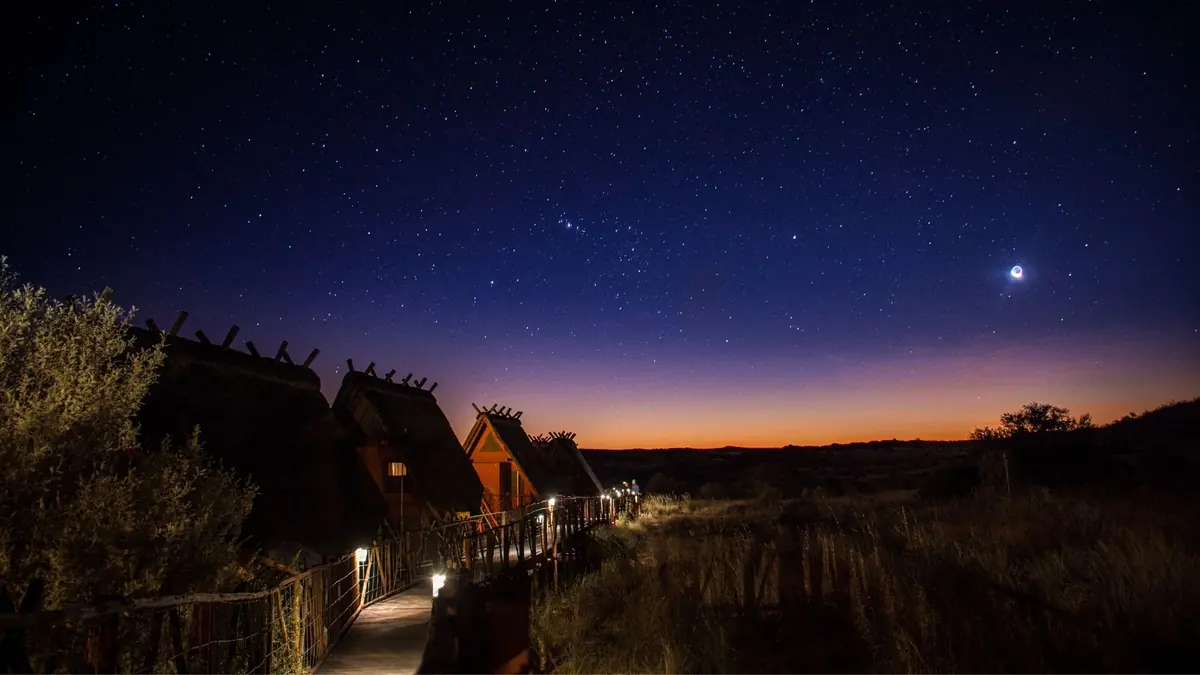
The South African quarter of the Kgalagadi Transfrontier Park, a vast dry corner of the Kalahari known for black-maned lions, raptors and long gravel roads along two dry riverbeds.
Short answer
At Kgalagadi Transfrontier Park, international visitors pay R662 (about US$38, €34 or £29) per adult and R331 per child per day. The rates apply from 1 November 2026 to 31 October 2027.
- Daily fee, international adult
- US$38 €34 · R662
- Malaria
- Malaria risk in the park is low to nil.
- Places to stay
- 17
- Where
- Northern Cape, South Africa25.62°S 20.33°E
Kgalagadi Transfrontier Park fees 2026/27
Checked South African National Parks tariffValid 1 November 2026 to 31 October 2027, per person per day, in rand.
| Who | Adult | Child |
|---|---|---|
| International visitorsUS, Europe and everyone else | US$38 €34 · R662 | US$19 €17 · R331 |
| SADC nationals | R283 | R141 |
| South African residents | R134 | R67 |
- These rates apply from 1 November 2026.
- Adults are 12 and older. Child rate applies to ages 2 to 11; children under 2 enter free.
- Members of the SANParks WILD loyalty programme (Wild Card) do not pay daily conservation fees if they show ID and their card on arrival.
- Botswana nationals visiting Kgalagadi pay the South African rate under the transfrontier agreement.
- Wild Card holders do not pay daily fees. Is the Wild Card worth it for you?
- Fees are set by South African National Parks. Official tariff · Seen a new rate? Tell us
US$1 = R17.47 · €1 = R19.20 · £1 = R22.93 (ECB rate, 20 Nov 2026). Converted amounts are approximate; you pay in rand.
How we got these figures
- Checked against the official SANParks tariff on 7 October 2026. Before that these figures came from published reports (places.co.za). They matched the official sheet.
- SANParks conservation fees 2026-11-01 to 2027-10-31 (official tariff) · official · checked 7 Oct 2026
Two names, one place. The Kalahari Gemsbok National Park was proclaimed on the South African side in 1931, next to Botswana’s Gemsbok National Park across an unfenced border. In May 2000 the two were formally launched as the Kgalagadi Transfrontier Park, southern Africa’s first peace park. Kgalagadi means place of thirst. The whole park is about 38,000 square kilometres and roughly a quarter is in South Africa, the part with the camps and nearly all the visitors.
Getting there
Upington is the gateway, with daily flights from Johannesburg and Cape Town and hire cars at the airport. From there it is about 250 km on tar to Twee Rivieren, the entrance camp. Inside the park every road is gravel and most of it is corrugated. A sedan can be done but is miserable; a bakkie or SUV with high clearance is the sensible minimum. You only need a true 4x4 for the Botswana side and the Bitterpan and Gharagab wilderness camps.
When to go
May to September. Days run 20 to 30 degrees, and animals stay close to the waterholes in the dry riverbeds. Nights drop below freezing. Summer, roughly October to April, regularly passes 40 degrees and thunderstorms bring nearly all of the year’s rain, which is not much. A big storm can still do damage: in November 2025 Nossob had 109 mm in two days, which damaged tents and some park roads, and visitors were told to use high-clearance or 4x4 vehicles until repairs were done. The main camps are often full six to twelve months ahead for the June and July school holidays, so book the moment you know your dates.
What to do
The game drives follow the Nossob and Auob riverbeds, dry channels that are said to flow about once a century, with a row of pumped waterholes along each. Twee Rivieren to Mata-Mata on the Auob is about two and a half hours without stops; Twee Rivieren to Nossob is three and a half. One group reported 60 km taking four hours, which is about right if you keep stopping for cheetah, gemsbok, meerkats and the black-maned lions the park is famous for. Raptors are a speciality. Counts vary by source, from around 30 species to over 50, so expect plenty of them.
Beyond the three main camps there are six small unfenced wilderness camps (Kalahari Tented Camp, Urikaruus, Kieliekrankie, Bitterpan, Gharagab, Grootkolk) where the animals come to you.
Good to know
Gates open between 05:30 and 07:30 and close between 18:00 and 19:30 depending on the month, and there is no driving after dark, so plan to be inside your camp before the gate shuts. The speed limit is 50 km/h. Fuel is sold at Twee Rivieren, Mata-Mata and Nossob only; shops are basic and there is no ATM, so bring cash and everything you need. Twee Rivieren is the only camp with 24-hour power and mobile signal. Nossob runs on solar with generator backup, and one traveller reported the power going off from 23:00 to about 06:00. Camp tap water is very salty, and travellers disagree on whether it is fit to drink, so plan on bottled or brought water and carry at least 10 litres in the car. Malaria risk is low to nil. If you enter from South Africa and plan to leave into Namibia at Mata-Mata, you must clear immigration at Twee Rivieren and spend at least two nights in the park.
Wildlife you might see
12- very likelyGemsbok (oryx)Along the Auob and Nossob riverbeds. All yearsource
- very likelySpringbokRiverbed floors and waterholes. All yearsource
- very likelyBlue wildebeestsource
- likelyBlack-backed jackalsource
- likelyLion (the black-maned Kalahari lion)Along the riverbeds and around the pans and waterholes. All year. In the dry winter months animals are drawn to the few waterholes, which makes them easier to findsource
- likelyCheetahHunting along the dry riverbedssource
- likelyBirds of prey (martial eagle, pygmy falcon and many more)All yearsource
- likelyOstrichsource
- likelySouthern giraffesource
- possibleMeerkatsource
- possibleLeopardsource
- rareBrown hyenaMostly active at nightsource
Likelihood is for a normal visit of two or three days, from the sources linked. Nothing is guaranteed in the wild.
Hikes and walks
1- Morning wilderness walk at !Xaus Lodge
The lodge, owned by the ‡Khomani San and Mier communities, starts the day with a walk in the dunes led by a guide and a local tracker, reading the night's tracks. It goes only as far as the group wants to. There are no self-guided trails listed for the park.
Permit: Part of a stay at the lodge
!Xaus Lodge
Staying safe in Kgalagadi Transfrontier Park
- Stay with your car
- Only get out at the camps and the marked picnic spots. If you break down, stay in the vehicle, where you are safest and easiest to find. Do not try to walk to a camp. source
- Unfenced wilderness camps
- The wilderness camps have no fence, and animals walk through after dark. Keep your wits about you at night and watch for scorpions. source
- Heat and water
- Summer days pass 40 degrees. Drink a lot and keep emergency water in the car, since the camps are a long drive apart. source
- Snakes
- Venomous snakes live in the park, among them Cape cobra, puff adder and horned adder. Use a torch and watch where you step around camp at night. source
- Malaria
- Malaria risk in the park is low to nil. Check again if your trip carries on north into Botswana or Namibia. source
- Gate times and speed
- No driving after dark. Gate times are strict and you can be fined for getting to camp late, so leave enough time between camps. Driving off the road is not allowed. source
- Speed limits
- The limit is 50 km/h on the park's main roads and 20 km/h in the camps. All the roads are gravel and can be badly corrugated. source
Tips from travellers
- Give it time. Three or four nights is the sensible minimum, because the distances are long and the park rewards a slow pace. one source
- There are no ATMs in the park, so bring cash. Fuel is sold only at Twee Rivieren, Mata-Mata and Nossob, and costs more than outside, so fill up in Upington too. several sources
- Driving takes much longer than the map suggests. With stops at waterholes, 60 km can easily take four hours. one source
- Pack warm layers even if the afternoon will be hot. Early morning drives are cold, and winter nights drop below freezing. several sources
- Book early. Camps for the June and July school holidays fill six to twelve months ahead. one source
- Bring your own toilet paper for the picnic spots. One traveller found they are serviced only about once a week. one source
Checked 7 October 2026. Conditions change, so confirm with the park or venue before you go.
In and around Kgalagadi Transfrontier Park
87 places listedWhere to stay in Kgalagadi Transfrontier Park 17
- 26.15°S 20.26°EChalet!Xaus Community Lodge+27 21 701 7860xauslodge.co.za
- 25.42°S 20.60°ECampsiteNossob Rest Campsite+27 12 428 9111sanparks.org
- 25.79°S 20.02°EChaletKalahari Tented Camp+27 12 428 9111sanparks.org
- 25.77°S 20.00°ECampsiteMata-Mata Camp Site+27 12 428 9111sanparks.org
- 25.42°S 20.60°ECampsiteNossob Premium Camps+27 12 428 9111sanparks.org
- 25.42°S 20.60°EHotelNossob Rest Camp+27 12 428 9111sanparks.org
- 26.01°S 20.35°EChaletUrikaruus Wilderness Camp+27 12 428 9111sanparks.org
- 25.04°S 20.08°EChaletGharagab Wilderness Camp+27 12 428 9111sanparks.org
- 24.89°S 20.15°EHotelGrootkolk Wilderness Camp+27 12 428 9111sanparks.org
Show all 17 places to stay
- Bitterpan chalets · Chalet
- Kameeldoring Camp · Campsite
- Kij Kij · Campsite
- Riverfront Chalet · Chalet
- Riverfront Chalet # 20 · Chalet
- Rosyntjiebos Camp Site · Campsite
- Twee Rivieren Campsite (South Africa) · Campsite
- Witgat Camping Site · Campsite
Sights 69
- Auchterlonie MuseumMuseum
- Klein StofpanAttraction
- Auchterlonie WaterholeAttraction
- Bedinkt WaterholeAttraction
- Dikbaardskolk WaterholeAttraction
- Houmoed WaterholeAttraction
- Kij Gamies WaterholeAttraction
- Kij Kij WaterholeAttraction
- Mata-Mata WaterholeAttraction
- Melkvlei WaterholeAttraction
- Montrose WaterholeAttraction
- Nossob WaterholeAttraction
Show all 69 sights
- Polentswa Waterhole · Attraction
- Rooiputs Waterhole · Attraction
- Samevloeiing Waterhole · Attraction
- !Xaus Community Lodge (Bushmen Village) · Attraction
- Auchterlonie Blacksmith Workshop · Ruins
- Auchterlonie Kraal for Livestock · Ruins
- Auchterlonie Outside Cooking Area · Ruins
- Auchterlonie Well · Ruins
- Batulama Waterhole · Viewpoint
- Cheleka Waterhole · Viewpoint
- Craig Lockhart Waterhole · Viewpoint
- Craig Lockhart Waterhole · Attraction
- Cubitje Quap Waterhole · Attraction
- Dalkeith Waterhole · Viewpoint
- Dankbaar Waterhole · Viewpoint
- Dertiende Boorgat · Viewpoint
- Dikbaardskolk Waterhole · Viewpoint
- Game & Bird Hide · Viewpoint
- Geinab Waterhole · Attraction
- Gemsbok Waterhole · Attraction
- Gemsbokplein Waterhole · Viewpoint
- Gharagab Camp Waterhole · Viewpoint
- Gharagab Waterhole · Attraction
- Jan se Draai Waterhole · Attraction
- Kameelsleep Waterhole · Viewpoint
- Kamfersboom Waterhole · Attraction
- Kampfersboom Waterhole · Viewpoint
- Kamqua Waterhole · Viewpoint
- Kannaguass Waterhole · Attraction
- Kaspersdraai Waterhole · Attraction
- Kij Kij Waterhole · Attraction
- Kouant Waterhole · Attraction
- Kransbrak · Viewpoint
- Kransbrak Waterhole · Attraction
- Kwang · Viewpoint
- Kwang Waterhole · Attraction
- Langklaas Waterhole · Attraction
- Leeuwdril Waterhole · Viewpoint
- Marie se Draai Waterhole · Viewpoint
- Monro Waterhole · Viewpoint
- Nossob Camp Hide · Viewpoint
- Nossob River Viewpoint · Viewpoint
- Nu-Quap Waterhole · Attraction
- Rooibrak Waterhole · Viewpoint
- Rooikop Waterhole · Attraction
- Rooiputs · Viewpoint
- Samevloeiing · Viewpoint
- Strathmore Waterhole · Viewpoint
- Tierkop Waterhole · Viewpoint
- Union's End Waterhole · Attraction
- Urikaruus Waterhole · Viewpoint
- Urikaruus Wilderness Camp Waterhole · Attraction
- Vaalpan Waterhole · Attraction
- Veertiende Boorgat · Viewpoint
- Waterhole · Attraction
- Waterhole · Attraction
- Waterhole Viewpoint · Viewpoint
Restaurants and cafes 1
- Twee RivierenRestaurant · pizza, burger, sandwich, grill
Quick answers
How much is the entry fee for Kgalagadi Transfrontier Park?
International visitors pay R662 (about US$38, €34 or £29) per adult and R331 per child per day. These rates apply from 1 November 2026 to 31 October 2027 and are set by South African National Parks (SANParks).
Do South Africans and SADC citizens pay less at Kgalagadi Transfrontier Park?
South African residents pay R134 per adult and SADC nationals pay R283 per adult per day. You need ID or a passport to get the lower rate.
When were these Kgalagadi Transfrontier Park fees last checked?
We last checked them on 7 October 2026 against 1 published source. We re-check every two weeks, but always confirm with South African National Parks (SANParks) before you travel.
What animals can you see in Kgalagadi Transfrontier Park?
Most visitors see gemsbok (oryx), springbok and blue wildebeest. You have a good chance of seeing black-backed jackal, lion (the black-maned kalahari lion), cheetah, birds of prey (martial eagle, pygmy falcon and many more), ostrich and southern giraffe. Brown hyena is there but rarely seen.
Kgalagadi Transfrontier Park and the parks nearest it
| Park | International adult | Distance | Where |
|---|---|---|---|
| Kgalagadi Transfrontier Park | US$38 €34 · R662 | · | Northern Cape |
| Augrabies Falls National Park | US$19 €17 · R325 | 323 km | Northern Cape |
| Barberspan Nature Reserve | US$16 €14 · R275 | 535 km | North West |
| Mokala National Park | US$18 €16 · R306 | 557 km | Northern Cape |
Guides for Kgalagadi Transfrontier Park
Where the Kgalagadi Transfrontier Park fees come from
Open data: all park fees (CSV) · JSON (CC BY 4.0)
Cite as: Travel Africa Guide, "Kgalagadi Transfrontier Park fees 2026/27", checked 7 October 2026, https://travelafrica.guide/south-africa/kalahari-gemsbok-national-park/
Map of Kgalagadi Transfrontier Park
See every place on this map as a list