City · Kgalagadi District, Botswana
Tsabong
Capital of Kgalagadi District, a Kalahari village of 11,651 people about 25 km from the McCarthy's Rest border. It is the last fuel before Mabuasehube and home to a herd of ex-police camels.
Short answer
Tsabong is in Kgalagadi District, Botswana. This page lists 2 places to stay and 1 sight. The nearest park with an entry fee on this site is Kgalagadi Transfrontier Park, about 120 km away, where international adults pay from P20.

- Places to stay
- 2
- Sights
- 1
- Park fee nearby: Kgalagadi Transfrontier Park
- US$1 €1 · P20about 120 km away
- Where
- Kgalagadi District, Botswana26.02°S 22.40°E
In and around Tsabong
3 places listedWhere to stay in Tsabong 2
- 26.01°S 22.40°EMotelSpringbok Motel+267 654 0747
- 26.02°S 22.39°EMotelDesert Motel
Sights 1
- Tsabong Ecotourism camel parkZoo
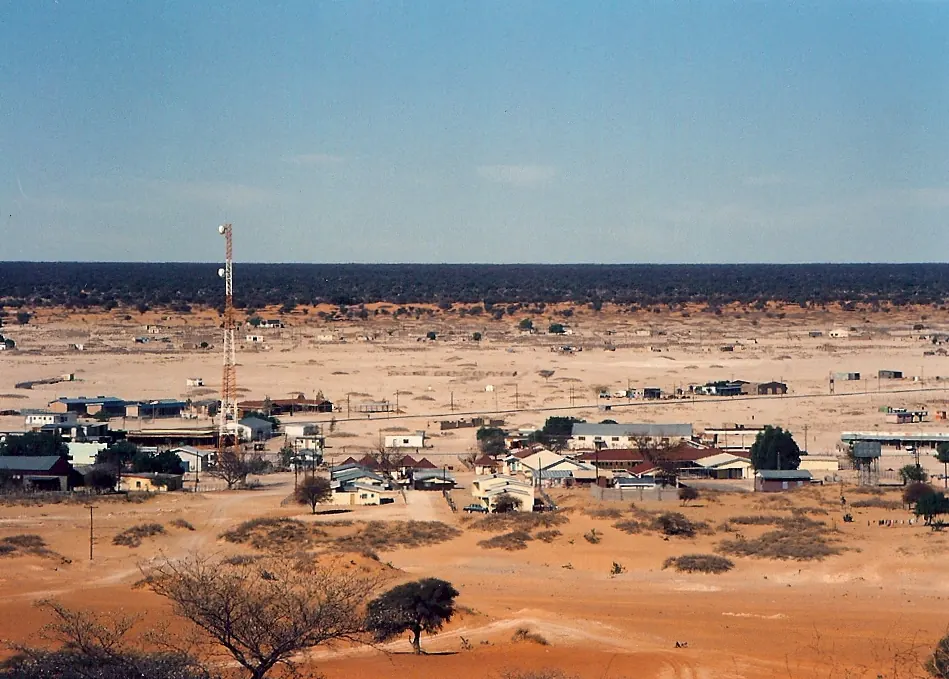
Tsabong (also spelled Tshabong) is the capital of Kgalagadi District, a government village on a big pan in the Kalahari, a little under 1,000 m up. The 2022 census counted 11,651 people, up from 8,939 in 2011. It has a primary hospital and a bank. Visitors come for the last tank of fuel before Mabuasehube, or for the camels.
Getting there
From South Africa you cross at McCarthy’s Rest, about 25 km south of the village on tar. Botswana’s immigration list gives the post’s hours as 08:00 to 16:00, so do not leave the crossing for late afternoon. From Gaborone the way in is the A2 to Sekoma, then south on the tarred A20. Buses leave the main bus rank in Gaborone in the morning and take six to seven hours.
When to go
May to September if you can. Summer is fierce here, with a record high of 42.6°C, and little rain (about 250 mm a year). Winter nights are the catch. Tsabong holds Botswana’s record low, minus 15°C, so campers heading on to the park need proper sleeping bags.
What to do
The Tsabong Ecotourism Camel Park is about 10 km from the village, 3,200 fenced hectares beside the main road. It began in 2003 with 40 camels handed over by the police, who had patrolled the border on them since colonial days. A trust for Tsabong, Maubelo and Maleshe runs it with the Botswana Tourism Organisation and offers camel rides and quad bikes. By 2022 the herd had grown to 517, far more than the land can feed, and the park could not take overnight guests while repairs were under way. The agreement between the trust and the tourism board ran out in 2024, so phone before you drive out.
The village itself has its old wells, the first jail and the colonial District Commissioner’s house.
Most people are here for Mabuasehube, the eastern side of the Kgalagadi Transfrontier Park. The gate is a little over 100 km north: gravel for the first half, then sand that gets thick towards the end. Allow four hours and bring a 4x4.
Good to know
Fill every tank and jerry can in Tsabong. There are two filling stations, one in the middle of the village and one on the tar towards Werda, and there is no fuel in the park. Drivers report paying by card, but not every time, so draw pula at the ATM as a fallback.
Opinions differ on the shops. One guide calls the supermarket well stocked and another group found very little, so buy food earlier. People who looked found no firewood for sale here or at the gate.
Let your tyres down when you leave the tar, and watch the calcrete stretch for holes where termite nests have caved in. Hit one at speed and the suspension goes. Stay off the tar after dark too, because livestock and game wander onto it.
Malaria is barely a concern. UK health advice rates the southern half of Botswana as very low risk, bite avoidance only, and the CDC does not list Kgalagadi South among its transmission areas.
The camel police of Tsabong and the cow nobody could handle
On 15 November 1902 a Cape Police corporal named A.C. Downes signed for eight camels. They had been sent up to Kimberley from a forest station outside Cape Town, with a pack saddle and a riding saddle imported from Australia and with handlers who did not stay long. A forest officer’s note pinned to the receipt twelve days later explains why: one of the cows had already put a man in hospital and badly hurt a second, so the handlers were sent home. The camels were for the police district that took in British Bechuanaland, the country just over the Molopo from where Tsabong stands.
Pines, wattles and a Boer general
Trevor Wilson, whose book The Camel came out in 1984, pieced the story together from the Cape Town archives for Botswana Notes and Records in 2013. The Cape government bought camels in the 1890s, when rinderpest was killing its work oxen, and a batch from the Canary Islands landed in February 1898. They were kept at the Uitvlugt forest station, where they ate the pines and wattles and, the conservator complained, did more damage than goats because they could reach higher. The police commissioner at Kimberley wrote in April 1898 that camels would suit Bechuanaland the way they suited Australia. Then the South African War got in the way. When the conservator asked in 1901 to have the herd moved to better grazing, the under secretary for agriculture replied that this was out of the question unless the government wished to make a present of them to General De Wet.
The lot Downes signed for, Egyptian and Senegalese animals among them, was released only after the peace, though Wilson found police already patrolling on camels by 1900. Mail went by camel too. From July 1899 to March 1914 a camel post ran through the dune country south-west of here to Rietfontein, three kilometres short of the German border, two camels to a trip, one ridden and one carrying the bags. When drought and the fighting in German South West Africa wore those animals thin in 1904, the police patrol camels carried the letters.
Sergeant Rakgomo’s escort
Tsabong is where the record keeps placing the camel section. A photograph in the national archives shows a mounted camel escort drawn up here in August 1956 for the farewell visit of the High Commissioner, Sir Percivale Liesching, with Sergeant E. Rakgomo on the right and Sub-Inspector J.M.J. Leach in the middle. The Boy’s Own Paper had run a piece called “The Camel Police of the Kalahari” back in 1929, and Botswana later put the patrol on a postage stamp.
The police kept working camels long after their neighbours had given them up. About 60 were still on active duty in the mid 1970s, and two fresh bulls were brought from the Northern Cape in 1977 to widen the bloodline. When Wilson photographed the Tsabong herd in 1986 each animal carried the government arrow on the right stifle, BP for Botswana Police above the left and its own mark on the neck.
The handover is where accounts part. Park staff told the Daily News in 2019 that it all began with 40 police camels in 2003. Wilson says 2001, and 155 camels shared out among Kgalagadi villages: 92 to Tsabong, the rest in small lots to places such as Khawa, Middlepits, Zutshwa and Ukhwi, with another 38 sold at auction. I would back Wilson, who had the village by village numbers. In the staff version a farmer, Gill Thomas of Berry Bush, minded the animals while the community found land, and youth volunteers worked on the fence line in 2006. University researchers who came in October 2017 found the police station still keeping a herd of its own.
What is behind the fence
Go expecting a stock farm with a tourism sideline, not a game reserve. Researchers from the Botswana University of Agriculture and Natural Resources have counted it twice. In early 2014 the herd was 287, with 110 males, when a breeding herd wants one bull to thirty or more cows. By 2017 it was 416, bulls still the biggest group. The researchers heard of calves born deformed, which they put down to inbreeding in a herd that has had almost no new blood. Libya sent breeding stock in 2008 (a bull by the academics’ count, three camels by the park’s).
The camels come in five colours, from white through fawn and grey to dark brown and black. Their favourite browse is the shepherd’s tree. A cow gives about four litres a day and will not let the milk down unless her calf is there to start her off. Most of the staff said they milked once a day, and the supervisor told the researchers that villagers came by often to collect milk for nothing. Zebra have been put in with the camels too, 55 of them by the 2022 count.
Between 2015 and 2017 nine visitors in ten were from Botswana. Wedding parties wanting photographs with a camel are an income line of their own.
Lions are four hours north
Tsabong itself has no big game. The village started at Maubelo, two kilometres off, and an elderly resident told the Daily News in 2014 that the name means a place where people found refuge.
The animals are at Mabuasehube, in the Kgalagadi Transfrontier Park. One overlanding guide ranks Mpayathutlwa Pan first for game. A writer on the Tracks4Africa blog, camped there in January 2018, watched a male lion pad through camp from behind the tent mesh, was woken the next night by a leopard lapping water and had a brown hyena at the pan for twenty minutes at first light. That is one traveller’s luck, but she and the guide both warn that lions walk through these unfenced camps. The same guide favours September and October, when the dry pushes game onto the pans and waterholes. Her own sightings all came in January, so the season is not settled.
On 25 November 2030 the moon’s shadow crosses Tsabong: about a minute of total eclipse, a little before half past seven in the morning.
Map of Tsabong
See every place on this map as a list