City · Southern District, Botswana
Kanye
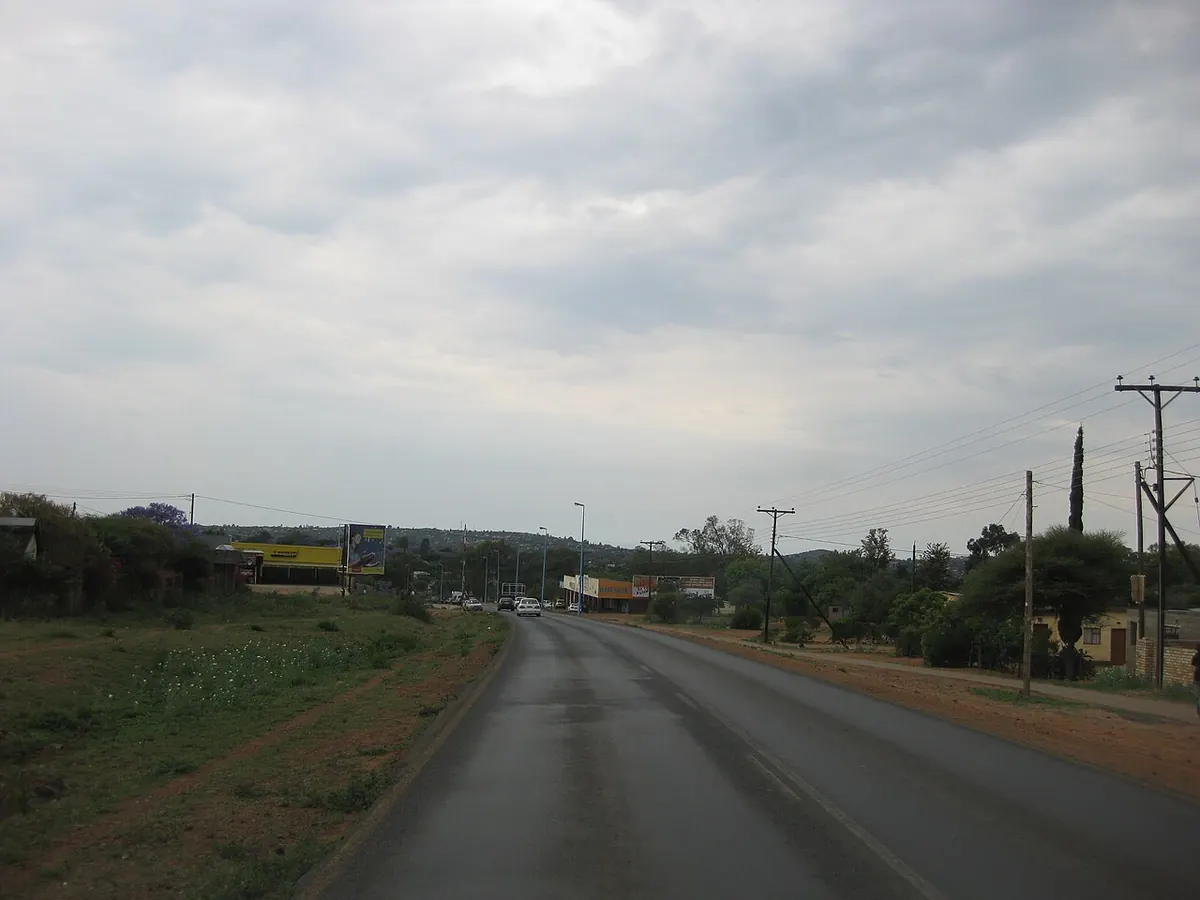
Hilltop capital of the Bangwaketse, 83 km south-west of Gaborone on tar. A half-day stop for the kgotla on Ntsweng hill, the Bathoen II museum, Pharing Gorge and Mmakgodumo Dam.
Short answer
Kanye is in Southern District, Botswana. This page lists 9 places to stay, 2 places to eat and drink and 2 sights.

- Places to stay
- 9
- Eat and drink
- 2
- Sights
- 2
- Where
- Southern District, Botswana24.98°S 25.34°E
In and around Kanye
13 places listedWhere to stay in Kanye 9
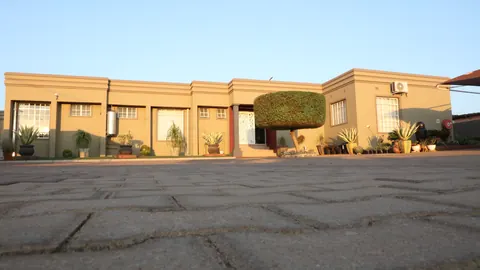
- 24.96°S 25.34°EGuest houseKgogomodumo LodgeKanye
- 24.98°S 25.34°EGuest houseThe Savanna Lodge
- 24.95°S 25.29°EResortMaila Hotel & Resort (MHR)
- 24.96°S 25.34°EGuest houseMotse Lodge
- 24.96°S 25.33°EGuest houseRoyal Plateau Hotels
- 24.96°S 25.31°EGuest houseThokgamo Bed & Breakfast
- 25.01°S 25.36°EHotelWarmhands Hotel
- 24.96°S 25.34°ECampsiteWena Tented Camp
Sights 2
- Kgosi Bathoen II MuseumMuseum · Old Camp Road, Kanye+267 544 2552
- Polokwe View PointAttraction
Restaurants and cafes 2
- Ko Gae CafeCafe
- Chicken LickenCafe · fried chicken
Kanye is the capital of the Bangwaketse, one of Botswana’s eight principal tribes, and the administrative centre of Southern District. It spreads over a line of hills at 1,306 m, 83 km south-west of Gaborone, and 48,028 people lived here at the 2022 census. It became a major Bangwaketse settlement around 1790, under Makaba II. People stop for the chief’s court, the old royal houses beside it and a mission church from the 1890s.
Getting there
The A10 from Gaborone runs through Thamaga and Moshupa and meets the A2 at Kanye, a little over 80 km in all. A stretch nearer the city, from Mogoditshane to Mmankgodi, is being widened to dual carriageway and the work has run late, so allow for roadworks.
The A2 is the Trans-Kalahari road. East of Kanye it is 50 km to the A1 junction south of Lobatse and another 11 km to the South African border at Pioneer Gate. Westward, Jwaneng is 90 km away and Sekoma 157 km. Every road into Kanye is tarred and an ordinary car is all you need. Buses come out from Gaborone.
When to go
The south is dry from April to October. Winter, early May to late August, brings cold winds, and Kanye is high. The Mmakgodumo cultural festival is held at the dam between August and October, in 2025 on the last Saturday of October, with dance, poetry, crafts and food.
What to do
Go up Ntsweng hill to the main kgotla, the chief’s meeting place and customary court. Around it stand the former house of Kgosi Bathoen I, the tribal offices Seepapitso III built in 1914 and the house of Bathoen II. Call at the kgotla offices first and say you would like to look around. That is the expected courtesy, and someone will usually show you the buildings.
The Kgosi Bathoen II Memorial Museum is in the old District Commissioner’s offices. It has sections on geology, mining, culture and the Bangwaketse chiefs. Ask the staff about a guided tour. They take visitors to the old cemetery, the kgotla buildings, the grain silos, the King George V Memorial Hall and Mmakgodumo Dam.
Pharing Gorge begins roughly 300 m south-east of Seepapitso Secondary School and follows a watercourse. Some Bangwaketse took cover in it around 1830, during an attack by Mzilikazi’s Amandebele (Ndebele). Mmakgodumo Dam, also called Bathoen II Dam, was built by age regiments under Bathoen II and has a bird sanctuary beside it. For a view, drive to the Polokwe viewpoint about 10 km north of the village, or climb Kgwakgwe Hill, which Wikivoyage puts at 110 m.
Good to know
- The CDC records only rare malaria cases in Southern District and advises bite precautions, not tablets.
- Livestock and wildlife stray onto the roads outside the towns. The UK government warns that the danger is greatest after dark.
- The museum has been short of money for years. In 2019 its curator counted 10 to 20 visitors in a week and said there were no funds for a display hall, so don’t expect a polished exhibition.
History and culture
Kanye is the capital of the Bangwaketse, one of the eight principal tribes of Botswana, and has been their seat without a break since 1852. One of its chiefs went to London in 1895 to keep his country out of the hands of Cecil Rhodes's company, and the village later produced Botswana's second president and its first Olympic champion. The chief's court, the old royal houses and a mission church from the 1890s are still standing.
- About 1790
Makaba II became kgosi (king or chief) of the Bangwaketse about 1790. His cattle raids on the neighbouring Bakwena, Barolong and Batlhaping made the Bangwaketse the strongest people in the area. In 1824 he was killed fighting an invasion by the Bakololo. source
- About 1790 to 1852
Under Makaba II the Kanye area became a major Bangwaketse settlement from about 1790. After his death in 1824 the Bangwaketse broke into several groups and Kanye was deserted. Around 1830 some of them took cover in Pharing Gorge during an attack by Mzilikazi's Amandebele (Ndebele). In 1852 two groups reunited and settled at Kanye, which has been the capital ever since. source
- 1850s to 1889
Gaseitsiwe, Makaba's grandson, took control of the Bangwaketse after the war between the Batswana and the Boers of 1852 to 1853 and reunited them in June 1853. In the 1860s he gained access to the trade route across the Kalahari and pushed Bangwaketse territory west. He invited into Kanye the British expedition that declared the Bechuanaland Protectorate, and died in 1889. source
- 1895
Bathoen I of the Bangwaketse travelled to Britain with Khama III of the Bangwato and Sebele I of the Bakwena. They persuaded the British government not to hand the protectorate to Cecil Rhodes's British South Africa Company. After the Jameson Raid failed that December, talks on the transfer were put off indefinitely. source
- 1910 to 1916
Seepapitso III ruled for six years and is remembered as a moderniser. He was the first Tswana kgosi to keep minutes of kgotla meetings, drew the Bangwaketse laws into a single list in 1913, and sank the boreholes that made Kanye the first village in the protectorate with standpipes. His brother Moepitso shot him dead at a kgotla meeting on 18 June 1916 and was hanged for it. source
- 1916 to 1928
Seepapitso's heir, Bathoen II, was a child, and three regents came and went in seven years. His grandmother Gagoangwe took over in 1923, already dying of cancer, and arranged for his aunt Ntebogang to follow her. Ntebogang was regent from 1924 to 1928. She extended Kanye's piped water and, through her contacts in the Seventh-day Adventist Church, brought clinics and then a hospital to the village. source
- 1928 to 1969
Bathoen II, born in Kanye on 18 May 1908, was chief for forty years. He abdicated on 1 July 1969 to stand for the opposition Botswana National Front, and beat the sitting vice-president, Quett Masire, in the Kanye South constituency by a wide margin. He left parliament in 1984 and died in 1990. source
- 2011
Malope II became kgosi of the Bangwaketse on 7 October 2011, following his father Seepapitso IV. He is still the chief. source
- The Bangwaketse
- The Bangwaketse are a Tswana people and one of the eight principal tribes of Botswana. Kanye is their seat and Malope II is their kgosi. The 2022 census counted 48,028 people in the village. source
- Language
- People here speak Setswana, an official language of Botswana and the common language of the country. Ngwaketse is one of its recognised dialects. source
- Mmakgodumo festival
- The Bathoen Trust holds a cultural festival at Mmakgodumo Dam each year. The 2025 festival, on the last Saturday of October, took the traditional Ngwaketse wedding as its subject, with music, dance, poetry, crafts and traditional cooking. source
- Food
- The museum has cooked and served the older Setswana dishes, letlhodi, lebelebele, dikgobe and serobe among them, because its curator was worried at how fast modern food was replacing them. source
Main sights in Kanye
8- Main kgotla, Ntsweng hill
The chief's meeting place and customary court, on top of Ntsweng hill. Around it are the house Bathoen I lived in, the tribal offices Seepapitso III put up in 1914 and, close by, the former home of Bathoen II.
The Botswana Society, Kanye - Kgosi Bathoen II Memorial Museum
Bathoen II started a museum in the old London Missionary Society building in the early 1960s, but it closed for lack of money and support. Today's museum is in the old District Commissioner's offices, with sections on geology, mining, culture and the Bangwaketse chiefs, and it can arrange guided tours of the village's heritage sites.
Mmegi, Know Your Museums (4 May 2018) - First Christian Church (old London Missionary Society church)
The Botswana Society says the Bangwaketse built their first church on this site in 1884 and put up the present building in 1896 after a fire. It later served as a school and a museum before becoming a church again. Inside are murals by the local artist Speedo Gaotlhalelwe.
The Botswana Society, Kanye - Pharing Gorge
The gorge begins roughly 300 m south-east of Seepapitso Secondary School and follows a watercourse that draws a good range of birds. This is where some Bangwaketse took cover from Mzilikazi's Amandebele around 1830.
The Botswana Society, Kanye - Mmakgodumo Dam (Bathoen II Dam)
Government press dates the dam to 1932 and calls it what is left of an irrigation scheme that Bathoen II had age regiments build to grow fruit and vegetables for schoolchildren. In 2016 Kgosi Malope II said his people wanted the area turned into a visitor attraction.
Botswana Daily News (government), British envoy pays tribute to Bangwaketse (17 August 2016) - Mmalekwa Royal Cemetery
The burial ground of Bangwaketse royalty and other prominent people, and of the first white settlers: missionaries, pastors, traders and police officers.
Botswana Daily News (government), Kanye heritage sites - King George V Memorial Hall
A hall Bathoen II built. It served as a primary and then a secondary school and is now used for all sorts of functions.
Botswana Daily News (government), Kanye heritage sites - Polokwe viewpoint
A lookout about 10 km north of the village, over the valley to the north. The Daily News recommends it at sunrise and sunset.
Botswana Daily News (government), Kanye heritage sites
Did you know?
- Wikipedia calls Kanye the longest continuously occupied tribal capital in Botswana. source
- Letsile Tebogo, born in Kanye on 7 June 2003, won the 200 m at the Paris Olympics on 8 August 2024 in 19.46 seconds, an African record. It was Botswana's first Olympic gold medal. source
- Quett Masire, president of Botswana from 1980 to 1998, was born in Kanye. In 1950 he helped found Seepapitso II Secondary School here and was its headmaster for about six years. He died on 22 June 2017 and was buried in the village a week later. source
- Bathoen I is one of the three chiefs on Botswana's 100 pula banknote and one of the three bronze figures of the Three Dikgosi Monument in Gaborone. source
- The dam's name comes from goduma, a Setswana word for a gulp. Local legend puts a snake with a woman's face in the water, smiling at visitors and then pulling them under. source
- Giyani Metals plans a manganese mine at its K.Hill project beside Kanye. The company says it has its environmental, mining and special economic zone licences, and in May 2026 it published a definitive feasibility study for an open pit with a 25-year life. source
Checked 12 October 2026.
The chief who would not hear of the dead rising
On 1 July 1824 Robert Moffat left his mission near Kuruman for the town of a man his neighbours had warned him against. Makaba II of the Bangwaketse was in his sixties and had spent thirty years taking other people’s cattle. Moffat went up with a party of Griqua elephant hunters under Berend Berend. The capital they reached is Kwakwe in the old books. That is Kgwakgwe, the hill just south of modern Kanye.
“I have slain my thousands”
Makaba met him laughing. He wondered aloud that anyone would walk unarmed into the town of “such a villain” as he was said to be, and announced that his heart was “whiter than milk”. Moffat, for his part, was taken with the housekeeping. In Missionary Labours, published in 1842, he wrote that the Bangwaketse houses were no bigger than those of the Batlhaping he lived among but built with more taste and comfort, the round walls and uprights set true by eye alone, the yard floors “smooth as paper”. No dairymaid in England, he said, kept her wooden bowl cleaner.
The sermon went less well. One Sunday he found the old chief sitting among his headmen while they cut and sewed skin cloaks, and began on the resurrection. Makaba questioned him closely. Would his father rise? The men killed in battle? The ones eaten by lions and hyenas? Told yes each time, he called on his councillors to say whether they had ever heard such a thing, then bared his spear arm and ended the discussion: “I have slain my thousands, and shall they arise!” He did not want to hear it again.
Moffat was lucky to get home. The Griquas changed their minds about hunting and rode back with him, and at Pitsana about twenty of them, mounted and carrying guns, beat off an attack on Tauane’s Barolong that would otherwise have caught the missionary on the road. Makaba was not so lucky. His son Tshosa had already risen against him the year before, and within months of Moffat leaving he was dead, killed fighting the Bakololo. There is a primary school in Kanye named after him.
The eye Sechele took
A century on, the person holding the Bangwaketse chieftaincy together was an old woman with one eye. Gagoangwe was a daughter of Sechele of the Bakwena, the chief David Livingstone converted. As a girl she put out a servant’s eye. Her father, reading his Old Testament literally, let the servant take one of hers. She married a chief called Pilane, left him in 1875 to run off with Bathoen, heir to the Bangwaketse, and only married him in church fifteen years later.
Their son Seepapitso III is the chief shot dead in the kgotla on 18 June 1916, a killing covered in the timeline above. Two details from that day are less often told. The brothers had argued that same morning over money Moepitso felt was owed to him, and Moepitso was caught because he left his spectacles lying with the gun. The dying chief is said to have asked, in Setswana, why his brother was killing him.
Gagoangwe took the regency herself in 1923, already very ill, and held it just long enough to pass it to her daughter Ntebogang. Ntebogang was the first woman to sit on the protectorate’s Native Advisory Council. Clinics opened at Kanye, Manyana and far-off Lehututu in her time, paid for by a levy on the whole tribe, and she lived until 1979.
Ducks, bass and a leopard you won’t see
Mmakgodumo Dam has been a gazetted bird sanctuary since 1992, the protected ground running 1.6 km out from the water. Mike and Jeremy Brook, writing up Botswana’s protected areas in 2015, reported that the monthly counts there turned up more than twenty species, South African shelduck, yellow-billed duck and Maccoa duck among them. The Maccoa is the one birders would drive out for, a scarce diving duck across southern Africa. Nobody seems to have published the counts month by month, so treat one as a bonus.
The dam has bass in it. An angler told Mmegi in 2009 that the one he caught was so big the fish must have bred here for generations, and that bass lived nowhere else in Botswana. Both claims are one man’s word. The dam also holds bream and barbel, sits in a stand of eucalyptus and is fed by an underground stream.
Pharing Gorge is three minutes’ drive away. The Brooks describe a waterfall with a plunge pool and trees growing straight out of bare rock, and the government’s heritage notes mention old stone walling beside the paths. A Mmegi reporter in 2009 found candle stumps and hearths on the rocks above it, left by spirit mediums, so if a group is busy there, leave them to it. Wikivoyage lists leopards and baboons for these hills. Baboons are believable on any morning. A leopard in daylight, this close to 48,000 people, is not something to plan around. Kgosi Malope II wants the area fenced and stocked with game, a wish repeated at the dam’s festival in October 2025, which tells you how little is there now.
What came out of the hills
Moffat’s Kwakwe turned out to be full of manganese. It was mined from 1957 into the 1960s, by rough methods, until the price dropped and the shaft became too dangerous, and a tunnel about 100 m long still runs into the hillside. Don’t go looking for it. The hill is a mining lease again, and in October 2023 a minister stood up in the Kanye kgotla to ask residents to keep off it.
The other mine was asbestos, out at Moshaneng. A 2014 study of the closed site found shafts that had never been sealed properly and asbestos fibres in every air sample, so admire that one from the road too.
Map of Kanye
See every place on this map as a list