Town · South-East District, Botswana
Lobatse
Old railway and cattle town in a valley 70 km south of Gaborone, where the A1 meets the Trans-Kalahari road. Home of the Meat Commission abattoir, a High Court division and two sites from the liberation years.
Short answer
Lobatse is in South-East District, Botswana. This page lists 1 place to stay and 2 sights.

- Places to stay
- 1
- Sights
- 2
- Where
- South-East District, Botswana25.21°S 25.68°E
In and around Lobatse
3 places listedWhere to stay in Lobatse 1
- 25.21°S 25.68°EHotelCumberland+267 533 0281
Sights 2
- Big Valley Game LodgeViewpoint
- Lobatse Town ParkTheme park
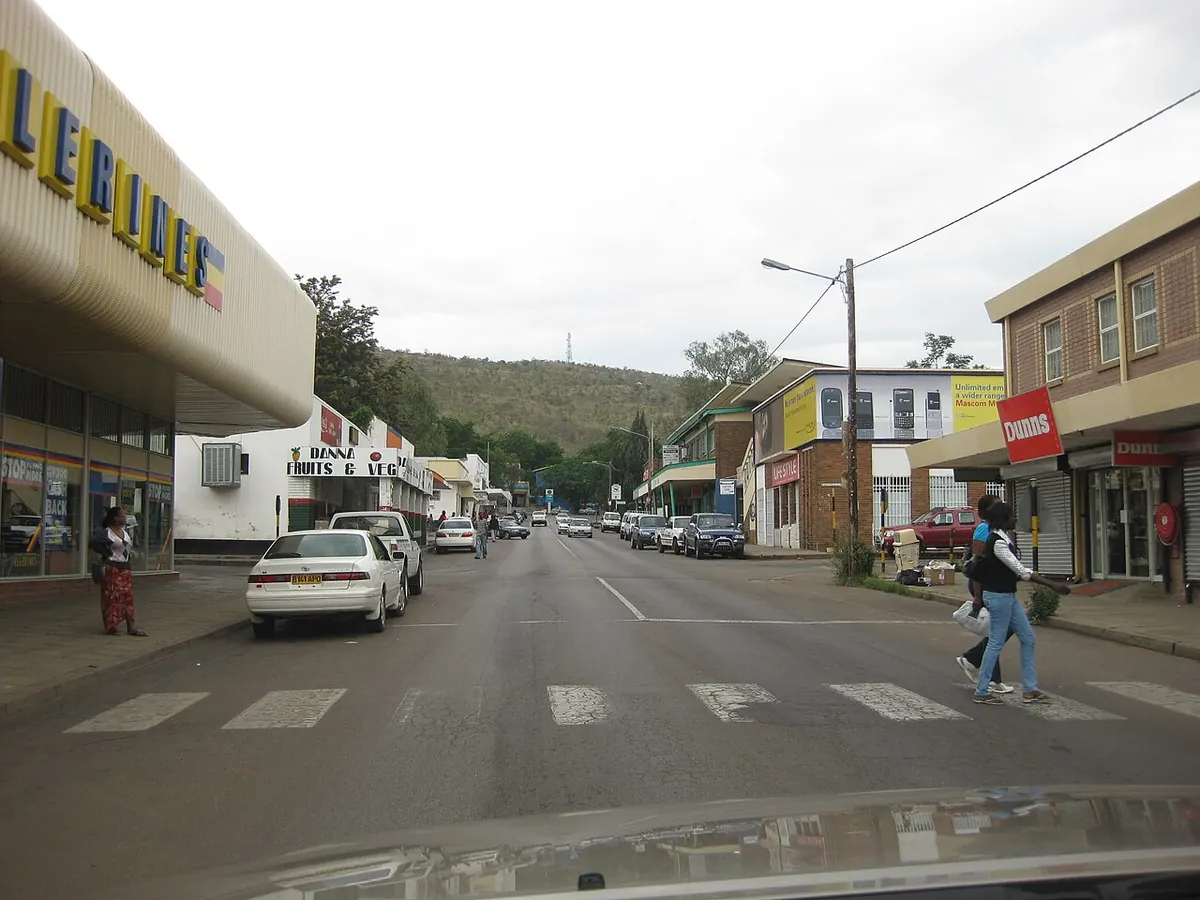
Lobatse sits in a valley, 70 km south of Gaborone and a few kilometres from the South African border. It is a cattle town. The Botswana Meat Commission has its head office and its biggest abattoir here, and the 2022 census counted 29,772 people. Most visitors are passing through, in from Zeerust or on the way to Namibia. Give it a couple of hours anyway, because a good deal of the country’s political history happened here.
Getting there
From Gaborone take the A1 south. It passes through town. Just south of Lobatse the A2 branches off: 11 km east to the Pioneer Gate border post (Skilpadshek on the South African side, 52 km from Zeerust on the N4), or west to Kanye, 50 km away, and on across the Kalahari to Namibia. Stay on the A1 and you reach the Ramatlabama border after 46 km, with Mahikeng beyond.
The immigration department’s list has Pioneer Gate open from 06:00 to midnight and Ramatlabama from 06:00 to 22:00. The railway to Gaborone and Francistown runs through town, but Botswana Railways has suspended its passenger trains.
When to go
Any month works. Rain in this corner of Botswana falls mostly between October and April, and those months are hot. In winter the days stay warm and the nights turn cold.
What to do
Start with the history. Fish Keitseng, a Motswana deported from South Africa after the Treason Trial, ran a safe house here for African National Congress members slipping north. Nelson Mandela and Thabo Mbeki both stayed in it, and it was declared a national monument in 2012. The Samora Machel Museum, opened in April 2022, remembers the Mozambican leader’s stay with John Kgaboesele, a headman in Peleng. I could not confirm opening hours for either, so ask in town.
The tourism board says tours of the abattoir can be arranged through the Meat Commission’s general manager for operations.
Older things lie outside town. There are stone walls from the Bangwaketse settlements of the late 1700s, some on private farmland where you need the owner’s permission. Beside the Mahikeng road is a panel of rock paintings of wildebeest, now badly faded.
Heading back north, the hill Lentswe la Baratani stands beside the Gaborone road about 20 km from Lobatse, at Otse. The village also has the Manyelanong Game Reserve.
Good to know
- Lobatse is not on the CDC’s list of malaria districts, which lie further north and west. The neighbouring Southern District has only rare cases, and no tablets are advised there.
- The A1 and A2 are tar, so an ordinary car is fine.
- Going west on the Trans-Kalahari, fill up before you leave. Travellers’ standing advice for Botswana is to be sure of fuel and water for the next stop before setting off.
- Cattle and donkeys wander onto the roads, and the UK government calls that a particular risk after dark. Cross the border with daylight to spare.
History and culture
Lobatse is a small cattle and railway town near the South African border, and around 1960 a good deal of the Bechuanaland Protectorate's politics happened here. The party that led Botswana to independence was founded in the town, exiles from South Africa and Mozambique were hidden here, and it was the first choice for the capital. What is left to see is modest, but it explains a lot about how Botswana came to be.
- About 1770
The Bangwaketse, a Tswana people, built a stone-walled settlement at Seoke and, later in the century, a village on what became Lobatse Estates. The tourism board calls that village the first major settlement in the area. Conflict with neighbouring groups then pushed them west to Kanye, which is still their capital. source
- 1896
A construction camp and siding were built for Cecil Rhodes's railway, which ran north to Southern Rhodesia (now Zimbabwe). The first station building has not survived. source
- 1900
The historian Neil Parsons dates Lobatse as a town from 1900, one of two in the country that began as small railway centres serving white settler farmers. The other is Francistown. Both only grew much from the 1950s. source
- 1959 to 1962
Fish Keitseng, a Motswana trade unionist who had been one of the accused in South Africa's Treason Trial, was deported home in 1959 and set up a safe house in Lobatse for African National Congress (ANC) members leaving South Africa in secret. Nelson Mandela and Thabo Mbeki were among those he sheltered. In October 1962 the ANC held a clandestine conference at the house that endorsed armed struggle against apartheid. source
- 1961
The Bechuanaland Democratic Party was set up in Lobatse in November 1961 under Seretse Khama, with Quett Masire as general secretary, and held its first congress the following February. It won the 1965 election with 28 of 31 seats and, renamed the Botswana Democratic Party, led the country to independence on 30 September 1966. source
- 1965
The Botswana Meat Commission was established to develop the country's livestock industry, with its head office in Lobatse. source
- 1965
The protectorate's capital moved from Mafeking to the new town of Gaberones (Gaborone). Lobatse had been the first choice for the capital but was judged too limited a site. source
- 2022
The Samora Machel Museum opened in the town in April 2022, recalling the stay of the future president of Mozambique 59 years earlier. source
- Cattle
- The tourism board describes Lobatse as the end of the road for farmers who drive their cattle in from the Kalahari to sell to the Meat Commission. It ranks cattle farming as the country's third-largest earner, with the beef going mainly to the United Kingdom and the European Union. source
- The courts
- Lobatse is a legal town. The judiciary lists three High Court divisions, in Gaborone, Lobatse and Francistown. Until 1992 the court's judges were expatriates on contracts of two or three years. The judiciary says all are now citizens. source
- A town of exiles
- The town hid freedom fighters from the neighbouring countries. At the 2022 museum opening the local MP described a code of secrecy that children learned early. John Kgaboesele, a headman of Peleng who later became deputy mayor, took in liberation fighters and refugees from across southern Africa. The mayor called Lobatse a town of firsts and said it housed the country's first parliament. source
- Football
- Extension Gunners, founded in the town in 1962 as Lobatse CS Gunners, play in the Botswana Premier League at the Lobatse Sports Complex. source
- Heritage events
- A Lobatse Heritage Walk and a celebration of Samora Machel's birthday are among the events started to revive the town. The council is working with a Swedish partner on a heritage trail that will link the historic sites. source
Main sights in Lobatse
7- Fish Keitseng's safe house
The house where Keitseng hid ANC members on their way into exile, Mandela and Mbeki among them, and where the ANC met in secret in October 1962. It has been a national monument since 2012.
Wikipedia: Fish Keitseng - Samora Machel Museum
Opened in April 2022 to mark the time Samora Machel, later president of Mozambique, spent sheltered by the Kgaboesele family in Lobatse before travelling on to Tanzania. His son spoke at the opening.
Botswana Daily News: Lobatse's concealment history made it refugee haven (18 April 2022) - Botswana Meat Commission
The head office and biggest abattoir of the state body set up in 1965 to develop the cattle industry. The tourism board says tours can be arranged in advance through the general manager for operations.
Botswana Tourism Organisation: Lobatse (archived copy) - High Court, Lobatse
The Lobatse branch of Botswana's High Court, the superior court that sits above the magistrates' courts and below the Court of Appeal. The court itself dates from 1938, in protectorate times.
Wikipedia: High Court of Botswana - Bangwaketse stone walls
Remains of the late 18th century Ngwaketse village on Lobatse Estates and of the earlier Seoke settlement from about 1770. Some are on private land, so permission is needed before visiting.
Botswana Tourism Organisation: Lobatse (archived copy) - Wildebeest rock paintings
A panel of rock paintings of wildebeest beside the main road to Mahikeng, just outside town. The tourism board thinks they were probably made by Khoe herders between about 1000 and 1700 AD. They are badly faded.
Botswana Tourism Organisation: Lobatse (archived copy) - Lentswe la Baratani, Otse
A hill beside the Gaborone road about 20 km from Lobatse, known for a legend of two young lovers who went missing on it.
Wikipedia: Otse
Did you know?
- Lobatse was the first choice for the capital of independent Botswana. It was turned down as too limited, and a new city was built at Gaborone instead. source
- The town's MP told the Daily News in 2022 that Lobatse was long known as a place of concealment, because cattle rustlers used to hide stolen animals in the hills around it. source
- The Meat Commission gives its Lobatse plant a capacity of 143,000 animals a year, more than its Francistown and Maun plants put together. source
- The 2022 census counted 29,772 people in Lobatse. It is one of only seven places in Botswana that are officially towns or cities, each counted as a census district of its own. source
- Lobatse is twinned with Walvis Bay in Namibia, the port at the other end of the Trans-Kalahari Corridor. The agreement dates from 24 October 2011. source
Checked 12 October 2026.
The house with a plank for a door, and the town that hid Mandela
Fish Keitseng was plastering a wall on the afternoon of 11 January 1962 when a car pulled up outside. He looked out and saw Nelson Mandela, driven, as he put it years later, by “an Indian chap”. The driver was Amien Cajee, a friend of Ahmed Kathrada. The house, in the township of Peleng, was not finished. Mandela was given a share of the one usable room with Keitseng and his wife Sina. Keitseng remembered that it had no proper door, only a piece of wood hung from the wall.
David Motsamayi on Peleng Hill
Mandela stayed about a week under the name David Motsamayi. By his host’s account he was up at five every morning to train, walked over Peleng Hill and out along the Kanye road, and ate once a day. Mandela’s own memoir remembers the hills above the town, a young companion called Max Mlonyeni, and a troop of baboons he followed for a while because they moved like soldiers.
The way on was by air. A Captain Herbert Bartaune ran a small charter outfit, Bechuanaland Safaris, out of Lobatse, and after the Sharpeville shootings of 1960 its light aircraft became the airborne leg of the escape route, by way of Kasane to Mbeya and Dar es Salaam. Mandela took off from the Lobatse airstrip on 19 January. He came back on the evening of 23 July in one of Bartaune’s planes, which put down at Kanye because Keitseng thought Lobatse too closely watched. Within two hours he was over the border at Pioneer Gate. On 5 August he was arrested outside Durban.
The yard still gives things up. In February 2014 a British film company, preparing a feature built around that stay, brought metal detectors to the Keitseng plot. The police first told them to stop digging. Town gossip had it that they were after the gun Mandela was given in Ethiopia. It was a pistol, and it left Lobatse long ago. What came out of the ground was spent ammunition, metal ornaments and old rice sacks, and the sacks interested the National Museum’s archaeologist most. The deeper ones were marked in pounds and the upper ones in kilograms, which dates the layers.
Tar laid for the King’s train
On 17 April 1947 the White Train, running half an hour behind its own pilot train, brought King George VI, Queen Elizabeth and the two princesses to what was then spelt Lobatsi. The administration tarred a road from the station for the day, the first tar anywhere in the protectorate.
The Sunday Standard went back to the photographs in 2021, and they are uncomfortable. Bathoen II of the Bangwaketse and Tshekedi Khama, regent of the Bangwato, both turned out in British military uniform, and the paper found not one black face on the dais. Princess Elizabeth, four days short of 21, walked along a line of four young Herero women in Victorian dresses.
Much of colonial Lobatse has gone missing since. Asked in 2012 about the old British commissioner’s residence, the mayor said she did not know where it was. The house Seretse Khama lived in has been pulled down. Radio Bechuanaland first went on air from the town’s police station, at 500 watts. What survives is the Cumberland Hotel, put up when Lobatse looked likely to be the capital and remembered as the first hotel in the country to take guests of any colour, and the mosque of 1967, the oldest in Botswana.
Shelled from the south, judged from the north
In the South African War burghers of the Marico commando were in Lobatse by late October 1899. Plumer’s column came down the line from Rhodesia on 6 March 1900 and had the telegraph working the next day. Nine days later General Snyman, who was besieging Mafeking, came up fast and shelled the position in the evening. Lieutenant Arthur Tyler was killed, a Lieutenant Chapman was taken prisoner, and the British fell back up the railway to Crocodile Pools, south of Gaborone.
In January 2011 the Court of Appeal, sitting in Lobatse, gave the San of the Central Kalahari the right to sink boreholes for their own water. By August 2012 both that court and the High Court’s headquarters had gone to Gaborone, leaving a regional division, and the Cumberland lost its lunchtime lawyers.
The writer Bessie Head came under a different kind of order. Early in 1971, after she hit a neighbour and pasted up a notice at the post office denouncing the president, a court sent her to the mental hospital in Lobatse. She was home by the end of June and began A Question of Power once she was recovering.
The tortoise and the toad
Two animals carry the town’s old spelling. In 1927 John Hyacinth Power, a Waterford-born schoolmaster in Kimberley and the honorary curator of reptiles and amphibians at the museum there, described a small hinge-back tortoise from here and called it lobatsiana. The type specimen sits in the Natural History Museum in London. It grows to about 17 cm, can close the back of its shell over its hind legs and tail, lives on rocky hillsides with thorn and bushwillow woodland in this corner of Botswana and across the border, and is now listed as vulnerable.
Power’s other find that year is far easier. The guttural toad, sometimes still called the Lobatsi toad, is very common across southern Africa. Males call from the surface of standing water with a snore every three seconds or so, and October and November are the main breeding months.
Cape vultures breed on the cliff at Otse, 20 km up the Gaborone road. It is not a big colony any more. Bird surveys counted over a hundred pairs in the 1960s and about fifty a season after a long decline, and the far larger colonies are now in the Tswapong Hills in the east. In 2015 the Sunday Standard reported that a group of Otse youths were guiding visitors to the breeding site.
Guides for Lobatse
Map of Lobatse
See every place on this map as a list