Park · South-East District, Botswana
Mokolodi Nature Reserve
A private, not-for-profit game reserve 10 km south of Gaborone with white rhino, giraffe and zebra. Guided drives, rhino tracking on foot and self-catering chalets fund its school programme.
Short answer
Mokolodi Nature Reserve is in South-East District, Botswana. This page lists 2 places to stay, 2 places to eat and drink and 2 sights.
- Malaria
- The US CDC says there is no malaria transmission in Gaborone, and the UK's NaTHNaC rates the southern half of Botswana as very low risk, advising bite avoidance and no tablets.
- Places to stay
- 2
- Where
- South-East District, Botswana24.75°S 25.79°E
Mokolodi is where you go to see a rhino if your Botswana trip gets no further than Gaborone. It is a private, not-for-profit reserve 10 km south of the capital, set up in 1994 on 3,700 hectares of old cattle land by the Mokolodi Wildlife Foundation. White rhino breed here, and there are giraffe, zebra, kudu and hippo. What you pay for drives and chalets keeps an education centre going that takes in more than 9,000 schoolchildren a year.
Getting there
The A1 runs south out of Gaborone to Lobatse, and the reserve is 10 km south of the capital. The reserve puts the drive from Sir Seretse Khama International Airport at 25 minutes, so it works as a half day from town or as a first or last night. You do not need a 4x4 of your own, because the reserve takes you round in its game viewers.
When to go
Gaborone’s rain falls between October and April, and October, just before the rains break, is often the hottest month. Winter days are warm and the nights are cold, so take a jacket for the 07:30 drive in winter.
What to do
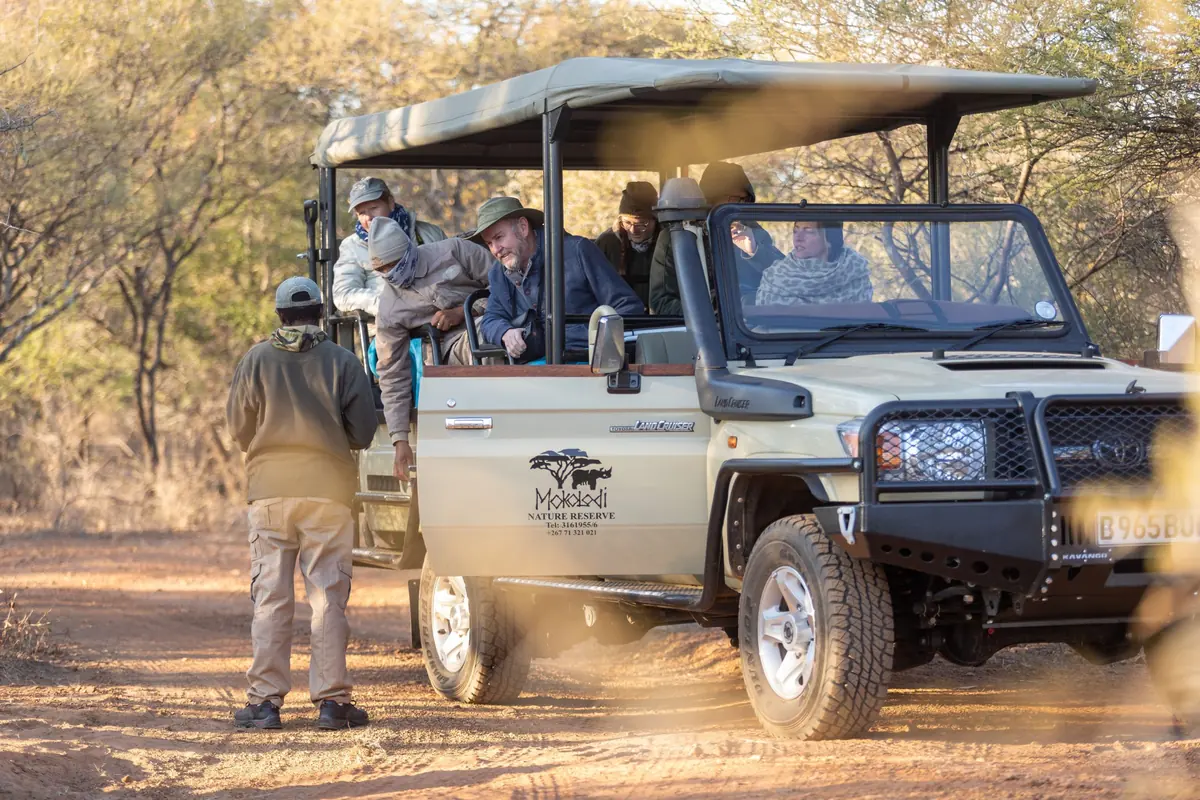
Game drives last two hours, stop for a snack, and leave at 07:30, 10:30, 14:00 and 16:00. Rhino tracking is the one to book ahead. You set off at 07:30 in a vehicle, and once the trackers find fresh spoor you get out and follow it on foot. Allow three to five hours. Giraffe tracking works the same way.
Cheetah and wild dog live in large enclosures that you visit by vehicle, and the reserve looks after injured vultures until they can be released. The reptile park runs guided tours of 30 to 45 minutes, with black mamba and puff adder among the snakes.
You can also walk or cycle the marked trails without a guide, as long as there are at least two of you.
Good to know
The reserve gives its hours as 07:00 to 18:00. Standard game drives need at least four people, and a smaller party pays a flat rate for the vehicle. Children under 12 cannot go rhino tracking and under-14s are not taken to the cheetah and wild dogs. The reptile park is closed on Mondays and Tuesdays.
The five chalets are self-catering and look over a waterhole. Bring all your food and drink (firewood is sold at reception), and keep it locked away with the windows shut, because baboons come through. The tea garden at reception does breakfast and lunch only. The 2026 price list has no camping on it and no self-drive entry for day visitors. Driving yourself round is listed as a perk for annual Friends of Mokolodi members.
The US CDC says there is no malaria transmission in Gaborone, and the UK’s travel health service rates the southern half of Botswana as very low risk, so tablets are not advised for a visit here. Livestock and game stray onto roads outside town, worst after dark, so day visitors should be back in Gaborone before nightfall.
Wildlife you might see
15- very likelyCheetah and African wild dogKept in large separate enclosures and seen on the cheetah and wild dog visit, not wild on a game drive. No children under 14source
- very likelyBlack mamba, Mozambique spitting cobra, puff adder and snouted cobraIn the reptile park, on a guided tour. Tours at 09:30, 13:00 and 15:00. Closed Mondays and Tuesdayssource
- likelySouthern white rhinoThe tracking walk sets out to find them on foot, following fresh spoor. A game drive may or may not turn one up. The tracking walk leaves at 07:30source
- likelyGiraffeOn a game drive. There is a giraffe tracking walk toosource
- likelyBaboonAround the chalets, where they go through anything left outsource
- likelyWhite-backed and Cape vulturesRescued birds kept in an aviary. The reserve cares for injured vultures with Vulpro and the Department of Wildlife and National Parkssource
- possibleZebraOn a game drivesource
- possibleWarthogOn a game drivesource
- possibleKudusource
- possibleImpalasource
- possibleRed hartebeest and gemsboksource
- possibleWaterbucksource
- possibleHipposource
- possibleMountain reedbuck and steenboksource
- rareLeopard and brown hyenaBoth are on the reserve's wild species list, but neither is an animal to count on seeingsource
Likelihood is for a normal visit of two or three days, from the sources linked. Nothing is guaranteed in the wild.
Hikes and walks
4- Rhino tracking on foot
Leaves at 07:30. You ride out in a game viewer, then follow fresh spoor on foot until you find the rhino. The price list has it with or without a brunch at the end. Giraffe tracking runs the same way.
Permit: Reservation only, with the reserve's guide and tracker. Minimum age 12 with a guardian, at least two people, at most seven
Mokolodi Nature Reserve, Activities, with the 2026 to 2027 price list (group size, brunch option) - Marked hiking and cycling trails (unguided)
The reserve lets you walk or cycle its designated trails without a guide. It publishes no trail names or distances, so ask for the routes at reception before you set off.
Permit: Charged per person on the price list. At least two people together
Mokolodi Nature Reserve, Activities, with the 2026 to 2027 price list - Guided hike
The price list has a guided hike as well as the unguided one, for anyone who would sooner not be on foot alone in a reserve with rhino and leopard.
Permit: At least four people
Mokolodi Nature Reserve, 2026 to 2027 price list (group sizes, durations and age limits) - Sanctuary walk
A walk round the reserve's sanctuary. The price list has a child rate for ages 4 to 12.
Permit: At least four people
Mokolodi Nature Reserve, 2026 to 2027 price list (group sizes, durations and age limits)
Staying safe in Mokolodi Nature Reserve
- Malaria
- The US CDC says there is no malaria transmission in Gaborone, and the UK's NaTHNaC rates the southern half of Botswana as very low risk, advising bite avoidance and no tablets. Mokolodi is 10 km south of the capital. The northern half of the country, Okavango included, is rated high risk from October to May. source
- On foot among wild animals
- Rhino, hippo and leopard live wild here. Go tracking only with the reserve's guides, keep to the designated trails if you walk or cycle unguided, and never go alone (the reserve asks for at least two people, for your own safety). source
- Baboons
- Baboons pass through the chalet area. Lock food and drink away and shut the windows whenever you leave the chalet. Do not feed them. source
- Ticks
- African tick bite fever is a risk across southern Africa. NaTHNaC's advice is to avoid bites by day as well as night, so cover your legs on the trails and check yourself for ticks afterwards. source
- Heat
- Gaborone has 74 days a year above 32°C on average, and October is often the hottest month. Take water and a hat on the walks and pick the 07:30 start in summer. source
- Roads
- Livestock and game stray onto roads outside the towns, and the risk is highest at night. Day visitors should aim to be back in Gaborone before dark. source
Tips from travellers
- Book rhino and giraffe tracking ahead. Both leave at 07:30 and run by reservation only. official
- Game drives go at 07:30, 10:30, 14:00 and 16:00 and need at least four people. Fewer than four can still go, but pay a flat rate for the vehicle. official
- Do not plan the reptile park for a Monday or Tuesday. It is closed both days. official
- The chalets are self-catering with a fridge, gas stove and braai. Bring all your food and drink from Gaborone. Firewood is sold at reception, and the tea garden there serves breakfast and lunch only. official
- Check-in closes at 18:00 and check-out is 10:00. The reserve's hours end at 18:00 too, so do not arrive late. official
- Use mokolodi.co.bw for bookings. The old mokolodi.com address that Wikipedia and Wikivoyage still link to no longer shows the reserve's site. official
Checked 12 October 2026. Conditions change, so confirm with the park or venue before you go.
The elephants that embarrassed a president at Mokolodi
On 10 July 2003 George W. Bush stood in the thornveld south of Gaborone with his wife Laura and their daughter Barbara, posed for the cameras beside two tame elephants. A Washington Times reporter in the press pool wrote down what came next. The bull, Shaka, picked that moment to try to mount the cow, Thandi. The journalists fell about. Barbara covered her face and the president pulled his cap down over his. The elephants’ trainer, a Sri Lankan called Uttum Corea, told him this was how elephants learn about “the birds and the bees”.
There are no elephants at Mokolodi now. How they came and went is the strangest part of the reserve’s past.
Four cull orphans who took orders in Sanskrit
Corea had settled in Botswana with his family, and trained thoroughbred horses as a hobby. One evening in 1990 they watched a television report on the elephant cull in the Kruger National Park, and he decided to take in two calves orphaned by culling in South Africa. Shaka and Thandi were two years old when he brought them north at his own expense and put them on an eight-acre plot he called Serendib, an old name for Sri Lanka. Two years later, after another cull, he added Sukiri and Seeni, both about 18 months old.
He had been told in Africa that an African elephant cannot be tamed, and he meant to prove otherwise. A Colombo newspaper that profiled him in 1998 reported a Sri Lankan mahout teaching Batswana apprentices, with the commands given in Sanskrit. By then eight acres was too small and the four had moved to Mokolodi, where children fed them and tourists went on walks behind them.
An online register of elephant keepers records that on 8 April 2008 two of the project’s Sri Lankan handlers, Chandan Alahakoon, who was 38, and Piyal Pedige, 35, were killed by elephants at the reserve. A Yale student who wrote up a stay in May 2013 listed elephant among the animals Mokolodi does not have, and none of today’s activities involve one. Nothing I have read says what became of the four.
A lawyer’s cattle farm with a radar on the hill
The land belonged to Ian and Gwithie Kirby. He grew up in Rhodesia, was thrown out of South Africa for his politics and came to Botswana in 1969 as a government attorney. She was raised in Kenya and worked as secretary to the vice president, Quett Masire. They met in Lobatse, married in 1971, and took on a farm here for cattle and crops. It employed nine people. The reserve that replaced it came to employ more than 70.
The drought of the early 1980s stripped the grass and the herd had to go. The story told at the reserve’s 30th anniversary in 2024 is that a family friend, Peggy Appiah, had remarked to the Kirbys that children were growing up without ever seeing a wild animal. She was a children’s author, the daughter of the British chancellor Sir Stafford Cripps. The Kirbys gave a large part of the farm to a foundation whose board first met under Ian Khama, then an army general and later president.
A review of the Kirbys’ 416-page memoir, Mokolodi (2024), says they also gave a hilltop to the Botswana Defence Force for a radar station, in the years when South African raids on Gaborone were a regular fear. Bill Clinton sat down with five African environmentalists at the reserve on 31 March 1998 and thanked the Kirbys by name.
Rhino sent to the delta, cheetah sent to India
Mokolodi’s white rhino came up from South Africa in the 1990s. In October 2001, after four weeks in pens at Serowe, some of them were trucked much further north, to holding pens at Mombo on Chief’s Island, in a delta where white rhino had been poached out. Three of the first five animals put back into Moremi were bought from Mokolodi. Two were females who knew each other, and Nick Galpine, who looked after the pens, noted that sharing one settled the younger animal, Kabelo. The pair were released on 9 November 2001 with Ian Khama, by then vice president, looking on.
Rebecca Klein arrived to work at Mokolodi in 2001 and looked after two tame cheetahs, Duma and Letotse. She found that nobody in the country was working to protect the wild ones, and in 2003 she and two colleagues started Cheetah Conservation Botswana here. In August 2010 a wild dog male and his pups, caught at a den near Tsabong after a farmer lost cattle, were penned here with three orphaned females and released as a pack in the northern Central Kalahari on 31 August. And in November 2025 eight cheetahs caught around Ghanzi were in the quarantine pens here when President Boko handed them over to India’s President Murmu, bound for the Kuno National Park.
What a drive turns up, and what it does not
Student groups wrote up their drives here in 2013, 2017, 2023 and 2024, and the lists are short. Giraffe and impala are in every one. Kudu and ostrich are in most, and warthog, zebra and wildebeest turn up now and then. Rhino are less certain than those lists make them look. One group in June 2023 counted five and another a month later met a cow and calf after the first hour of their first drive, but that group’s leader pointed out that some people come several times and never see one.
The only hippo sighting in these accounts was at dusk. The 2013 visitors counted two, heads just out of the water, as the sun went down over Mokolodi Dam. Nobody in these accounts saw a leopard. The hyenas they describe were two spotted ones behind a tall fence, and their guide, Onks, brought them running after sunset by shaking it.
Then there is Alice. In November 2022 a zebra of that name and her mate, Wonderboy, were keeping close to the restaurant and walking up to visitors, and the following June a student group stroked her. Do not feed her. Mokolodi is a small reserve beside a city, and people in Botswana told the Yale group straight that for lion, buffalo or elephant you go to the Central Kalahari or the delta.
In and around Mokolodi Nature Reserve
6 places listedWhere to stay in Mokolodi Nature Reserve 2
- 24.75°S 25.80°EHotelMokolokodi Camp
- 24.75°S 25.80°ECampsiteMokolokodi Campsite
Sights 2
- Cheetah EnclosureZoo
- Mokolodi Reptile ParkAttraction
Restaurants and cafes 2
- Mokolodi Bush KitchenRestaurant
- Tea GardenCafe
Quick answers
What animals can you see in Mokolodi Nature Reserve?
Most visitors see cheetah, african wild dog, black mamba, mozambique spitting cobra, puff adder and snouted cobra. You have a good chance of seeing southern white rhino, giraffe, baboon, white-backed and cape vultures. Leopard and brown hyena are there but rarely seen.
What are the best hikes in Mokolodi Nature Reserve?
Rhino tracking on foot, Marked hiking and cycling trails (unguided), Guided hike and Sanctuary walk. See the hikes section for times, difficulty and permits.
Map of Mokolodi Nature Reserve
See every place on this map as a list