Park · Central District, Botswana
Khama Rhino Sanctuary
A fenced community reserve of 8,585 hectares on the Serowe to Orapa road and the surest place in Botswana to see rhino. Many people give it one night on the long drive between South Africa and the north.
Short answer
At Khama Rhino Sanctuary, international visitors pay P117.2 (about US$8.50, €8 or £6.50) per adult and P58.6 per child per day. The rates apply from 12 October 2026 to 31 March 2027.
- Daily fee, international adult
- US$9 €8 · P117
- Malaria
- The US CDC lists the Serowe and Palapye sub-district among the parts of Botswana with malaria transmission and recommends tablets for visitors.
- Places to stay
- 2
- Where
- Central District, Botswana22.23°S 26.68°E
Khama Rhino Sanctuary fees 2026/27
Checked Khama Rhino Sanctuary Trust tariffValid 12 October 2026 to 31 March 2027, per person per day, in pula.
| Who | Adult | Child |
|---|---|---|
| International visitorsUS, Europe and everyone else | US$9 €8 · P117 | US$4 €4 · P59 |
| Botswana citizens | P40.7 | P20.35 |
- The child rate is for ages 6 to 12. The trust's fee table lists no charge for younger children.
- The resident row is the rate for Botswana citizens. Foreigners living in Botswana pay the trust's separate resident rate: P67.80 an adult and P33.90 a child. There is no SADC rate, so South Africans and Namibians pay the non-resident fee.
- Vehicle park fee, on top of the per person fee: P144.20 for a non-resident vehicle under 5 tonnes (P88.10 resident, P67.80 citizen) and P423.70 over 5 tonnes (P247.10 resident, P189.30 citizen).
- Camping is extra, per person per night: P146.30 for non-citizens, P90.90 for residents and P74.80 for citizens, with children aged 6 to 12 at half.
- Fees are paid at reception at the entrance gate, which is open from 7:00 to 19:00 every day.
- The trust publishes these fees without a start or end date. The start date shown is the day I read them on the trust's own page, not the day they came in. I show them as valid to 31 March 2027, the end of Botswana's government financial year, and will re-check before then.
- Fees are set by Khama Rhino Sanctuary Trust. Official tariff · Seen a new rate? Tell us
US$1 = P13.47 · €1 = P15.06 · £1 = P18.07 (ECB rate and the Bank of Botswana rand rate, 3 Nov 2026). Converted amounts are approximate; you pay in pula.
How we got these figures
- The trust's fees page carries no date. An archived copy of the same page from 14 October 2025 showed the earlier fees: P106.55 for a non-resident adult, P61.60 for a resident and P37.00 for a citizen. So the current fees came in some time between then and 12 October 2026, and the trust does not say when.
- The step from P106.55 to P117.20 is a 10% rise, and the vehicle fees went up by the same share (P131.10 to P144.20 for a non-resident vehicle under 5 tonnes).
- The camping fees are the ones on the trust's accommodation page on 12 October 2026. The only archived copy of that page I could open dates from February 2024, so I cannot say when camping last changed.
- Khama Rhino Sanctuary Trust, activity and facility fees · official · checked 12 Oct 2026
- Khama Rhino Sanctuary Trust, accommodation price list (camping fees) · official · checked 12 Oct 2026
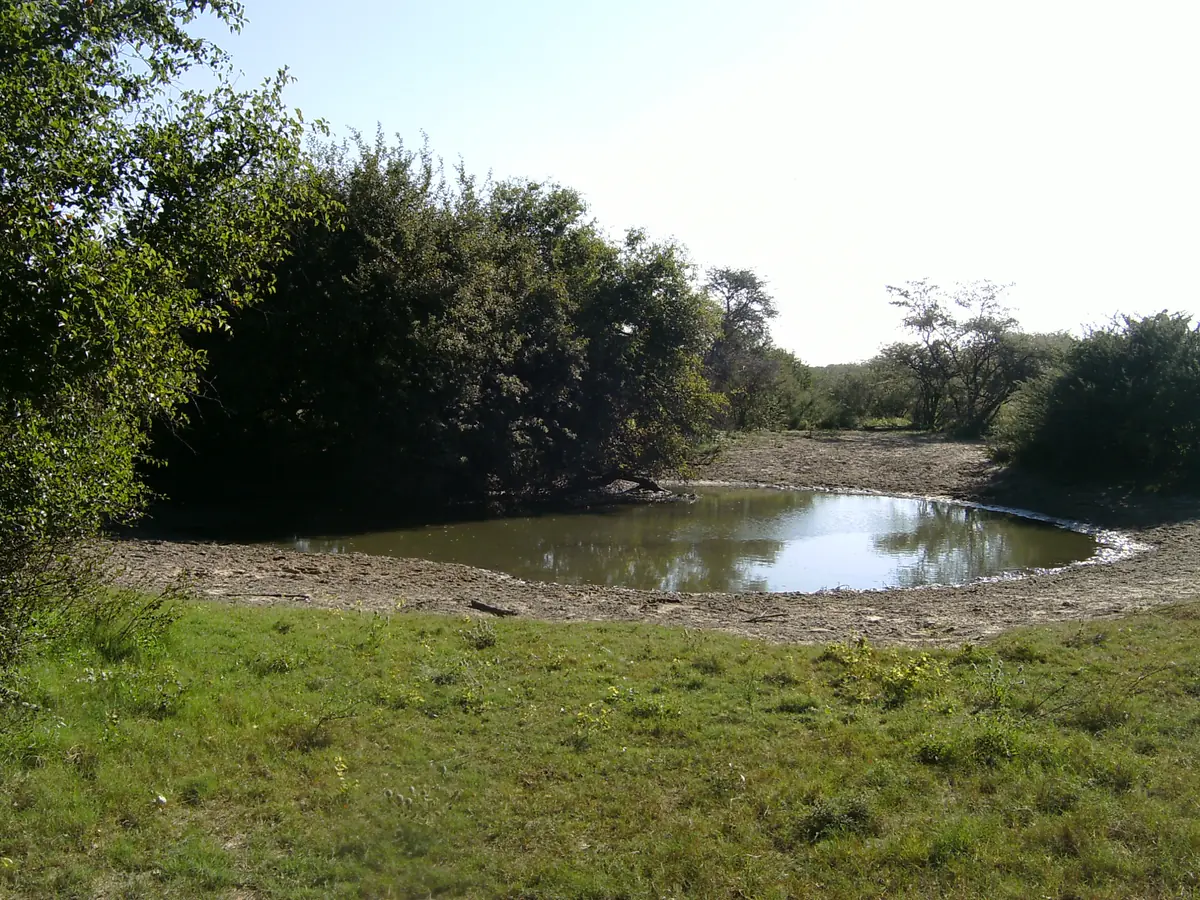
Khama Rhino Sanctuary is a community trust reserve 25 km north of Serowe, on the road to Orapa. It covers about 8,585 hectares of Kalahari sandveld around Serwe Pan, a wide grassy hollow with natural waterholes, and it exists to breed rhino back into a country that had all but lost them. White rhino are the reason to come, and they are not hard to find.
Getting there
From Serowe, take the Orapa road north through Paje. The gate is beside that road, about 25 km out. Coming from Palapye, turn north for Orapa before you reach Serowe. From Orapa it is roughly 180 km south.
Tracks4Africa puts Johannesburg at 650 km and about nine hours once the border is counted, which is why its ten-day Botswana route spends the first night here.
Inside, the trust says its tracks are kept up for two-wheel-drive and 4x4 bakkies (pickups). That is not the same as a low hire car, and this is sand country.
When to go
Botswana’s dry season runs from about April to October, and those are the easy months for camping and for the sandy tracks. Winter, May to August, is cold, which matters because rhino tracking leaves at 06:00. In the rainy season a 4x4 is a help.
What to do
Drive the loops around Serwe Pan early or late in the day. White rhino graze the open grass. Giraffe and the few black rhino keep to the thicker bush in the south. Zebra, wildebeest, eland, gemsbok and springbok were all brought back here and are commonly seen.
A ranger will take you out for two hours in a sanctuary vehicle, or ride along in yours. There are night drives and guided walks too. Rhino tracking runs in the morning only, for people aged 16 to 60, eight at a time.
There is a bird hide, with more than 230 bird species on the list, and a pool at the restaurant.
Good to know
Gate hours are 07:00 to 19:00. Arriving later is possible only if you arrange it beforehand. You pay at reception, which also sells a map, firewood and ice.
The speed limit is 30 km/h. No driving after dark, none on the pans, and you stay in the car except at your campsite.
The 22 campsites each sit under a big mokongwa tree, with a tap and a braai stand but no power points. Chalets come with bedding, a fridge and a kettle, except the A-frame on the edge of Serwe Pan, which has no electricity. Cooking utensils are no longer supplied, so bring yours.
The US CDC lists the Serowe and Palapye sub-district as a malaria area where tablets are recommended.
Rhino were poached here for the first time in 2022, according to the wildlife department, and in April 2023 the environment ministry reported four more shot, two of which died. Botswana Defence Force soldiers patrol alongside the rangers. Fees are in the table on this page.
History and culture
Khama Rhino Sanctuary is a fenced reserve around Serwe Pan, 25 km north of Serowe, started by local people when rhino had all but vanished from Botswana. It sits in the heartland of the Bamangwato (also written Bangwato), the Tswana chiefdom of Khama III and of Seretse Khama, the country's first president, so a stop here pairs well with an hour in Serowe.
- 1895
Khama III, kgosi (king or chief) of the Bamangwato, travelled to Britain with two other Tswana rulers, Bathoen I and Sebele I, to ask for protection from Cecil Rhodes's British South Africa Company. The mission succeeded, and their country stayed a British protectorate. source
- 1902
Serowe became the Bamangwato capital under Khama III, after earlier capitals at Shoshong and Phalatswe (Old Palapye). It has been the chiefdom's main town ever since. source
- 1948 to 1966
Seretse Khama, born in Serowe in 1921 and heir to the Bamangwato chieftaincy, married an Englishwoman, Ruth Williams, in 1948. In 1950 the British government barred him from the protectorate. He came home in 1956 after giving up the chieftaincy, and on 30 September 1966 became the first president of independent Botswana. source
- 1989
A group of Serowe residents proposed a wildlife reserve near the town. Serwe Pan had once been a hunting ground full of game and was by then a cattle post. source
- 1993 to 1995
The Ngwato Land Board gave the land around Serwe Pan to the Khama Rhino Sanctuary Trust in 1993, and that February the wildlife department moved four rhino from northern Botswana into holding pens built by local volunteers. A 28 km electric fence paid for by Debswana and De Beers was finished in June 1995, the rhino were set free inside it, and South Africa's North West Parks Board donated five more white rhino. source
- 2016
Six rhino bred at the sanctuary were trucked to the Okavango Delta in June by Rhinos Without Borders, and seven from a private South African reserve were brought in to widen the breeding stock. source
- 2022
Mmegi reported the first poaching incident at the sanctuary, late in the year, with two rhino killed and dehorned. Until then it had been known as a reserve that had never lost an animal to poachers. source
- 2023
In April the environment ministry said four rhino had been shot at the sanctuary. Two died, with their horns left intact. source
- The Bamangwato
- The sanctuary lies in the country of the Bamangwato, one of the eight principal Tswana chiefdoms. Their kgosi holds a seat in the Ntlo ya Dikgosi, the national House of Chiefs. Ian Khama, Botswana's fourth president and the son of Seretse Khama, is regarded as their paramount chief. source
- A reserve run by its neighbours
- The sanctuary belongs to a community trust, not to the state. Its board of trustees is elected from Serowe and from Paje and Mabeleapodi, two villages within 15 km of the fence. source
- Bessie Head's Serowe
- The writer Bessie Head, born in South Africa, settled in Serowe and died there in 1986. Several of her novels are set in the town, and her book Serowe: Village of the Rain Wind is a history of it, worth reading before you come. source
For American visitors: The trust's list of sponsors includes the US Fish and Wildlife Service, the Rhino and Tiger Conservation Fund and the United States Peace Corps. source
Main sights in Khama Rhino Sanctuary
5- Serwe Pan
The grass-covered hollow at the centre of the sanctuary, with several natural waterholes. This is where the white rhino graze and where the 1989 plan to bring the game back began.
Independent Travellers, Khama Rhino Sanctuary (reproduces the trust's history text) - The bird hide
A hide inside the sanctuary, and the place to sit still for some of the 230 and more bird species on the list.
Independent Travellers, Khama Rhino Sanctuary (reproduces the trust's history text) - Environmental Education Centre
A hall and two 24-bed dormitories inside the sanctuary where school groups stay to learn about wildlife and the land. It is the part of the trust's work that visitors rarely notice.
Khama Rhino Sanctuary Trust, Environmental Education Centre - Khama III Memorial Museum, Serowe
Opened in 1985 in a house built around 1910. It holds archives on the Khama family, photographs of Seretse Khama's funeral, and a room given over to Bessie Head.
Wikipedia, Khama III Memorial Museum - Royal Cemetery, Serowe
The burial ground on a hill in Serowe where Sir Seretse Khama was laid to rest in 1980.
Wikipedia, Seretse Khama
Did you know?
- The sanctuary covers about 8,585 hectares, with more than 30 kinds of animal besides the rhino and over 230 bird species. source
- The site was picked partly because a Botswana Defence Force base is close by, which gives the rhino protection round the clock. source
- In August 2016 the environment minister told Parliament the sanctuary held 60 rhino, 53 white and seven black, and took in about 25,000 visitors a year. source
- By 2014 the sanctuary had bred and moved 28 rhino to other wild areas across southern Africa, having started with four donated white rhino. source
- The road past the gate runs on to Orapa, where De Beers geologists found diamonds on 1 March 1967, five months after independence. The mine opened in July 1971 and belongs to Debswana, a partnership between De Beers and the Botswana government. source
- When a species outgrows what the land can carry, the trust sells or moves the surplus. The chief warden said in 2010 that this income and the visitor fees pay the staff and fund projects in Serowe, Paje, Mabeleapodi and Tshimoyapula. source
Checked 12 October 2026.
Wildlife you might see
15- very likelyWhite rhinoOne family writing for Tracks4Africa counted eight in under an hour on a late-afternoon drivesource
- likelyPlains (Burchell's) zebraBrought back by the trust and now commonly seensource
- likelyBlue wildebeestBrought back by the trust and now commonly seensource
- likelyGiraffeThe denser bush in the south of the sanctuarysource
- likelySpringbokBrought back by the trust and now commonly seensource
- likelyElandBrought back by the trust and now commonly seensource
- likelyGemsbok (oryx)Brought back by the trust and now commonly seensource
- likelyBirds (more than 230 species)Abdim's stork and bearded woodpecker are among those recorded. The sanctuary has a bird hidesource
- possibleBlack rhinoThe trust says one untamed bull can be seen at the restaurant in the afternoonsource
- possibleImpalaOn the trust's own list of animals in the sanctuarysource
- possibleSteenbokOn the trust's own list of animals in the sanctuarysource
- possibleOstrichOn the trust's own list of animals in the sanctuarysource
- possibleBlack-backed jackalOn the trust's own list of animals in the sanctuarysource
- rareLeopardNamed among the animals living in the sanctuarysource
- rareBrown hyenaNamed among the animals living in the sanctuarysource
Likelihood is for a normal visit of two or three days, from the sources linked. Nothing is guaranteed in the wild.
Hikes and walks
2- Rhino tracking
You follow rhino tracks with the sanctuary's guides. The trust asks for proper footwear and bush-coloured clothes. No distance is published.
Permit: Guided only, ages 16 to 60, eight people at a time
Khama Rhino Sanctuary Trust, rhino tracking - Nature walk
A walk for the small animals you miss from a car. The trust reminds walkers that every animal here is potentially dangerous.
Permit: Booked at reception
Khama Rhino Sanctuary Trust, activities and conditions of entry
Staying safe in Khama Rhino Sanctuary
- Malaria
- The US CDC lists the Serowe and Palapye sub-district among the parts of Botswana with malaria transmission and recommends tablets for visitors. See a travel clinic before the trip and use repellent in the evenings. source
- Rhino and other animals
- The trust says not to touch the wild black rhino bull that can be seen at the restaurant in the afternoon. He is not tame. Keep your distance. source
- Driving inside
- The limit is 30 km/h. Keep to the established roads, never drive on the pans, and drive only between sunrise and sunset. Do not get out of your vehicle except at a campsite. Day visitors must keep strictly to closing time. source
- Sand
- The trust says its roads are kept up for self-drive game viewing in four and two-wheel-drive bakkies (pickups), which is not a promise for a low saloon car. Ask at reception which loops your car will manage, or book a drive in a sanctuary vehicle. source
- Poaching
- In April 2023 the environment ministry said four rhino had been shot at the sanctuary, two of them fatally, with the horns left on. Voice of America described the sanctuary as heavily guarded. Keep to gate hours and stay on the roads. source
Tips from travellers
- Buy the map at the entrance gate and follow the signs. Reception also hires out basic binoculars. official
- Rhino are easiest to find early in the morning and late in the afternoon. If you arrive with an hour of light left, go straight out for a drive. one source
- Tracks4Africa starts its ten-day Botswana route from Johannesburg with a night here before the Makgadikgadi pans, and says to stop in Serowe for meat and dairy on the way in. one source
- Campsites have no power points, and chalets no longer come with cooking utensils. Bring your own pots and plates, or eat at the restaurant. official
- The gate shuts at 19:00. If you are going to be late, arrange it with the trust in advance. official
Checked 12 October 2026. Conditions change, so confirm with the park or venue before you go.
Boss, Basedi and the last seven white rhino in Botswana
On 17 September 1992 an aerial survey found seven white rhino in the whole of Botswana. Allowing for animals the plane missed, the surveyors thought there might be as many as twelve. By the following February four of the seven counted were known to have gone to poachers, two more were poached that same month, and the answer was to take whatever could be caught out of Chobe altogether. A capture team from the Natal Parks Board caught four animals, and they were moved south to a cattle post outside Serowe that would not have a fence for another two years.
A conservation newsletter from 1995 gives them names. Basedi, a full-grown cow, came first with Baba, her calf of nine months. Two days later came a three-year-old bull called Lerumo and an old one, about thirty, known as Boss. All four had been dehorned so they would not injure themselves on the journey. Lerumo arrived with poachers’ bullets already through his chest and belly and was dead within a month. The newsletter has Basedi and Baba spending their days in a paddock behind the boma.
More than 70 white rhino had been brought into Botswana in the 1970s, to a north where the species had been gone since about 1890, and as late as 1990 people were still quoting a national herd of 100 to 150. Three years on, what Serowe had to show for all of it was a cow, a calf and an elderly bull in holding pens.
Built on a raffle and three boreholes
The place was homemade. The land was a ranch on tribal ground that the Serowe Brigades, the town’s vocational training movement, held on a 50-year lease. A 1994 update in the Okavango Wildlife Society newsletter reads like a farm diary: money from a raffle, three boreholes that struck water, five bomas and three paddocks finished and two more going up. Raymond Watson, a businessman with interests in the area, is credited in the government’s Kutlwano magazine as one of the people who pushed it through.
In May 1994 the wildlife department caught one more rhino in Chobe and brought it down, the first capture in Botswana done entirely by its own staff with its own kit. Another of the founders died that October. Five more white rhino came from South Africa in 1995 and three from Pilanesberg in 1999, and by early 2003 eleven calves had been born. The original 4,300 hectares or so was later doubled, which is why older write-ups give half the area we do.
Since then the traffic has run the other way. The six sanctuary-bred rhino darted and crated here in June 2016 went to the Okavango Delta, back to the north their kind had been evacuated from 23 years earlier.
Chinga, and Noddy who liked cars
The black rhino story is odder. The 1992 census had not found a single black rhino in Botswana. Ten years later a young cow turned up in the Chobe area. The chief warden then, Bathusi Letlhare, guessed she had either crossed from South Africa or come out of the national park. She was moved to the sanctuary in September 2002 and named Chinga, after the place she was found. A reporter who met her in the boma a few months later watched her dip her head as if to charge the gate, then think better of it.
At that point she was the only legal black rhino in the country. Her mate, when he came, was Noddy, a bull hand-raised in Zimbabwe and donated at 16 or 17 (2006 by one account, 2007 by another). In March 2008 Chinga calved, a bull. Her second calf was recorded on 16 November 2010, and there was a third later.
Noddy never unlearned people. He hung about the restaurant, the Mokongwa campsite, the rangers’ quarters and the education centre, he fought his own reflection in the restaurant windows, and he liked to rub himself against vehicles. He died on 5 November 2017, aged 27, and the post-mortem put it down to kidney failure. If you read anywhere that a black rhino bull turns up at the restaurant in the afternoons, the animal that fits is Noddy.
How likely are you to see one?
Very, but not certain, and the stories people tell cut both ways. A school group on an evening drive in June 2023 were warned by their guide that the cold would keep the rhino in the bush, then counted 14 white and one black. Next morning they saw two. A biker who came through in August 2019 saw none at all and decided the place was not worth the hype.
Where several accounts agree is on the hour: go early or go late, and the late drives get the better write-ups. Malema’s Pan is the first big stop on a guided drive. It is named after a man who lived there and was moved off when the reserve was made, not after the Babirwa leader Mmirwa Malema, as a guide had to explain to visiting Radio Botswana staff in 2014. Black rhino are another matter. One government magazine count has five of them to 56 white, and they are browsers that keep to thick bush.
The sand, and the soldiers
The thing to know beforehand is the sand. A poster on the 4x4 Community forum in November 2013 wrote of sections of very thick sand and said he would not have got through without four-wheel drive and low range. The 2019 biker put it at about 5 km of heavy going from the gate to the camp, and reported the two-wheel-drive car in his party stuck several times and pulled out. The trust says its tracks are maintained for ordinary bakkies. I would believe the people who got stuck.
The other surprise is the army. One tour passenger describes two vehicles of soldiers patrolling the tracks by day and by night, not company most people expect on a game drive.
In and around Khama Rhino Sanctuary
6 places listedWhere to stay in Khama Rhino Sanctuary 2
- 22.25°S 26.73°ECampsiteKhama Rhino Sanctuary Mokongwa campsite #10
- 22.25°S 26.73°EGuest houseThe JAW Camp
Sights 3
- Khama HideViewpoint
- Lipscombe MonumentMemorial
- Serwe PanViewpoint
Restaurants and cafes 1
- Khama Rhino Sanctuary RestaurantRestaurant
Quick answers
How much is the entry fee for Khama Rhino Sanctuary?
International visitors pay P117.2 (about US$8.50, €8 or £6.50) per adult and P58.6 per child per day. These rates apply from 12 October 2026 to 31 March 2027 and are set by Khama Rhino Sanctuary Trust.
Do Botswanans and SADC citizens pay less at Khama Rhino Sanctuary?
Botswana citizens pay P40.7 per adult per day. You need ID or a passport to get the lower rate.
When were these Khama Rhino Sanctuary fees last checked?
We last checked them on 12 October 2026 against 2 published sources. We re-check every two weeks, but always confirm with Khama Rhino Sanctuary Trust before you travel.
What animals can you see in Khama Rhino Sanctuary?
Most visitors see white rhino. You have a good chance of seeing plains (burchell's) zebra, blue wildebeest, giraffe, springbok, eland and gemsbok (oryx). Leopard and brown hyena are there but rarely seen.
What are the best hikes in Khama Rhino Sanctuary?
Rhino tracking and Nature walk. See the hikes section for times, difficulty and permits.
Khama Rhino Sanctuary and the parks nearest it
| Park | International adult | Distance | Where |
|---|---|---|---|
| Khama Rhino Sanctuary | US$9 €8 · P117 | · | Central District |
| Makgadikgadi Pans National Park | US$14 €13 · P190 | 272 km | Central District |
| Central Kalahari Game Reserve | US$14 €13 · P190 | 295 km | Ghanzi District |
| Khutse Game Reserve | US$14 €13 · P190 | 298 km | Kweneng District |
Where the Khama Rhino Sanctuary fees come from
- Khama Rhino Sanctuary Trust, activity and facility fees
- Khama Rhino Sanctuary Trust, accommodation price list (camping fees)
Open data: all park fees (CSV) · JSON (CC BY 4.0)
Cite as: Travel Africa Guide, "Khama Rhino Sanctuary fees 2026/27", checked 12 October 2026, https://travelafrica.guide/botswana/khama-rhino-sanctuary/
Map of Khama Rhino Sanctuary
See every place on this map as a list