City · North-East District, Botswana
Francistown
Botswana's second city, founded in 1897 beside a gold mine. Most visitors stop for a night, cash and supplies where the road from Gaborone splits for Zimbabwe and for Nata, Maun and Kasane.
Short answer
Francistown is in North-East District, Botswana. This page lists 17 places to stay, 17 places to eat and drink and 14 sights. The nearest park with an entry fee on this site is Khama Rhino Sanctuary, about 145 km away, where international adults pay from P117.2.
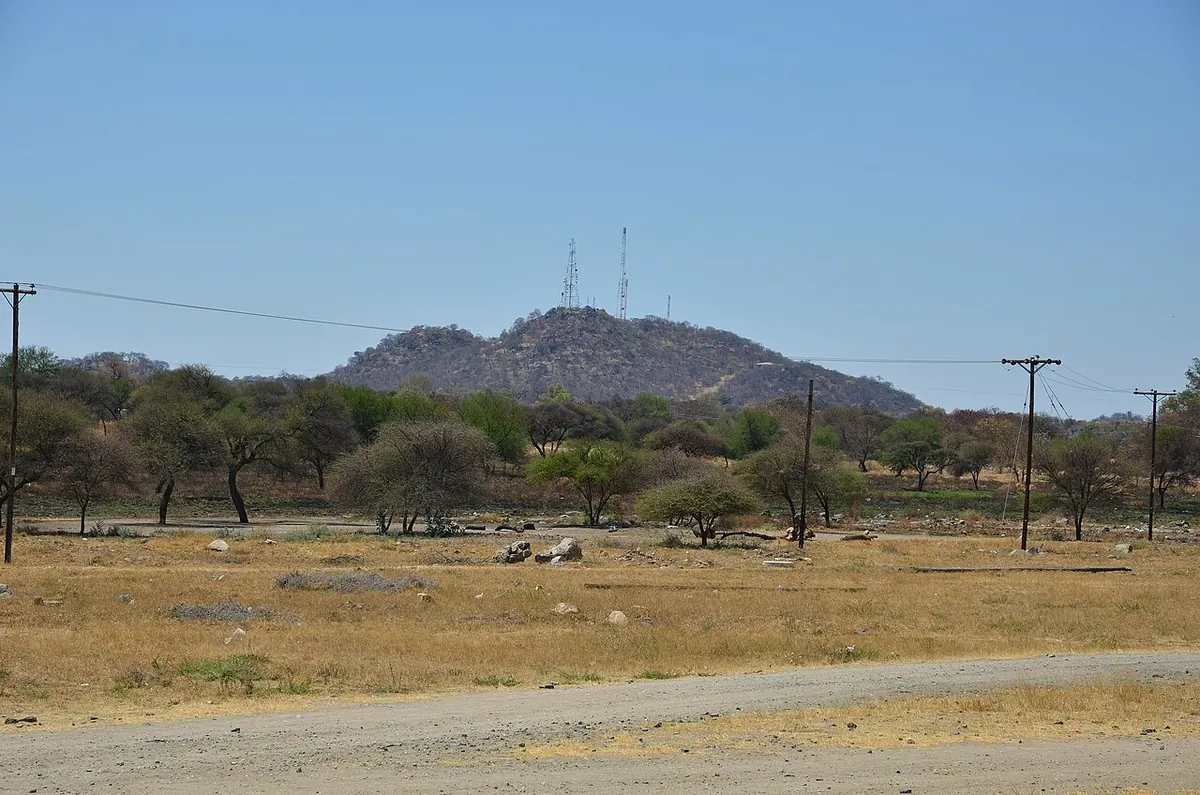

- Places to stay
- 17
- Eat and drink
- 17
- Sights
- 14
- Park fee nearby: Khama Rhino Sanctuary
- US$9 €8 · P117about 145 km away
In and around Francistown
48 places listedWhere to stay in Francistown 17
- 21.16°S 27.52°EHotelGreen HouseLenong+267 71 555 556
- 21.16°S 27.52°EGuest houseGreen House B&BLenong+267 71 555 556
- 21.01°S 27.56°EGuest houseWayside ChaletsFrancistown+267 71 313 233waysidebotswana.com
- 21.16°S 27.51°EHotelCity Inn
- 21.08°S 27.46°ECampsiteWoodland's Stop Over
- 21.16°S 27.50°ECampsiteAreaS Bdf camp
- 21.16°S 27.52°EGuest houseChars house
- 21.20°S 27.53°EHotelCresta Marang Gardens
- 21.13°S 27.51°EGuest houseDumela Lodge
Show all 17 places to stay
- Dumela Lodge Campsite · Campsite
- Hilstead Inn · Guest house
- Home ft · Guest house
- Kondwane · Guest house
- Satellite · Hotel
- Tati River Lodge · Hotel
- Tsunami BHC · Hostel
- UCCSA Lephoi Centre. Hostel For The Blind · Hostel
Sights 14
- Douma's Crocodile FarmMuseum
- Francistown Records CentreMuseum
- Kagiso Funeral PalourMemorial
- Kenneth Nkhwa InterchangeAttraction
- Monarch CemeteryMemorial
- Old Water TankMonument
- Ruth Funeral PalourMemorial
- Sunshine Plaza (Shopping Mall)Attraction
- Supa Ngwao MuseumMuseum
- Tebo HouseCastle
- Telecom AntennaMonument
- Telecom AntennaMonument
Show all 14 sights
- The Hunters Road · Monument
- Thusanyo Funeral Palour · Memorial
Restaurants and cafes 13
- Thorn Tree CafeCafe · sandwich, breakfast, pizza, tea, coffee shop · Blue Jacket Street
- Barbara's BistroRestaurant · regional, german, international, steak house, mexican
- Debonnairs PizzaRestaurant · pizza
- TandureiRestaurant · chinese, indian
- Dave's friend restaurant babas bistrosCafe
- DawatRestaurant
- Milky Lane & co.Cafe
- PlattersRestaurant
- Roots Of AfricaRestaurant
- Thorn Tree Café / Diggers Inn RestaurantRestaurant
- Nando'sRestaurant · chicken, portuguese
- Nando'sRestaurant · chicken, portuguese
Show all 13 restaurants and cafes
- Ocean Basket · Restaurant · seafood
Bars and pubs 4
- Botsalano BarBar
- Milty Sport BarBar
- The Water holeBar
- Thusano BarBar
Francistown is Botswana’s second city, with 103,417 people at the 2022 census, built where the Tati and Ntshe rivers meet. It started in 1897 as a settlement beside the Monarch gold mine and old workings still surround it. Few people come on holiday. They come through, because this is where the road up from Gaborone splits, one arm for Zimbabwe and the other for Nata, Maun and Kasane.
Getting there
The A1 from Gaborone runs about 435 km through Mahalapye and Palapye. It carries on 82 km to the Ramokgwebana border post, with Plumtree on the Zimbabwean side. The A3 starts in the city centre as Gemmel Drive, crosses the Tati, passes the airport and reaches Nata after 180 km.
Buses leave Gaborone about every hour and take five to seven hours. There are direct buses to Maun and Kasane, and several a day from Bulawayo.
Air Botswana flies to Francistown. The airport is on the western edge of the city. Forget the train. The overnight service from Lobatse and Gaborone is suspended, along with every other passenger train in the country.
When to go
Rain falls from November to March and the winter months get almost none. June and July are dry with days around 24 °C, but nights average 5 °C and the record low is well below freezing, so pack warm bedding if you camp. October is the hottest month, with highs near 33 °C.
What to do
Not a great deal. German Wikipedia says flatly that the city has few sights and no colonial-era buildings to look round, so do not plan a full day here.
The Supa Ngwao Museum is the exception. Founded in 1986, it is the regional museum for the city and the north-east. The displays cover Kalanga history and culture, and the shop sells curios made by artists from the north-east.
Tachila Nature Reserve is 5 km from the centre on an old Tati Company farm called Lady Mary. Shashe Dam, about 25 km to the south-west, has a sailing club and sport fishing.
If you carry a tent, Woodlands Stop Over is about 10 km north of town, with a pool and shaded pitches. Tati River Lodge, 2 km from the centre on the river bank, also takes campers.
Good to know
The CDC lists the North-East District, Francistown included, as a malaria area and recommends tablets.
The UK government says violent crime is rising in Francistown, as it is in Gaborone and Maun, and that thieves target cars waiting at traffic lights. Keep doors locked and bags out of sight.
Livestock and wildlife wander onto the highways and the risk is worst after dark. Time the run to Nata or the border for daylight.
The highways north to the border and west to Nata are surfaced, so no 4x4 is needed. Shoprite on Blue Jacket Street in the centre is the easy place to stock up, and there are bank ATMs in town that take Visa and Mastercard.
History and culture
Francistown grew out of the first gold rush in southern Africa, on ground the Kalanga had mined long before any prospector arrived. For decades the land around it was held by a mining company under a concession from the Ndebele king, and later the town was the staging post for men recruited across Africa for South Africa's gold mines. Little of that is on show today, which is why the museum is worth your hour.
- Before the 1860s
The Bakalanga (the Kalanga people) dug gold from pits along the Tati River long before Europeans arrived. The Tati goldfields may have been one of the sources of wealth for the Great Zimbabwe empire, which lasted from about 1200 to 1450. source
- 1866 to 1870
The German explorer Karl Mauch announced the Tati goldfields in 1866, and the first gold rush in southern Africa followed the next year. Daniel Francis, an Englishman, came to look for gold on the river in 1869 and left for the Kimberley diamond fields in 1870. The gold was hard to extract and the rush faded. source
- 1870 to 1880
The land belonged to the Ndebele (Matabele) kingdom. Its king, Lobengula, granted a mining concession in 1870 to Sir John Swinburne's London and Limpopo Mining Company in exchange for gold and arms. It was revoked in 1880 for failure to pay the annual fee and given to the Northern Light Mining Company, a syndicate that included Daniel Francis and was later renamed Tati Concessions. source
- 1893 to 1911
In 1893 the Tati land was detached from Matabeleland and put under the British Resident Commissioner of the Bechuanaland Protectorate, as colonial Botswana was called. It was formally annexed to the protectorate on 21 January 1911, with Rhodesian Railways keeping its right of access. source
- 1897
The present town was founded as a settlement near the Monarch mine and named after Francis. The company sold 300 plots in August that year. Early Francistown was a single street running beside the railway line, with two hotels (the Grand and the Tati), shops and three banks. source
- 1930s to 1980s
Gold carried the town until the depression of the 1930s. From 1936 into the 1980s its economy leaned on the Witwatersrand Native Labour Association (Wenela), which recruited men from many African countries for South Africa's mines and sent them on through Francistown by rail or air. source
- 1960 to 1966
The Bechuanaland People's Party, the first mass party to press for full independence, was formed in December 1960 with Philip Matante among its founders. In the first general election in March 1965 it won three of the 31 contested seats. Matante became the first member of parliament for Francistown and led the opposition when Botswana became independent in September 1966. source
- 1966 to 1974
Soon after independence the Tati Company's new owners gave or sold cheaply to Seretse Khama's government all the undeveloped land in Francistown and much of the company's farmland. In 1974 the state acquired its mineral rights as well. source
- 4 April 1974
A Wenela Air Services Douglas DC-4 came down shortly after taking off from Francistown for Blantyre in Malawi, killing 78 of the 84 people on board. Most of the dead were Malawian gold miners on their way home. source
- Languages
- Kalanga is the main language in and around Francistown. You will also hear Setswana, isiNdebele and ChiShona. source
- The Kalanga
- The Bakalanga are the second largest ethnic group in Botswana and also live in western Zimbabwe. Their language, Ikalanga or TjiKalanga, belongs to the western branch of the Shona group, and their history is tied to the early states of Mapungubwe, Great Zimbabwe and Khami. source
- Rain-making
- The Kalanga are known for rain-making through their supreme being, Mwali. The priests, called Wosana, wear black skirts for rain clouds and white shirts for raindrops when they go to ask for rain at the Njelele shrine in Zimbabwe. source
- Football
- TAFIC, one of the city's football clubs, plays its home matches at the Obed Itani Chilume Stadium. It holds 26,000 and opened in 2015, five years late: it was meant to be ready in time for the 2010 World Cup. source
For German visitors: Karl Mauch, the man who made the Tati goldfields known, was a German explorer and geographer. In 1871 he went on to report on the ruins of Great Zimbabwe, which he wrongly took for the biblical Ophir. source
For American visitors: The DC-4 lost in the 1974 crash was built in Santa Monica, California, in 1944 for the US Army Air Forces. It flew for Delta Air Lines from 1946 to 1953, then in Alaska for Pacific Northern Airlines and from 1955 for Overseas National Airways, before Wenela bought it in 1959. source
Main sights in Francistown
4- Supa Ngwao Museum
The regional museum for Francistown and the north-east, founded in 1986. It covers the history of the city and the culture and crafts of the Kalanga, and has a craft shop.
Wikipedia: Supa Ngwao Museum - Tachila Nature Reserve
A reserve 5 km from the centre on Lady Mary, an old Tati Company farm.
Wikipedia: Francistown - Domboshaba ruins
Out of town, near Masunga. A hilltop settlement first occupied towards the end of the Great Zimbabwe period (1250 to 1450) and tied to Kalanga history, with dry stone walls averaging 1.8 m high around the enclosures where the chief lived. It is a national monument looked after by the Botswana National Museum, and the gatehouse was built by the Kalakamati community.
Wikipedia: Domboshaba - Shashe Dam
About 25 km south-west of the city. The dam was finished in 1973 to supply the copper and nickel mines at Selebi-Phikwe, and since 1982 it has supplied Francistown's drinking water too. People sail and fish on it.
Wikipedia: Shashe Dam
Did you know?
- Francistown is the only city in Botswana with an English name. It is named after Daniel Francis, a prospector from Liverpool, and has been a city only since 1997. source
- The Tati goldfield was the first found by Europeans in southern Africa. Between 1866 and 1963 the goldfields, a band about 130 km long and 5 km wide, are estimated to have produced more than 200,000 ounces. source
- Haskins Street, named after a family prominent in the town before independence, was the first tarred road in Botswana. source
- The airport is named after Philip Matante, the opposition leader. Its terminal opened in 2011, and the old one at the eastern end went to the Botswana Defence Force. source
- The 1974 crash was caused by contaminated fuel. Wenela Air Services stopped flying in 1977. source
- The Tati River that the city stands on is a bed of sand for most of the year. It holds surface water for only a few days. source
Checked 12 October 2026.
The Dakota that burned on Francistown's airstrip in 1963
Early on 29 August 1963 a Douglas Dakota belonging to East African Airways was destroyed by fire on the ground at Francistown’s airfield. The day before, two men dressed as priests had flown in from Swaziland. They were Arthur Goldreich and Harold Wolpe, who had bribed a young warder and walked out of Marshall Square police station in Johannesburg on 11 August. One of the biggest manhunts South Africa had seen was still going on behind them. The ANC had chartered the Dakota to take them on to Dar es Salaam.
Jeff Ramsay, who went through the colonial files in the Botswana National Archives, puts the bombing down to “unknown agents”. Hage Geingob, SWAPO’s assistant representative in Botswana at the time and much later president of Namibia, was more definite. The usual account of his exile has him booked on an ANC charter out of Francistown that South African agents blew up the evening before it was due to leave, which fits this aircraft. Goldreich and Wolpe got away in a smaller plane on 8 September and landed in Tanzania to a crowd of reporters.
Machel’s three months of waiting
The Dakota was not the first. Ramsay traced one that left Francistown on 21 June 1963 with a passenger list of “26 South African students”. Two of them were Mozambicans, and one of those was Samora Machel, a 29-year-old hospital nurse who twelve years later was president of his country. Joe Slovo and JB Marks of the ANC were on board too. They reached Dar es Salaam, by way of Blantyre, on 23 June.
Machel had not meant to stop in Bechuanaland at all. He and Matias Mboa were riding the Rhodesia Railways train north with papers that made them Malawian migrant workers going home, and at Plumtree it came out that they spoke neither English nor Chichewa. A member of the Bechuanaland People’s Party saw what was happening and talked them into coming back down the line with him. Around 18 March they asked the District Commissioner in Francistown for asylum and got permits good for two weeks. The party then sent them south to Lobatse, where a family called Kgaboesele put them up for the best part of three months. Officials wanted the Mozambicans declared prohibited immigrants and put out. The Resident Commissioner, Peter Fawcus, said no. Francistown’s own administration was no friendlier: a telegram of 4 June from the travel agent in Dar es Salaam asks about landing a Dakota at Serowe instead, “as Francistown uncooperative”.
The August bomb ended the airline charters and the traffic went by road. Peter Mackay, a journalist who had left Rhodesia for Lusaka, ran what became known as the Freedom Road, carrying refugees in his Land Rover from Francistown to Zambia. In 1965 he arranged the transport for 19 Mozambicans, three of them children, who left Francistown for the river crossing at Kazungula. Among them were Josina Muthemba, who married Machel four years later, and Armando Guebuza, Mozambique’s president from 2005. Mackay’s memoir, We Have Tomorrow, covers those years.
The White House in Blue Town
Refugees waiting for a lift slept in a building in Blue Town, beside the airport, that everyone called the White House. Priscilla Kaoyao, who lived close by, remembers a hall partitioned into rooms that could take more than fifty people, most of them Namibians. Ian Khama, speaking at the city’s 120th birthday in 2017, said the first White House grew too small and that its replacement was bombed in July 1964. Thabo Mbeki, Sam Nujoma, Joshua Nkomo and Robert Mugabe were on his list of people who came through. Namibia’s first four presidents are all said to have been sheltered on that one Blue Town plot, where a woman of Namibian origin called Mary Kaoyao took them in.
The council pulled the hall down around the time of Namibian independence. The site is now Plot 7440, with Priscilla Kaoyao’s house on part of it. The bombs did not stop in the 1960s. Soul Moremi, who lived through those years in Francistown, told the Daily News in 2024 about a Blue Town man called Thotologolo Skoti whose house was bombed for taking in Zimbabweans in the Ian Smith years, and who carried on doing it. Moremi was also in the Mophane Club under Nyangabgwe hill in 1982 when a bomb went off while a band from Gaborone was on stage. He was wounded in the thigh.
J.M. Coetzee starts his novel Summertime here, in a way. The first page is a notebook entry dated 22 August 1972 about a newspaper report from Francistown: a white American car pulling up in the middle of the night at a house where South African refugees are living, and afterwards a father and son in Cape Town not quite discussing who sent it.
A haunted cottage and a typewriter
Bessie Head is always linked to Serowe, but her first novel was written in Francistown. She came up by train from Palapye in 1966 with her small son Howard after losing her job, because this was where the refugees were and she had decided she would have to become one officially. She had no passport. The two of them lived in a two-roomed cottage that people said was haunted. An advance from Simon and Schuster arrived in December 1966, she had a typewriter at last, and When Rain Clouds Gather was finished in just under a year.
It was not a happy stay. She applied to several countries for resettlement and none would have her. Once the book was done the religious visions she had had before came back, and Howard was having trouble at school for being “Coloured”. They went back to Serowe in January 1969.
Otters at Shashe, water under the Tati
Nobody comes to Francistown for animals. Shashe Dam is the nearest big water, and otters, Nile monitors and turtles are recorded on the reservoir along with the water birds. So is litter at the waterline. The Tati itself looks dead for most of the year, but the water is still there a little way down. Sand miners have been digging the bed out, and that has lowered the water table.
Guides for Francistown
Map of Francistown
See every place on this map as a list