Place to stay · Karas
Kalahari Farmstall
Family-run roadside farm stall with self-catering chalets and a campsite about 14 km from the Mata-Mata gate into the Kgalagadi Transfrontier Park.
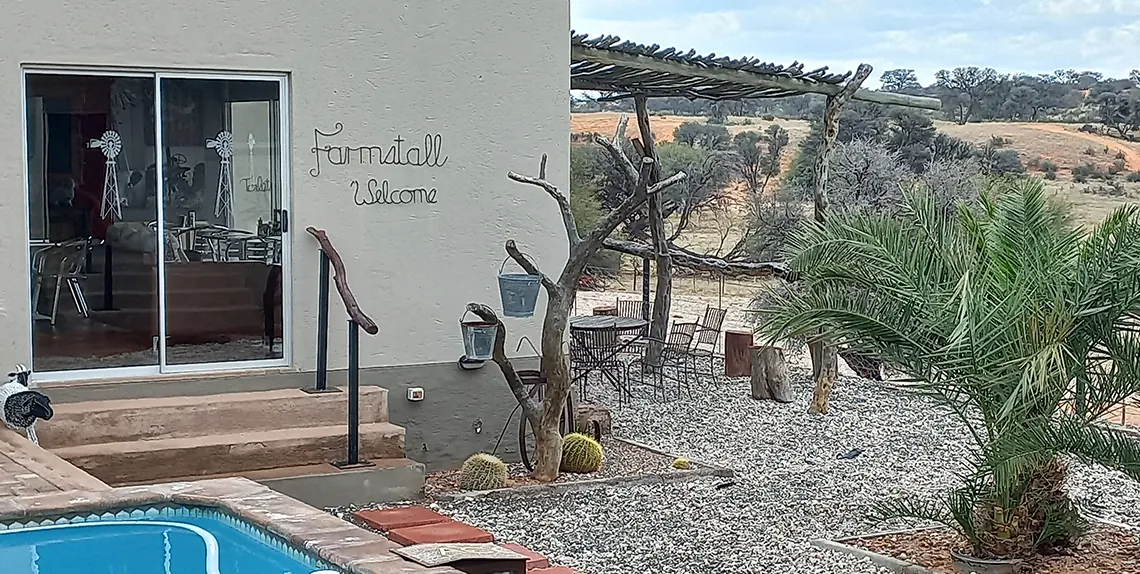
Kalahari Farmstall is a family-run stop on the Namibian side of the Kgalagadi Transfrontier Park, about 14 km by road from the Mata-Mata gate. It is part roadside shop, part coffee shop and part place to sleep. It works as a simple, self-catering base close to the park gate, or as a last stop for coffee and biltong before you cross.
What to expect
The chalets come as single, double and family units. Each has its own bathroom, air conditioning, a kitchen and a braai on the veranda. It is self-catering only, so no meals are served. There is also a separate camping area with power points, hot showers and braai places, plus a swimming pool, which you will want in summer.
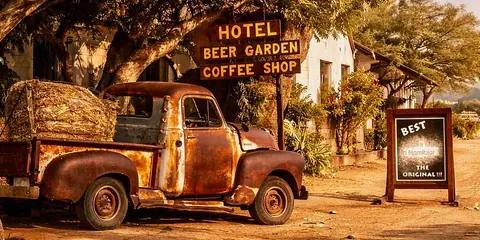
The farm stall sells biltong, drinks, curios and snacks, and the coffee shop does freshly ground coffee and toasted sandwiches. Wifi is available.
Practical details
- Phone +264 81 235 1859, email info@kalaharifarmstall.com.
- GPS S25.67358 E19.89552.
- Bookings are taken online through the NightsBridge system linked from their site.
Good to know
Mata-Mata is a South African park camp on the dry Auob River and the gate on the Namibian border. If you plan to drive through the park from one country into the other, you have to spend at least two nights inside the park first. Bring your groceries with you. The shop at Mata-Mata only stocks basic supplies.
Last updated 7 October 2026. Sources: Kalahari Farmstall, Kalahari Farmstall, accommodation, Kalahari Farmstall, contact, Kalahari Game Lodge, reaching the lodge (Kgalagadi crossing rules), Wikivoyage, Kgalagadi Transfrontier Park.
The farm stall 14 km from a gate that kept not opening
On Friday 12 October 2007 three presidents came to Mata-Mata, a park gate on the dry Auob River. Hifikepunye Pohamba, Thabo Mbeki and Festus Mogae were there, with more than 500 dignitaries, to open a tourist crossing between Namibia and the Kgalagadi Transfrontier Park. Pohamba called it a step towards the free movement of people. Mogae admitted that tourists having no way in from Namibia had been named as a hurdle back when the park was launched in May 2000.
Kalahari Farmstall is 14 km back up the C15 from that gate, on a working farm along the same riverbed. The C15 is 448 km of untarred road from Dordabis to the border. Until that Friday, a tourist who drove to the bottom of it could not get into the park.
The gate that kept not opening
People farming here had heard it before. In May 2007 a man whose parents farm 27 km from Mata-Mata, on the Namibian side, told a South African 4x4 forum that the ministry office in Keetmanshoop was now saying October. He did not put much on it. The same office had said the post would be open the year before.
The crossing came with a rule that is still in force: go from one country to the other through the park and you must sleep two nights inside it. The farmer’s son gave his reason for it the following February, and it was blunt. The rule was there to stop farmers using the park as a through route, which he reckoned was 100 km shorter than going round by Aroab and Rietfontein. That is one poster’s account, not an official one.
Then the gate shut again. In February 2022 the same forum was passing round a rumour that it would reopen in mid-March. It did not. On 24 June a camper staying at Mata-Mata reported the post still closed. It reopened on 1 August 2022, the same day as Twee Rivieren.
The padstal on the C15
The family that owns the farm still manages the stall. One forum poster in June 2014, answering in Afrikaans, called it the Kalahari Padstal and sent people there for lekkernye (treats), with the camp shop at Mata-Mata as the fallback.
Ron Swilling, writing in Travel News Namibia that same year, counted 250 km of gravel from Stampriet through Gochas to the park entrance, past farm stalls and red dunes. In February 2008 the farmer’s son wrote that the stretch past his parents’ farm was half rebuilt. A study into tarring the section from Stampriet to Mata-Mata was planned for the 2020/2021 financial year.
Why a dry river has water in it
The Auob very rarely flows. What it has is boreholes. When the First World War broke out, the Union government saw the beds of the Auob and the Nossob as a way into German South West Africa and began sinking boreholes to water troops on the march. After the war the land was divided into farms by a Scot, Roger Jackson, which is why so many waterholes down the river inside the park have Scottish names.
Gochas has an older soldier’s story. Captain Friedrich von Erckert was stationed at Gochas, where he turned his mounted men into camel riders and went into the Kalahari after the Nama leader Simon Kooper with 400 riflemen and 700 camels. He was killed within minutes of the fight starting on 16 March 1908. The gravestones of the German dead stand at Gochas, about 200 km west of where the men were buried.