City · Kgatleng District, Botswana
Mochudi
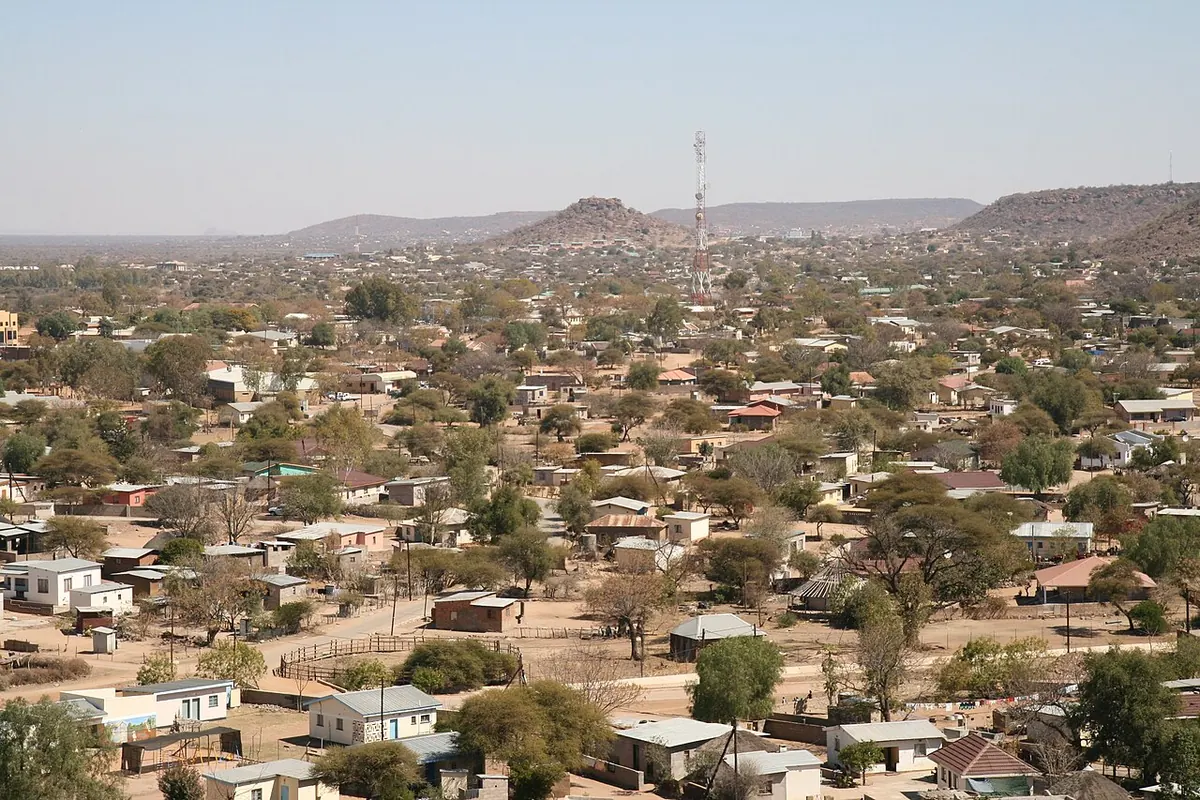
Capital of the Bakgatla, 37 km north-east of Gaborone. A half-day trip for the hilltop Phuthadikobo Museum in a 1920s school, the kgotla below it and the painted houses.
Short answer
Mochudi is in Kgatleng District, Botswana. This page lists 3 places to eat and drink and 1 sight.

- Eat and drink
- 3
- Sights
- 1
- Where
- Kgatleng District, Botswana24.38°S 26.15°E
In and around Mochudi
4 places listedSights 1
- Phuthadikobo MuseumMuseum · Mochudi
Bars and pubs 3
- Mokgoro TurnBar
- Mosaditswene BarBar
- Rheo BarBar
Mochudi is the capital of the Bakgatla, a Tswana people who crossed from the Transvaal and settled under Phuthadikobo Hill in 1871. It is still called a village, though 50,321 people lived here at the 2022 census. There is no game and no lodge scene. You come for the museum on the hill, the kgotla (the chief’s meeting place and customary court) below it, and a look at a Tswana capital that Gaborone has not yet swallowed. Readers of the No. 1 Ladies’ Detective Agency know it as Mma Ramotswe’s home village.
Getting there
Mochudi is about 37 km north-east of Gaborone. Take the A1 north, the main road to Francistown, and turn off at Pilane. The village is roughly 10 km on from the turn, several kilometres east of the highway.
When to go
Nothing here depends on the season, so pick your weather. Gaborone, the nearest place with a climate record, gets most of its rain between October and April, and January highs average close to 33°C. June and July nights drop to around 4 or 5°C, with clear days. The museum is on top of a hill, so winter is the kinder choice for the walk up.
What to do
The Phuthadikobo Museum is the reason to come. It sits on top of the hill in the old Bakgatla National School, built between 1921 and 1923 under the regent Isang Pilane. He recorded that every brick and stick was carried up by men and women of all ranks. The building is a U of eight classrooms around a courtyard, and the rooms now hold displays on Bakgatla life, a shop and a silkscreen printing workshop. The University of Botswana’s historians single out the material on Isaac Schapera, the anthropologist who did much of his work in and around Mochudi. The hilltop also looks out over the whole village.
Below the hill is the kgotla. It is a working court and meeting place, not an exhibit. Mochudi is also known for houses painted in the traditional way.
The Matsieng rock engravings and the Oodi weavers are elsewhere in the district and are covered on the Kgatleng page.
Good to know
I could not find opening hours for the museum that I trust, and its own website would not load in October 2026. Don’t build a tight day around it.
The Bakgatla kgosi (chief), Kgafela II, moved to the tribe’s other seat at Moruleng in South Africa in 2012 after a dispute with the government.
Malaria risk is low. The US CDC puts Kgatleng among the districts with only rare cases and recommends avoiding bites, not tablets.
The UK government warns about stray livestock on roads outside the towns after dark. Drive back in daylight. The Notwane River beside the village runs only briefly after rain, sits dry through the dry season and can flash-flood.
We list no places to stay in Mochudi. Sleep in Gaborone.
History and culture
Mochudi is the capital of the Bakgatla-ba-Kgafela, a Tswana chiefdom split between Botswana and South Africa since 1871. The village grew up around Phuthadikobo Hill, where the chiefs built their school and where the museum now stands, and its story of flight from Boer rule, a border war and a self-built education system explains much of what you see there today.
- 1500s to 1600s
The Kgatla ruling line is one of the main Tswana dynasties. Historians at the University of Botswana trace it, with the Hurutshe and Kwena lines, to the Phofu dynasty, which broke up in the western Transvaal (now South Africa's North West province) between about 1500 and 1600. source
- 1869 to 1871
The Bakgatla-ba-Kgafela lived around the Pilanesberg in the Transvaal, under Boer rule. In 1869 their kgosi (chief or king), Kgamanyane, refused to supply men for a dam project of the Boer commandant-general Paul Kruger. Kruger had him flogged in public at Saulspoort, and part of the chiefdom left. They settled in Bakwena territory in 1871, where Mochudi now stands. source
- 1896 to 1899
The move started a long quarrel with the Bakwena, on whose land the Bakgatla had settled. It ended when the boundary between the two was fixed in 1896 and 1899. A proclamation of 29 March 1899 listed the Bakgatla Reserve among the tribal reserves of the Bechuanaland Protectorate, the British territory declared in 1885 that became Botswana. source
- 1899
The Bakgatla took the British side in the South African War (the Boer War). On 25 November 1899 Kgatla fighters under their kgosi Linchwe I (also spelt Lentshwe), with British troops under Colonel G. L. Holdsworth, attacked a Boer wagon camp at Derdepoort, just over the border. Two women were killed and 17 women and children were captured. source
- 1903
The Bakgatla built a primary school in Mochudi under Linchwe I. Ox-wagons brought the thatching grass from the foot of Kgale Hill at Gaborone. Linchwe Primary School used the buildings until it moved to a new site in 2012. source
- 1921
Isang Pilane became regent in 1921 and in that first year started building the Bakgatla National School on top of Phuthadikobo Hill. Speaking in Johannesburg in 1933, he said every brick and stick was carried up the hill by men and women of all ranks. source
- 1963 to 1975
Linchwe II was installed as kgosi on 6 April 1963 and held the position until his death in 2007. He opened kgotla meetings to women in 1964, and in 1975 he brought back bogwera, the initiation schools for young men that most Tswana chiefdoms had dropped under mission influence. source
- 2008 to 2012
His son Kgafela II was installed in 2008, with President Ian Khama draping him in the leopard skin. Kgafela rejected the government's authority over chiefs, faced criminal charges over floggings of community members, and was de-recognised as paramount chief in 2011. In 2012 he moved to Moruleng, the Bakgatla seat in South Africa. source
- The Bakgatla and their wards
- The Bakgatla-ba-Kgafela are one of five Bakgatla branches and the only one that straddles the border, with headquarters at Mochudi and at Moruleng near the Pilanesberg. Mochudi is divided into five main wards (dikgoro): Kgosing, Morema, Mabudisa, Tshukudu and Manamakgote. source
- Kgotla
- The kgotla is the chief's open meeting place and customary court. In Botswana most civil cases and a good share of criminal ones are still heard in customary courts, so Mochudi's kgotla is a working institution. source
- Pottery
- Bakgatla women make earthenware pots by hand from clay, weathered sandstone, iron oxide and cow dung, building them up from the base in slabs and firing them in a pit kiln. The pots are used for beer, for fermenting sorghum meal and in healing rituals. UNESCO put the skill on its list of heritage in need of urgent safeguarding in 2012 as the number of master potters falls. source
- Dikopelo choirs
- Dikopelo is unaccompanied choir singing with set dance steps, performed by a whole neighbourhood together. It began on the farmlands and has moved into the villages as fewer people farm. UNESCO listed it as in need of urgent safeguarding in 2017. source
- Football
- Mochudi Centre Chiefs, founded by village elders in 1972 and nicknamed Magosi, have won the Botswana Premier League four times. They went the whole 2007-08 season unbeaten. Their listed home grounds are the National Stadium in Gaborone and Molepolole Stadium, not Mochudi. source
For American visitors: Linchwe II, kgosi of the Bakgatla from 1963 to 2007, served as Botswana's ambassador to the United States from 1969 to 1972 while his uncle Mmusi Pilane acted as regent. source
For German visitors: Nia Künzer, who scored the golden goal that won Germany the 2003 Women's World Cup final against Sweden, was born in Mochudi on 18 January 1980. Her parents were working there as development aid workers, and she grew up in Wetzlar. source
Main sights in Mochudi
4- Phuthadikobo Museum
The district museum, in the hilltop school of 1921 to 1923. The Kgatleng council approved a museum in 1972 and offered the empty school building at the end of 1975, with Linchwe II behind the project. The old classrooms hold displays on Bakgatla life, a craft shop and a silkscreen printing workshop.
Wikipedia, Phuthadikobo Museum - The school building itself
A U-shaped block of eight classrooms and an assembly hall around a courtyard, about 480 square metres, with views over the village. Built from 1921 to 1923, it was the first attempt in the country to take schooling past the elementary level the mission schools offered.
Wikipedia, Phuthadikobo Museum - Isaac Schapera displays
The anthropologist Isaac Schapera did much of his work in and around Mochudi. The University of Botswana's historians pick out the museum's displays of his work, and call the old school building worth seeing in itself.
University of Botswana History Department, historical and cultural tourism - The kgotla
The traditional meeting place of the Bakgatla, still in use. Mochudi is also known for houses painted in the old way.
Wikipedia, Mochudi
Did you know?
- Mochudi had 50,321 residents at the 2022 census, up from 44,815 in 2011, and is still counted among Botswana's villages. source
- Mma Ramotswe, the detective in Alexander McCall Smith's No. 1 Ladies' Detective Agency novels, comes from Mochudi. source
- Unity Dow was born in Mochudi in 1959. In 1992 she won the court case that let Batswana women pass citizenship to their children, in 1997 she became the country's first woman High Court judge, and in 2006 she sat on the case that found the removal of the San (Basarwa) from the Central Kalahari Game Reserve unlawful. source
- During apartheid Linchwe II worked with the African National Congress underground, and the Bakgatla secretly held and passed on weapons for its fighters in South Africa. source
- The village hospital, Deborah Retief Memorial, opened in September 1932 and is named after a missionary. It is now the government's district hospital. source
- Isaac Schapera's history of the Bakgatla was published in 1980 by the Phuthadikobo Museum itself, and scholars still cite it. source
Checked 12 October 2026.
The rain pots, the novelist and the school on the hill
Kgosi Lentswe I became a Christian in 1892. He was also the tribe’s rainmaker, and he kept the tools. Isaac Schapera, who wrote the standard book on the subject, called the rain ceremonies the most important a Tswana chief took part in. Lentswe left his pots with his daughter Kgabyana. She was uneasy about having them. Schapera was then a young anthropologist who first came to the Bakgatla in 1929, so she handed them to him, and he put them on loan with the museum in Cape Town on a promise that the tribe could have them back whenever it asked.
It asked in the 1970s. John Speed, a district officer in Mochudi, wrote to Cape Town and a pot came north, but he parked it at the National Museum in Gaborone for safe keeping, and the National Museum then refused to let it go the last stretch up the road. Too valuable to risk in a village, it said. Sandy Grant, who ran the new museum on the hill, fired off one strong letter, then admitted he had nowhere secure to put the thing and went quiet until he had a proper cabinet for the rain pots of Lentswe and of the regent Isang. Schapera backed him from London in June 1978: the pot was tribal property and belonged in Mochudi. Five years later he passed on what Alec Campbell, the National Museum’s founder, had told him: the pot on show there was a replica and the real one was hidden away. The rainmaking horn that went with it had never been given to Schapera at all, and he had no idea where it had gone.
Whether the original is in the hilltop cabinet today I can’t tell you from the published record. Ask when you are up there.
The anthropologist with the Voigtlander
Schapera used a Voigtlander camera in Mochudi, and what he wrote down here fed his handbook of Tswana law, his study of rainmaking and Married Life in an African Tribe (1940). In 1984 Grant posted him some of the old prints to identify. One showed a lion hunter. People in the village said it was Moswetsi Kgakole. Schapera was fairly sure it was Klaas Segogwane of Mabalane, a man who turns up in the praise poems he had collected.
The letters he and Grant exchanged from 1968 to 1985 have been printed, and they are funny. In 1979 the magazine Kutlwano reviewed one of his books and called him “late”. He asked Grant to tell the editor that he was still alive, or had been on 3 March. He came back in 1980 for a tea party at the museum with people he had known half a century before. In October 1985 he flew out for an honorary degree in Gaborone and did not make it up the road to Mochudi. He died in 2003, aged 98.
A bench in Mafikeng
Linchwe II was in his mid-twenties and studying in Britain when the novelist Naomi Mitchison invited him to her house at Carradale in Scotland in 1960. In 1963, the year he was installed as kgosi, the two of them sat down side by side in the central square of segregated Mafikeng, on a bench marked for blacks only, until the police arrived with warnings. Grant, who knew them both, thought it was staged from start to finish. Linchwe told the tribe that she was his adopted mother. The Bakgatla called her Mmarona, “our mother”, and she kept the role of tribal adviser until 1989.
The old mission hands did not take to her. The Dutch Reformed mission had had the Bakgatla to itself for about 90 years and, by Grant’s account, it allowed no tennis on its court on Sundays and no ballroom dancing at all. Mitchison wrote about birth spacing and the joy of sex in the magazine Kutlwano, and got the horrified reaction she was fishing for. Her own book about those years is Return to the Fairy Hill (1966).
The Londoner who stayed
It was Mitchison who talked Linchwe into offering land for a transit centre for people fleeing apartheid, and the London activists behind it recruited a 26-year-old assistant editor, a publican’s son who had read history at Cambridge, to run it. That was Sandy Grant, at the end of 1963. The colonial government disliked the idea and the tribe agreed only once the refugee centre was paired with a community centre for the village. It opened at the end of 1964, in the middle of a drought that had started in 1962 and did not break until 1966, so its first real work was feeding people. A printing works, a night school and a tennis club came later.
Grant stayed in Botswana for the rest of his life. From 1975 he restored the abandoned school on Phuthadikobo, built the first road up to it, brought in water and power, and saw it open as a museum in 1977. Linchwe had revived bogwera by then, and the numbers show how it caught on: about 400 young men one year, 700 to 800 expected in 1982. Grant photographed the 1982 school with the chief’s permission and hung 81 of the pictures on the hill.
In 1981 the government let Linchwe shoot a lion so that the skin could be given to the visiting head of UNESCO. His first expedition found nothing and the second found one lion, after which he called for a five-year ban on killing them.
What has gone since
Grant’s photographs are now the record of a village that mostly isn’t there any more. They show ox wagons and “donkars”, the back half of an old bakkie pulled by donkeys, and thatched rondavels with decorated courtyard walls. He and Elinah Grant put the painted houses into a book, Decorated Homes in Botswana, in 1996, as block and tin were replacing them.
The Grants gave up the museum in 2007, the year Linchwe died, and Sandy wrote afterwards that it went downhill without them. His recording of the initiation songs, the only one in existence, ended up unplayable. He became a citizen in 1982 and died in 2021, aged 84.
Map of Mochudi
See every place on this map as a list